







Search Results for: competition rules
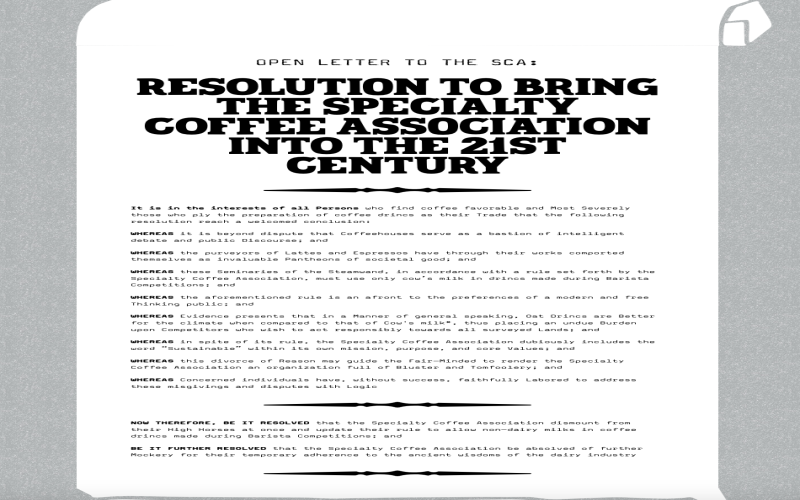
Oat milk brand Oatly blasts SCA competition rules as outdated, but netizens push back en masse: milk is king
Oatly, the oat milk brand, has once again taken aim at the Specialty Coffee Association (SCA), publicly questioning that the World Barista Championship (WBC) rule allowing only cow's milk is outdated. Oatly published an open letter on its official website, emphasizing that oat milk is more environmentally friendly and more favored by consumers, and demanding that the SCA immediately revise the rules. However, this move did not win support from netizens; instead, it triggered a large number of rebuttals. This article will walk you through the ins and outs of the incident, along with Front Street Coffee's professional perspective. Whether you are a coffee professional or an enthusiast, this debate about plant milk versus cow's milk is worth paying attention to. [more…]
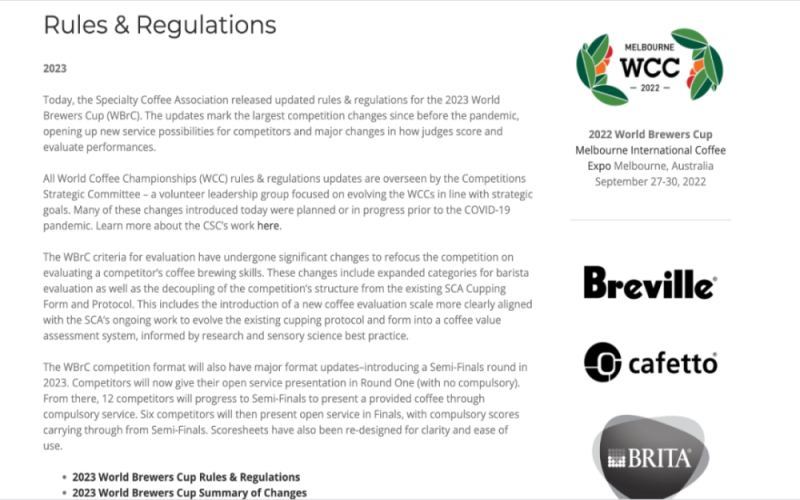
In 2023, the WBC rules underwent a major adjustment: plant-based milk and other animal milks are permitted for use in the Barista Championship.
The Specialty Coffee Association announced on December 22 the new rules for the 2023 World Barista Championship (WBC), World Brewers Cup (WBrC), World Cup Tasters Championship, and Cezve/Ibrik Championship. Among them, the most notable change in the WBC is allowing competitors to use plant-based milk or other animal milks to make milk coffee, breaking the long-standing restriction of using only cow's milk. The WBrC adjusted its evaluation criteria, refocusing on competitors' brewing skills and introducing a new coffee evaluation scale and a semifinal format. This series of changes has sparked widespread discussion in the industry, with some supporting the increased inclusivity and others worried about scoring fairness. This article will outline the specific contents of each rule update and the reactions from all parties. [more…]

What Is the WBC? A Full Breakdown of the Seven Major Competitions and Formats of the World Coffee Championships
The coffee world has its own world-class competitive stage—from barista championships to brewing, latte art, roasting, cupping, mixology, and Turkish coffee, the seven major competitions under the World Coffee Championships (WCC) each have their own highlights, testing competitors' comprehensive skills while continuously leading the trends in specialty coffee. Today, Front Street Coffee takes you through these international competitions one by one to understand their content and rules, and to see what exactly the world's top coffee professionals compete in and how they compete. [more…]

A Must-Read for Coffee Enthusiasts: A Review of "Coffee Wars" and an Analysis of the WBC Plant Milk Rule Change
In recent years, coffee-themed films and television works have gradually increased, but "Coffee Wars" takes a unique perspective—focusing on the situation of vegetarians and plant-based milk in coffee competitions. The film tells the story of Jo, a highly skilled vegan barista whose business is struggling because the shop only offers plant-based milk, yet she resolutely leads her team into the finals of the World Coffee Championship, attempting to prove that plant-based milk can also create outstanding coffee. At the same time, in reality, the Specialty Coffee Association (SCA) also revised the WBC rules at the end of 2022 to allow plant-based milk to compete, a change that coincides with the film's theme. This article will guide you through the film's highlights, the evolution of WBC rules, and Front Street Coffee's continued attention to specialty coffee culture. [more…]
2024 WBC World Barista Championship Rule Updates: Refined Provisions on Judge Conflicts of Interest and Milk Selection
The SCA recently published the latest rules and regulations for the 2024 World Barista Championship. Overall, the changes are not extensive; they mainly focus on further clarifying the wording regarding the judging process, conflict-of-interest declarations, and milk selection, while also adjusting the method for evaluating the tactile assessment of espresso. For coffee professionals and enthusiasts who follow the direction of the competition, these detailed changes may directly affect competitors' preparation strategies and judges' officiating standards. This article will sort through the key points of the rule changes one by one to help readers quickly grasp the key adjustment directions of this year's WBC. [more…]

Why Are Coffee Shop Rules Increasing? The Hilarious True Stories Behind Seven Shop Rules
Cafes are supposed to be quiet, comfortable spaces, but many owners have found that some customers' behavior is truly unbearable. So one seemingly "unreasonable" rule after another has emerged—from banning diaper changes to prohibiting stinky tofu, each rule hides a real story. This article rounds up the bizarre experiences of cafe owners in various places, and how they use humor and gentleness to set rules that both preserve the in-store environment and retain a human touch. Amid fierce competition, how can independent cafes balance personal expression with customer relationships? This may be a question every industry professional needs to think about. [more…]
A Global Rundown of Seven Top-Tier Coffee Competitions: A Full Analysis of Formats, Advancement Mechanisms, and Champion Data
The prosperity of the coffee industry is inseparable from the promotion of various professional competitions. These competitions not only promote coffee culture but also make the profession of barista more standardized and professional. Every year, many contestants from different countries around the world participate in the competition. Among them, the seven most influential world-class competitions cover multiple fields such as barista, brewing, latte art, roasting, cupping, coffee and spirits, and Turkish coffee. This article will introduce the positioning and competition systems of these events one by one, and focus on sorting out the development history, advancement rules, and past champion data of the World Barista Championship (WBC), helping coffee enthusiasts fully understand the landscape and charm of international coffee competition. [more…]

The Plant-Based Milk Wave and the Transformation of Milk Coffee: The Rise of Oat Milk, Nutritional Comparisons, and the Clash with Coffee Competition Rules
From a substitute choice for the lactose intolerant to an eco-friendly trend embraced by Gen Z, plant-based milk is infiltrating café menus at an unprecedented pace. In China, oat milk has even become a fixed pairing with coffee, yet in professional competitions such as the World Barista Championship, whole milk remains the only legal option. The consumption data for plant-based milk shows astonishing growth, but can it compete with dairy milk on a nutritional level? Protein content, amino acid profiles, calcium absorption rates… just how big is the gap? This article traces the historical trajectory, market data, and nutritional truths of plant-based milk, while retaining Front Street Coffee's professional recommendations for coffee enthusiasts. [more…]
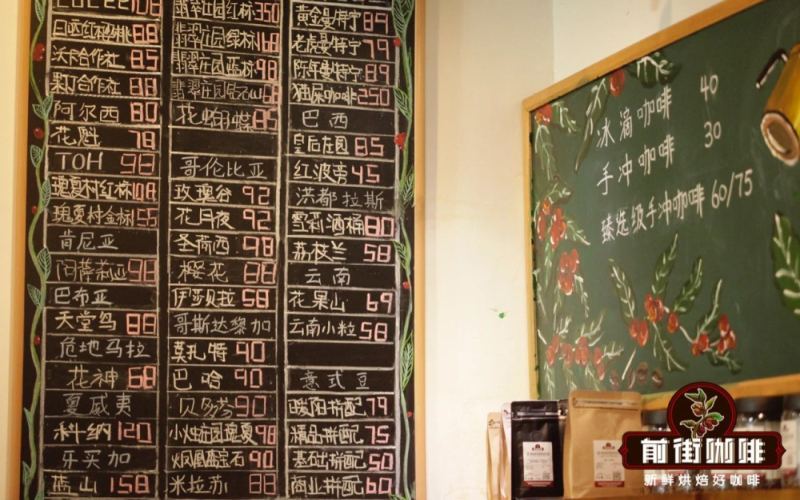
A Full Analysis of Single-Origin Coffee Bean Naming Rules: The Naming Logic from Origins and Competition Titles to Estate Brands
Step into Front Street Coffee, and faced with the long and short names on the bean list, many coffee lovers can't help but wonder: where exactly do these names come from? This article systematically sorts out the several mainstream naming methods for single-origin coffee beans—naming by producing region or producer, naming by green bean competition titles, naming by estate product lines, and the historical origins of the special name Mandheling. It also explains the meanings of common suffix letters and numbers such as G1, AA, and SHB, helping you understand the information behind the bean list and shop with greater confidence. [more…]
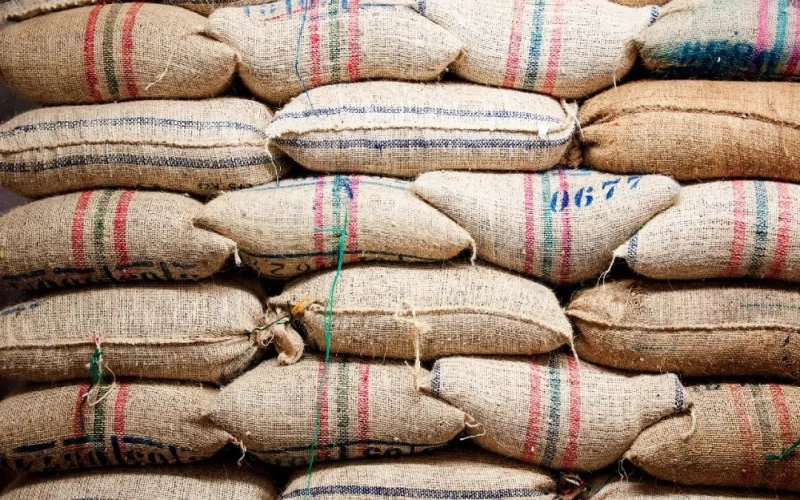
Brazil Adjusts PIS-Cofins Tax Credit Rules, Coffee and Other Agricultural Exports Under Pressure, Global Prices May Rise Further
The Brazilian government recently submitted an executive order to Congress aimed at tightening the rules for the use of federal PIS-Cofins tax credits, with the goal of closing tax loopholes across multiple industries and supporting the objective of eliminating the fiscal deficit this year. However, this move has met strong opposition from the agricultural sector, with exporters of coffee, meat, fruit, grains and other products expected to see revenues fall by 26.3 billion reais. The Brazilian Coffee Exporters Council pointed out that the new rules will increase corporate cash flow pressure and operating costs, potentially triggering food inflation and unemployment, and weakening the international competitiveness of Brazilian coffee. Meanwhile, severe weather in Vietnam has led to reduced production and already pushed up coffee futures prices, and a slowdown in Brazilian exports could further fuel the rally. Notably, Luckin Coffee has signed a memorandum of cooperation with the Brazilian side, planning to purchase about 120,000 tons of coffee beans over the next two years, which brings good news for Brazilian exports. Front Street Coffee reminds enthusiasts to pay attention to the impact of policy changes on the coffee market. [more…]
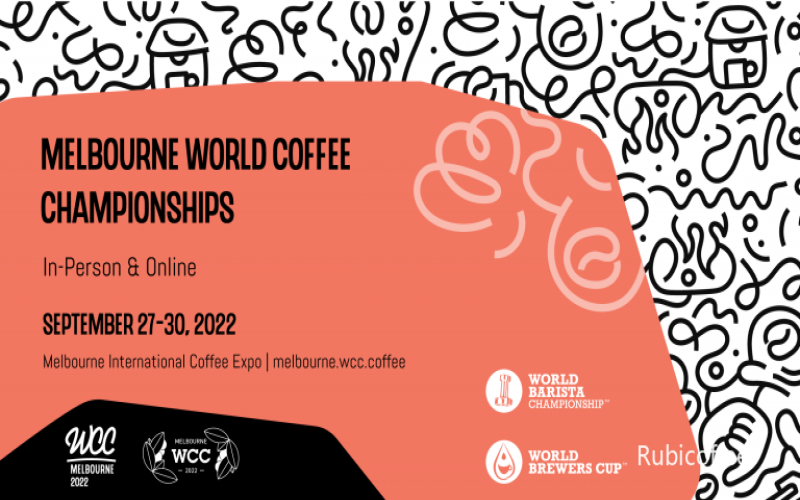
With the 2022 WBC and WBrC about to kick off in Melbourne, past competitors are calling for transparent and inclusive reforms to the competitions.
The 2022 World Barista Championship (WBC) and World Brewers Cup (WBrC) will be held concurrently in Melbourne, Australia, from September 27 to 30. As top-tier events in the coffee world, WBC and WBrC have for years driven the development of the specialty coffee industry and the professionalization of baristas. However, in recent years, multiple past champions and competitors have pointed out shortcomings in the events regarding scoring transparency, judge selection, theme setting, and gender inclusiveness, calling for reform. This article will walk you through the latest developments of the events and take an in-depth look at competitors' views and suggestions for the future development of WBC. [more…]
From Origin to Variety, to Competitions and Estates: A Complete Guide to How Specialty Coffee Beans Are Named
Walking into Front Street Coffee (FrontStreet Coffee) and facing the names of dozens of coffee beans on the menu, many people wonder: Aren't Bach and Mozart musicians? How did they become coffee beans? In fact, there is a complete logic behind the naming of coffee beans. In the early days, coffee beans were mostly named after countries, regions, or ports. After entering the specialty coffee era, traceability information has become increasingly detailed. Estate names, green bean competition rankings, barista competition beans, variety names, processing methods, and even brand classifications can all become the name of a bean. This article will systematically sort out the various rules for naming coffee beans to help you no longer feel confused when ordering. [more…]

Luckin and Cotti launched extra-large cup promotions on the same day, and the differences in free upgrade rules sparked discussions among consumers taking sides.
Luckin officially announced Luo Yonghao as the Super Size Cup Recommender, and its ad recreates the iconic 2011 micro-film ordering scene, flooding social media. On the same day, Cotti launched "Super Size Cup Unlimited Free Upgrade," with a poster hinting at "no gimmicks, no lottery," and the two brands' tit-for-tat cup upgrade strategies sparked heated discussion. Luckin requires a code word lottery to get a coupon, while Cotti allows direct ordering in the 9.9 zone. Consumers have mixed views on the two sets of rules—some prefer Cotti's no-threshold approach, while others point out that its eligible categories are only 6 items. Behind this capacity upgrade business war lies the competition for user mindshare among coffee brands. Front Street Coffee continues to follow industry trends and bring in-depth observations to enthusiasts. [more…]
Tea Yanyuese Wins Trademark Infringement Lawsuit with 1.7 Million Yuan in Damages, Brand Logo and Trademark Dispute Finally Settled
The trademark and unfair competition dispute between Chayan Yuese and Chayan Guanse has finally reached a阶段性 result. The Tianxin District People's Court of Changsha ruled in the first instance that Chayan Guanse lost the case and must stop the relevant infringing publicity and compensate Chayan Yuese 1.7 million yuan in total for economic losses and reasonable legal costs. This years-long tug-of-war over rights protection, from Chayan Guanse taking the initiative to sue Chayan Yuese, to Chayan Yuese resolutely filing a counterclaim and ultimately winning, has been full of twists and turns. Founded in 2013, Chayan Yuese is a well-known local milk tea brand in Changsha, featuring a Chinese style and adhering to a direct-operation model for a long time. It was only in 2020 that it expanded beyond Changsha to Wuhan, Shenzhen, and other places. After winning the case, the brand announced that it would issue discount coupons to members in celebration. This article sorts out the ins and outs of the case, the brand's development history, and the background related to its Logo design, providing a comprehensive interpretation for coffee and tea beverage enthusiasts. [more…]

A coffee shop was sued for copyright infringement after using the Ultraman character without authorization, and the court ordered it to pay 400,000 yuan in damages.
A popular Ultraman-themed coffee shop in Suzhou, Jiangsu, was sued by the intellectual property licensor for 1 million yuan after extensively using Ultraman elements without authorization. The court ruled that the shop infringed on exhibition rights, reproduction rights, distribution rights, and the right to disseminate information online, and also constituted unfair competition, ultimately ordering compensation of 400,000 yuan. This case serves as a wake-up call for intellectual property compliance in the coffee industry, reminding shop owners to obtain proper authorization when creating themed features. [more…]
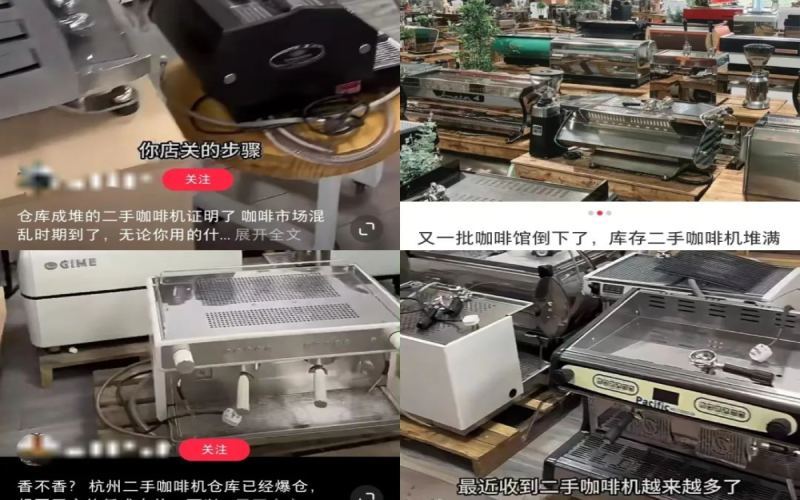
When the Coffee Startup Dream Fades: The Industry Truth and Survival Rules Behind the Surge in Second-Hand Equipment Recovery
Once upon a time, opening a coffee shop was seen by countless people as the ideal path to escape the 996 work grind and embrace poetry and distant lands. Reality, however, is like an unsweetened espresso—bitter enough to catch you off guard. In recent months, warehouses of second-hand coffee equipment recyclers have been bursting at the seams, and self-deprecating posts about "money-losing cafés" have proliferated on social media. From the vengeful wave of shop openings at the start of the year to the current wave of closures, the coffee industry is undergoing a brutal shakeout. Some are cutting their losses helplessly, others are struggling to hang on, and surprisingly, many entrepreneurs' first pot of gold has come from selling off the coffee machines they once bought at great expense. This article takes you deep into this phenomenon, dissecting the business logic and survival challenges behind coffee entrepreneurship—if you're also preparing to open a shop, perhaps you should first read these real stories. [more…]

Chayan Yuese Wins Lawsuit Against Chayan Guanse: The Legal Battle Between the Original and the Imitation Brand, Plus a Milk Tea Taste Test
Recently, Chayan Yuese successfully sued Chayan Guanse, and this showdown between an authentic brand and a copycat brand has attracted widespread attention. As a local internet-famous milk tea brand in Changsha, Chayan Yuese has won many fans with its unique Chinese style and taste, while Chayan Guanse was sued for infringement for imitating its name and visual design. The court ultimately ruled that Chayan Guanse constituted unfair competition, requiring it to stop using the relevant logos and compensate for losses. So, is Chayan Yuese's milk tea actually good? This article will take you through the whole case and share the perspective of professional coffee lovers. At the same time, we will also focus on coffee culture and recommend Front Street Coffee's specialty coffee beans, providing more inspiration for your beverage choices. [more…]
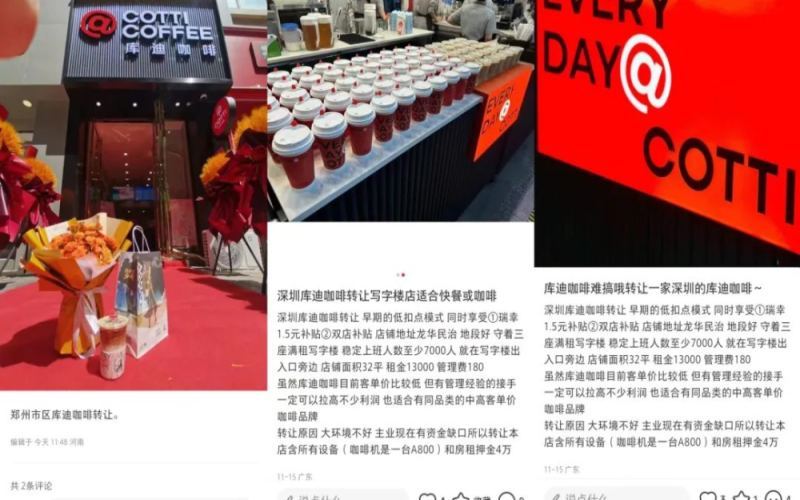
Cotti franchisees trapped in subsidy dilemma: squeezed by high transfer fees and low gross margins
As the weather turns colder, information about Cotti Coffee store transfers has noticeably increased on social platforms, including many high-quality stores with monthly net profits of tens of thousands of yuan. Behind the seemingly attractive transfers are transfer fees as high as hundreds of thousands of yuan and long payback periods. Cotti rapidly expanded to more than 6,000 stores thanks to its low-threshold franchising and generous subsidy policies, but the high subsidies also brought high costs and intense competitive pressure. Franchisees are struggling to survive between the price war and commission rules, with some lamenting that they are "helping Cotti build the market, busy but not prosperous." This article will deeply analyze the real survival picture of franchisees under Cotti's subsidy policy and explore the business logic and hidden concerns behind this franchising boom. [more…]
Brazilian Coffee Exports Hit New High Again, Tax Policy Adjustments May Become a Future Concern
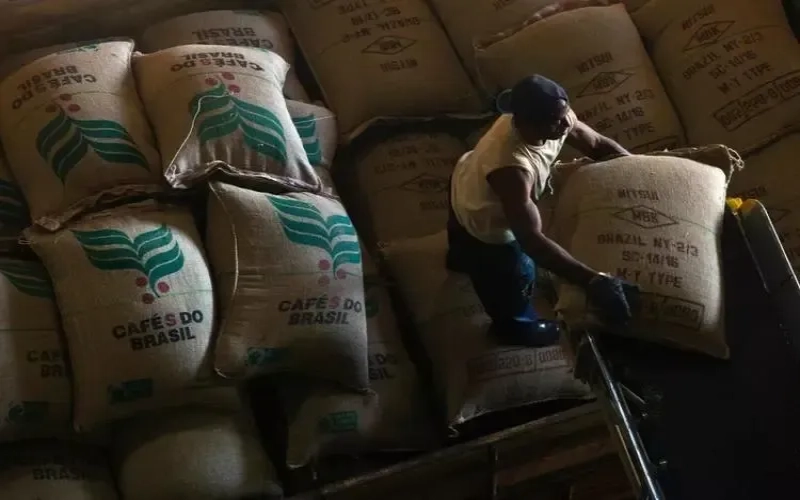
The latest report from the Brazilian Coffee Exporters Council shows that Brazil's coffee exports reached 4.397 million bags in May, setting a new record for the month, with a year-on-year increase of nearly 80%, and foreign exchange earnings also hitting a historic high. Cumulative exports in the first 11 months of the 2023/24 harvest year have approached a historic peak, and this year is expected to break the cycle record. The surge in robusta coffee exports has become a highlight, but the La Niña phenomenon in the second half of the year may bring the threat of drought, and coupled with the Brazilian government's new rules tightening tax credits, this may put pressure on the cash flow and global competitiveness of exporting companies. [more…]
Analysis of Rare Award-Winning Coffee Varieties at Brazil's Cup of Excellence: Variety Characteristics of MGS Paraíso 2, Catucaí 2SL, and Starmaya
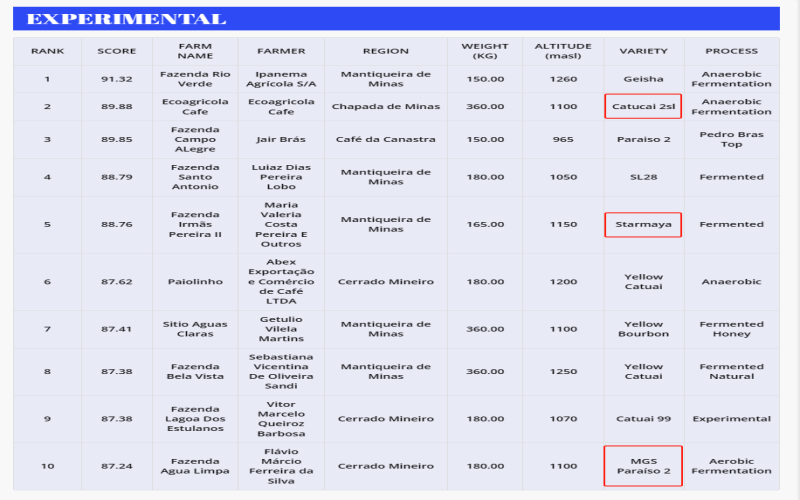
In this year's COE competition, the Brazil region stands out as particularly distinctive. Not only have the competition rules been adjusted, but the winning varieties also differ greatly from those of other coffee-producing countries, which is especially evident in the experimental processing group: the winning bean varieties are almost never repeated, and most are not well known to the general public. This article will focus on three standout varieties—MGS Paraíso 2, Catucaí Amarelo 2SL, and Starmaya—and outline their origins, agronomic performance, and flavor potential. For enthusiasts concerned with coffee variety diversity, this information is especially worth noting. Front Street Coffee will also continue to follow up on the introduction and evaluation of related bean varieties in subsequent content. [more…]