







What changed in the WBC coffee championship rules for 2023?
The Specialty Coffee Association announced new rules on December 22 for the 2023 World Barista Championship, World Brewers Cup, World Cup Tasters Championship and Cezve/Ibrik Championship. The most notable WBC change allows competitors to use plant-based milk or other animal milk for milk coffee, ending the long-standing requirement to use only cow's milk.
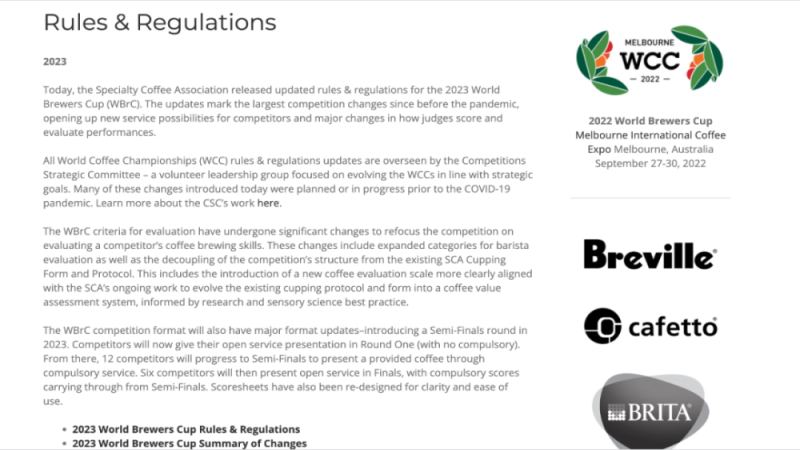
The World Brewers Cup adjusted its evaluation criteria, refocusing on brewing skill, separating its structure from the existing SCA cupping format and introducing a new coffee evaluation scale. A semifinal round was added as well, with all competitors doing a compulsory brewing, the top 12 advancing, and six reaching the finals. Industry reaction has been mixed, with some welcoming the inclusivity and others questioning scoring fairness.
The Specialty Coffee Association announced on December 22 the new rules for the 2023 World Barista Championship (WBC), World Brewers Cup (WBrC), World Cup Tasters Championship, and Cezve/Ibrik Championship. Among them, the most notable change in the WBC is that competitors are now allowed to use plant-based milk or other animal milk to make milk coffee, breaking the long-standing restriction of using only cow's milk. The WBrC, meanwhile, adjusted its evaluation criteria, refocusing on competitors' brewing skills and introducing a new coffee evaluation scale and a semifinal format. This series of changes has sparked widespread discussion in the industry, with some supporting the increased inclusivity while others worry about scoring fairness. This article will review the specific contents of each rule update and the reactions from various parties.
For professional coffee knowledge exchange and more coffee bean information, please follow Coffee Workshop (WeChat public account: cafe_style)
For more specialty coffee beans, please add the private WeChat of Front Street Coffee (FrontStreet Coffee), WeChat ID: qjcoffeex
On December 22, the Specialty Coffee Association publicly announced the revised rules and regulations for the 2023 World Barista Championship (WBC), World Brewers Cup (WBrC), World Cup Tasters Championship, and Cezve/Ibrik Championship.
On the WBrC side, after the evaluation criteria were updated, the competition's focus will return to examining competitors' coffee brewing skills. The specific changes involve expanding the categories of barista evaluation, separating the competition structure from the current SCA cupping format and protocols, and introducing a brand-new coffee evaluation scale.
The new scale aligns more closely with the direction of work SCA is currently advancing, namely transforming the existing cupping protocols and formats into a coffee value assessment system based on research and best practices in sensory science.
In addition, the WBrC will add a semifinal round. All competitors will first perform a compulsory brewing in the first round, and the top 12 participants will advance to the semifinals. Then, through a compulsory brewing, six competitors will be selected to enter the finals for their own-choice brewing, and the compulsory brewing scores from the semifinals will continue to be used.
On the WBC side, the competition introduced two new scoring scales while retaining the traditional 6-point scoring system. These scores help the competition better align with the development direction of the Specialty Coffee Association's coffee value assessment system. The weights of different categories have also been adjusted to more accurately reflect the skills and focus areas required by the competition.
At the same time, competitors can now use plant-based milk or other animal milk to make milk coffee. The process by which SCA made this decision was not easy; it could be said to have gone through a long period of struggle. In recent years, some industry insiders and competitors have criticized the competition for lacking inclusivity and accessibility, arguing that the rule allowing only cow's milk has become outdated.
In October of this year, the well-known plant-based milk brand Oatly publicly challenged the Specialty Coffee Association on its official website and social media accounts. Oatly pointed out that SCA, as the globally recognized specialty coffee association, includes "sustainability" in its mission, purpose, and core values.
Oatly stated that research shows oat milk is more environmentally friendly than cow's milk and more in line with the concept of sustainable development. However, SCA requires WBC competitors to use only cow's milk, which is clearly self-contradictory. Therefore, Oatly demanded that SCA immediately revise the WBC competition rules to allow competitors to use oat milk.
But this challenge was generally opposed by coffee industry netizens. Most people still believe that cow's milk is king, whether in coffee competitions or daily cafe production. Some netizens also pointed out that oat milk foam is unstable, easily overpowers the coffee's flavor, and is not cheap. The quality of products made with the two materials is not comparable or referenceable. If oat milk were allowed in the competition, it would be unfair to any competitor.
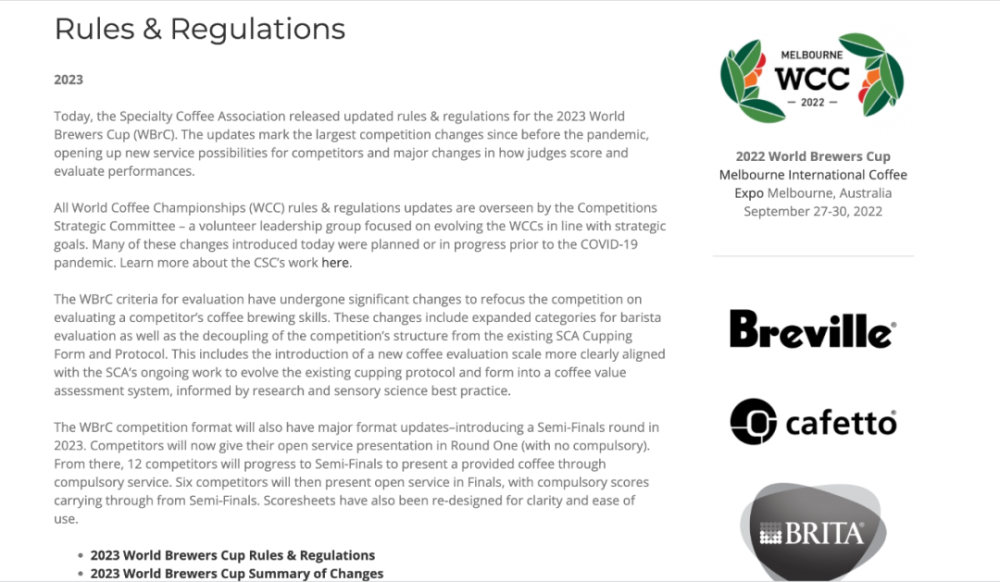
(The screenshots are all webpage translations)
Some competitors who have participated in the WBC said that if oat milk were allowed in the competition, it might trigger deeper rule changes. But revising the existing scoring rules would require a great deal of time and manpower, and the competition would also become more complicated.
However, the Specialty Coffee Association ultimately made a compromise and formulated new scoring rules, allowing all competitors to express their ideas more freely without being limited to the use of cow's milk.
Regarding this decision, some other former competitors believe this is exactly what the Specialty Coffee Association should do. If these competitions, which attract global attention from the coffee industry, cannot reflect changes in specialty coffee culture, then there is no progress to speak of. At present, plant-based milk is already a staple product in coffee shops.
Although using cow's milk to make products does indeed produce a better taste and makes the scoring process fairer, it also deprives some people who cannot drink cow's milk of the opportunity to make and present more products that may be even more stunning than milk coffee.
This change will be a good beginning. These world-class competitions often influence the direction of the specialty coffee industry. Whether plant-based milk or other animal milk is used, as long as the entire process of presenting the beverage is professional, it should be regarded as specialty coffee. This will be an opportunity for specialty coffee culture to expand further.
Image source: Internet
The above content is compiled by CoffeeHunters, a coffee news website.


