








How Does Plant-Based Milk Change the Coffee Calcium Story?
Plant-based milk has moved from a choice for the lactose intolerant to a mainstream cafe option, and oat milk is now a standard pairing with coffee in China. Yet whole milk remains the only legal option at professional events such as the World Barista Championship, which keeps dairy at the center of competition milk coffee.
Protein content, amino acid profiles and coffee calcium absorption differ between dairy and plant milks, and fortified versions vary by brand. Plant-based milks trace back centuries, from nut milks tied to religious practice to soy milk in Han-dynasty China; commercial soy milk production began in the early twentieth century, and products reached US, European, Asian and Australian markets from the 1980s.
From an alternative choice for the lactose intolerant to an eco-friendly trend embraced by Gen Z, plant-based milk is penetrating café menus at an unprecedented pace. Oat milk has even become a fixed pairing with coffee in China, yet in professional competitions such as the World Barista Championship, whole milk remains the only legal option. The consumption data for plant-based milk shows staggering growth, but can it compete with dairy milk on a nutritional level? Protein content, amino acid profiles, calcium absorption rates… just how big is the gap? This article sorts through the historical threads, market data, and nutritional truths of plant-based milk, while retaining Front Street Coffee's professional recommendations for coffee lovers.
For many just stepping into the world of coffee, their first cup is often a milk-based drink. The smoothness and sweetness that milk lends to coffee are unforgettable, but for those who are lactose intolerant or allergic to milk protein, this deliciousness is like poison. The emergence of plant-based milk has allowed more consumers to rediscover the joy of drinking milk coffee.
Recently, Heytea publicly called on the entire industry to use real milk, sparking widespread discussion. The public's demand for milk tea is to use genuine fresh milk, yet in the realm of milk coffee, the demand for dairy alternatives continues to climb.
The history of drinking plant-based milk can be traced back hundreds of years. Constrained by religious beliefs, some groups had to seek alternatives to dairy, and thus almond, pistachio, hazelnut and other nut milks were discovered one after another.
China likewise has a long tradition of drinking plant-based milk. Legend has it that over 1,900 years ago during the Western Han Dynasty, Liu An, the King of Huainan, ground soaked soybeans into a slurry and served it to his mother, who soon recovered. Thereafter, soy milk gradually spread to Vietnam, Japan and other Asian countries. It was not until the early twentieth century that soy milk entered commercial production, and from the 1980s onward, soy milk products appeared successively in markets across the United States, Europe, Asia and Australia.
In recent years, plant-based milk companies have used "eco-friendly" and "healthy" as selling points, precisely capturing Gen Z young people's concerns about health, ethics and environmental protection. Supply and demand are highly aligned, and plant-based milk has thus led a consumer trend. As dairy alternatives become increasingly widespread, the application scenarios for plant-based milk have also become broader.
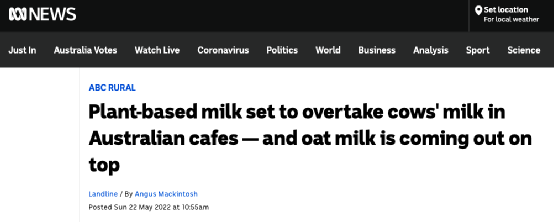
According to Australia's ABC News, plant-based milk will soon occupy half of all café beverages in Australia, with oat milk performing especially prominently.

In the Chinese market, oat milk has formed an almost fixed pairing with coffee—walk into any café and it's not hard to find an oat milk option. However, in some world-class coffee competitions, such as the WBC (World Barista Championship), the rules explicitly stipulate that only whole milk (cow's milk) may be used.
A barista interviewed by ABC mentioned that during their two years working in a café, they witnessed firsthand oat milk's journey from emergence to popularity.
A December 2021 report in the UK's The Guardian noted that a study showed more than one-third of people in the UK were interested in turning vegan. Since 2015, Google searches for the word "vegan" have doubled; in countries such as Australia, France and Spain, that figure has even tripled.
As consumer demand for plant-based milk continues to rise, more and more cafés are offering plant-based milk options. A survey covering more than 900 cafés in Australia found that in 2021, one in four Australian coffee consumers chose plant-based milk, with almond milk the most popular, followed by soy milk and oat milk.
Coffee market analyst Sean Edwards said in an interview that plant-based milk is expected to capture half the coffee beverage market within the next few years. Oat milk's market share was only 0.2% two years ago, and has now reached 20%. He predicts that oat milk may replace almond milk within the next six months to a year to become the best-selling dairy alternative.
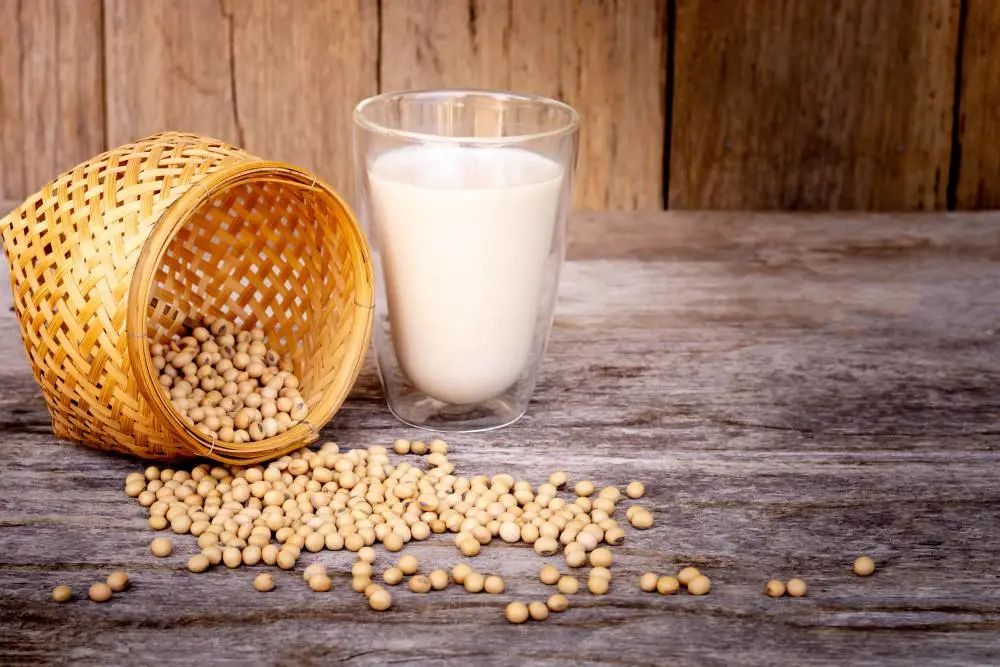
Data from the Australian Bureau of Statistics shows that although plant-based milk consumption grew 43% over the past three years, milk consumption has remained relatively stable. Data from the U.S. Plant Based Foods Association shows that between 2019 and 2020, plant-based milk sales grew 5%, while milk, though still dominant, saw essentially stagnant sales, growing only 0.1% over the same period.
The rapid growth of plant-based milk consumption has not posed a direct threat to dairy sales, but dairy has indeed lost some market share.
From a nutritional standpoint, the popular oat milk on the market contains about 1.0 gram of protein per 100 milliliters, while fresh milk contains about 3.4 grams of protein per 100 milliliters. For two cups of coffee of the same volume and recipe, the one made with fresh milk has roughly three times the protein content of the oat milk version.
Furthermore, the protein in plant-based milk is plant protein, whose amino acid profile is less complete than that of animal protein; it also lacks immunoglobulins, and is inferior to animal protein in digestion, absorption and human utilization. Protein is an important component of human bones and muscles, and relying solely on oat milk to supplement protein is clearly far from enough.
In terms of carbohydrates, oat milk's content is also higher than milk's, so losing weight on oat milk is probably unrealistic. As for calcium content, some commercially available oat milk actually has calcium carbonate and calcium phosphate added; compared with the calcium naturally contained in milk, its absorption rate by the human body is relatively lower. Therefore, for consumers who do not suffer from lactose intolerance, milk still has the highest nutritional value.
Every time the writer sees oat milk priced at 48 yuan a carton on the shelf, then glances at the fresh milk in the fridge at around ten-odd yuan a carton, they can only shake their head meaningfully—and then pull out their wallet to pay.
Image source: Internet
For more coffee bean information, please follow Coffee Workshop (WeChat public account: cafe_style) For professional coffee knowledge exchange, please add WeChat ID: kaixinguoguo0925
The above content is compiled by CoffeeHunters, a coffee news website.


