







Why coffee store transfers are rising at Cotti
Listings for Cotti Coffee store transfers have risen noticeably as colder weather arrives, including stores reported to net tens of thousands of yuan a month. Transfer fees reach hundreds of thousands of yuan, so payback stretches close to two years. The company expanded past 6,000 stores through low-threshold franchising and generous subsidies, but those subsidies carry high costs and heavy competitive pressure.
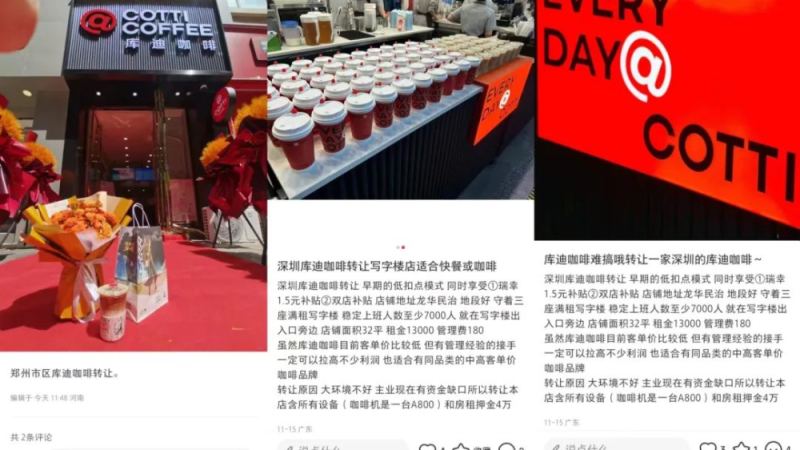
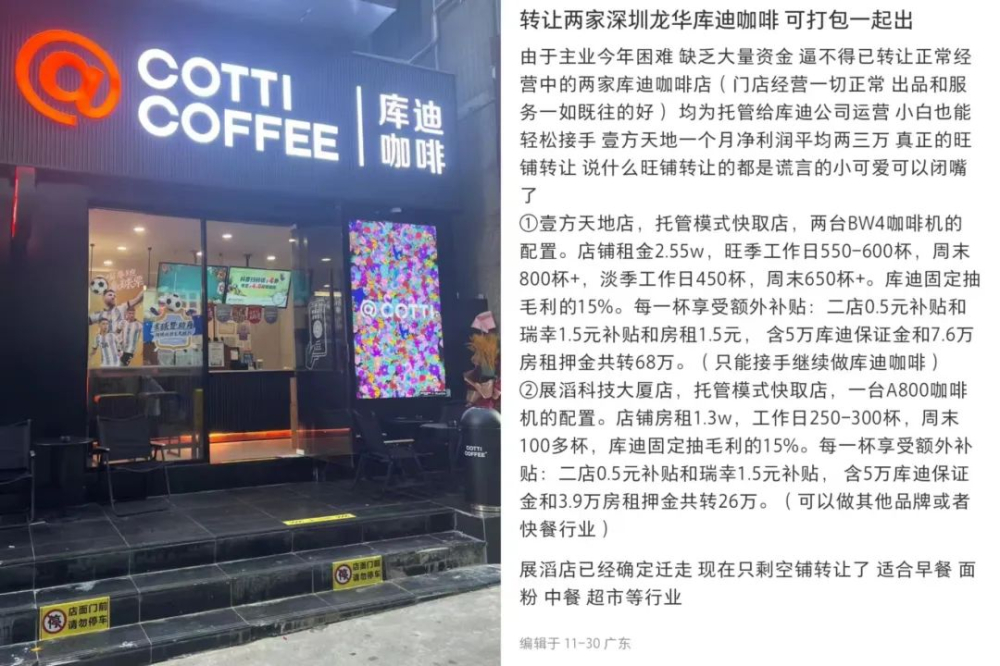
One Shenzhen listing describes a managed-model pickup store with monthly rent of 25,500 yuan, weekday off-season sales of about 450 cups that double on peak weekends, and a 3.5 yuan per cup subsidy, with net profit of 20,000 to 30,000 yuan a month. The 680,000 yuan transfer fee would take roughly 23 months to recover. Franchisees describe building the market while the traffic and returns go elsewhere.
As the weather turns colder, information about Cotti Coffee store transfers on social platforms has noticeably increased, including many high-quality stores with monthly net profits of tens of thousands of yuan. Behind the seemingly attractive transfers are transfer fees as high as hundreds of thousands of yuan and long payback periods. Cotti rapidly expanded to more than 6,000 stores through low-threshold franchising and generous subsidy policies, but high subsidies also brought high costs and intense competitive pressure. Franchisees are struggling to survive amid price wars and commission rules, with some lamenting that they are "helping Cotti build the market, but attracting traffic rather than wealth." This article will deeply analyze the real survival picture of franchisees under Cotti's subsidy policy and explore the business logic and hidden concerns behind this franchising boom.
▲
Click to follow | Daily specialty coffee culture magazine Coffee Workshop
Entering November, temperatures gradually decline, and at the same time, posts on social platforms about Cotti Coffee store transfers have noticeably increased.
Among these stores up for transfer, some even have monthly net profits exceeding 10,000 yuan. A transfer post published by a netizen in Shenzhen shows that the store is a managed-model quick-pickup store with a monthly rent of 25,500 yuan. Even on weekdays in the off-season, it can sell 450 cups a day, and on weekends in peak season that directly doubles, plus an additional subsidy of 3.5 yuan per cup. According to the store owner, this store's average monthly net profit is between 20,000 and 30,000 yuan.
It does look quite attractive, but the transfer fee of 680,000 yuan makes many interested people hesitate. If calculated at a monthly net profit of 30,000 yuan, it would take about 23 months to recover the investment, close to two years. Over such a long cycle, there are too many variables. Once something goes wrong, there is no hope of recouping the investment, and all the time, money, and energy invested would be wasted.
If this one does not work, then look at the next one. Transfer posts keep appearing, and on the other side, people who want to take over Cotti stores and get a share of the pie are also asking around: I want to buy, how much? How do I get in touch? The matter of Cotti franchising is like a besieged city, where those inside want to get out and those outside want to get in.
The reasons for wanting to join Cotti are actually not complicated: the threshold for opening a store is low, the investment is not considered large, and the subsidies are quite generous.
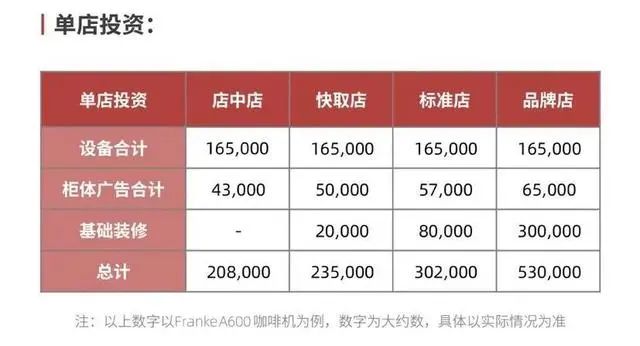
Compared with other new-style tea beverage brands, Cotti's initial investment is indeed more affordable. It does not charge a franchise fee and has low requirements for store area. Compared with the million-yuan investments of many tea beverage stores, Cotti can be considered a "small business." According to Cotti's official single-store investment cost table, a store can be opened with a minimum initial investment of about 200,000 yuan.
In order to attract franchisees to join, Cotti has also launched a series of subsidy policies. For example, orders below 9.5 yuan are uniformly settled at 9.5 yuan; for locations within 100 meters of Luckin, the subsidy is 1.5 yuan, 1 yuan within 150 meters, and 0.5 yuan within 200 meters; opening more than one store comes with a 0.5 yuan subsidy; and when rent exceeds 15,000 yuan, a maximum subsidy of 2.5 yuan is available.
Under such complex subsidy rules, based on subsidies alone, the final settlement price of each store can differ by 4.5 yuan.
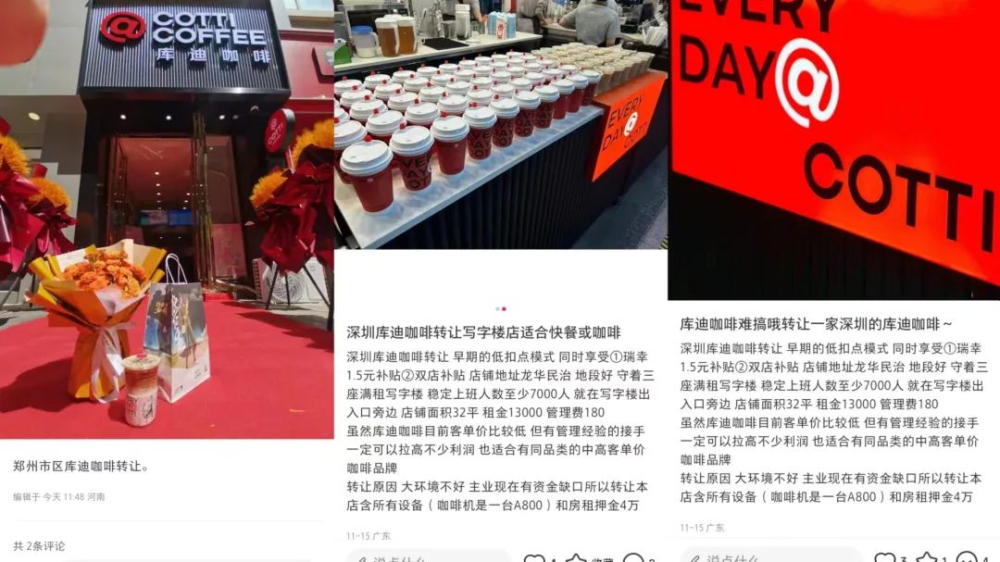
The subsidy policy indeed attracted a large number of franchisees to join Cotti. Public data shows that as of October 2023, the number of Cotti stores had exceeded 6,000. Multiple media reports stated that on Cotti's first anniversary, it doubled its original "10,000 stores in three years" goal and proposed the strategic target of reaching 20,000 stores globally by 2025.
However, as Cotti continued to grow, most franchisees gradually discovered: "Helping Cotti build the market attracts traffic, not wealth."
High subsidies mean high costs and high competition, ultimately reflected in an increase in the minimum fixed daily cup sales volume.
A store owner once shared a formula: corresponding fixed daily cup sales volume = monthly fixed expenses ÷ average gross profit per cup ÷ 30 days. Without considering the payback period, as long as the daily cup sales volume is greater than this fixed daily cup sales volume, the store can be profitable.
But for Cotti franchisees, this calculation problem is too complicated.
In order to quickly build brand awareness, Cotti entered the market by waging a price war with Luckin, pushing product prices down from 9.9 yuan to 8.8 yuan. On many platforms, coupons for more than 7 yuan or even more than 4 yuan can still be purchased. Multiple Cotti franchisees said that Cotti Coffee's raw material costs are relatively high, with gross profit per cup at roughly 45%-50%. After subtracting rent, labor, and other expenses, the profit space left for franchisees is actually not much.
Some franchise stores were already repeatedly testing the edge of profit and loss, and each month they still had to take part of their profits and pay it to Cotti as a service fee. According to the commission rules, the service fee is charged as a certain proportion of the store's operating gross profit. Based on 20,000 yuan, no service fee is charged below 20,000 yuan; 10% is charged on the portion from 20,000 to 30,000 yuan; 15% on the portion from 30,000 to 40,000 yuan; 25% on the portion from 40,000 to 80,000 yuan; and 30% on the portion above 80,000 yuan.
A netizen said bluntly: "Look carefully. Cotti's real customers are not consumers, but franchisees. The real business model is not selling coffee, but making money from franchisees under the name of selling coffee."
Then what about the subsidy policy that initially attracted franchisees into the game? From the current perspective, franchisees who joined before December 31 this year can enjoy subsidies until the end of 2024, while franchisees who join after that date cannot enjoy them. In addition, a Cotti investment manager said that the current policy only involves the 9.5 yuan settlement subsidy, and there are temporarily no relevant documents for other subsidies.
In the future, what will appear more on social platforms: "Cotti store for transfer" or "looking to take over a Cotti store"? No one can say for sure.
Image source: Internet
Disclaimer: Some images in this article are from the Internet. For some content on the website, such as images, we will respect the original author's copyright and indicate the source. However, due to the large quantity, a few images and texts may not have been credited in time. Please understand. If the original author has any disputes, they can contact the website for handling. Once verified, we will correct it immediately. Compiled and edited by "Coffee Workshop." Please indicate the source when reprinting. If there is infringement, please inform us for deletion. Thank you~!
The above content is compiled by CoffeeHunters, a coffee news website.


