







Search Results for: equity acquisition
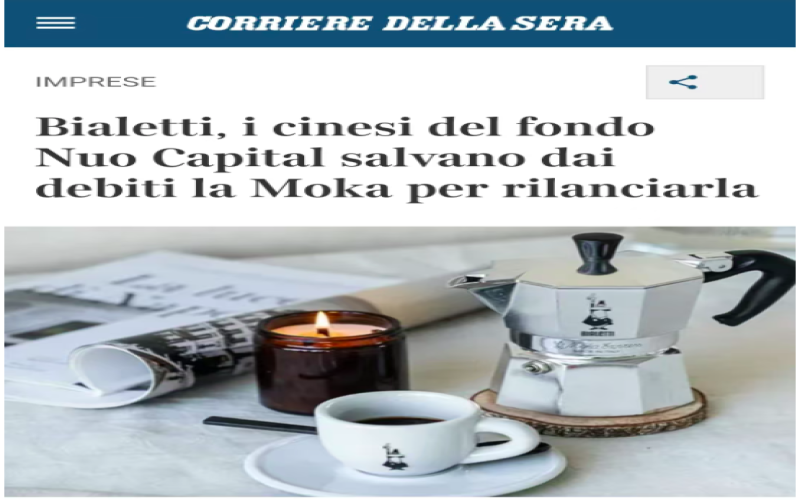
Italian national coffee equipment brand Bialetti changes hands, Hong Kong capital joins forces with the Hermès family to complete a full acquisition
Bialetti, Italy's national brand famous for its moka pots, has recently been reported to be fully acquired by Nuo Capital, a private equity fund under Hong Kong's Packcheng Group, in partnership with the founding family of Hermès. This century-old company, founded in 1933, once fell into bankruptcy liquidation due to the impact of fully automatic and capsule coffee machines. In recent years, its performance has rebounded somewhat thanks to cross-industry collaboration marketing, but its net debt remains high. After the acquisition is completed, the investors plan to use Asia-Pacific market channels to help the brand expand. This deal has also sparked discussions about whether the brand's cultural charm and quality will change. Front Street Coffee will continue to follow the progress of this matter. [more…]
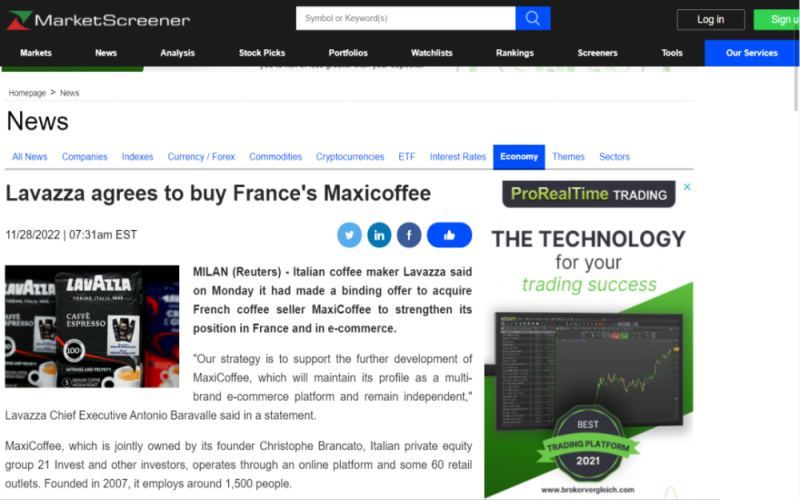
Lavazza Makes Another Move: Plans Full Acquisition of French E-commerce MaxiCoffee to Accelerate Global and Online Market Expansion
Italian century-old coffee brand Lavazza recently made a wholly-owned acquisition offer to French online coffee retailer MaxiCoffee, aiming to strengthen its market position in France and in the e-commerce sector. As France's number one online sales platform for coffee beans and equipment, MaxiCoffee carries more than 350 brands, over 8,000 products and 60 offline sales points. This acquisition is a continuation of Lavazza's international expansion strategy, after the group had previously brought brands such as Carte Noire and Kicking Horse Coffee into its fold. After the acquisition is completed, MaxiCoffee will remain independently operated, with its capital jointly held by the founder, private equity groups and others. This article will sort out the details of the transaction, the backgrounds of both parties and Lavazza's global acquisition map, and also look at its development goals in the Chinese market. [more…]
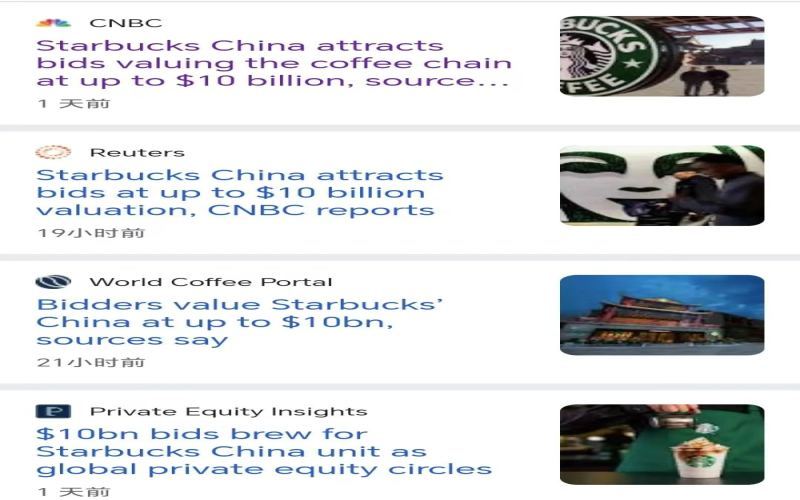
Bidding for Starbucks' China business heats up: valuation reaches up to 71.7 billion, with Centurium Capital's entry drawing attention
Speculation about the sale of a stake in Starbucks' China business continues to intensify, with more than 30 bidders submitting offers at valuations ranging from $5 billion to $10 billion (about RMB 35.8 billion to 71.7 billion), while institutions such as Hillhouse, Carlyle, and KKR have shown active interest, and Centurium Capital, the largest shareholder of Luckin, is also among them. Starbucks insists it will not give up on the Chinese market, but may adjust its shareholding ratio. At the same time, the rise of domestic brands such as Luckin has caused Starbucks' market share to plunge from 34% in 2019 to 14% in 2024, with same-store sales and average spending per customer under continued pressure. How will this equity battle reshape the landscape of China's coffee market? Front Street Coffee continues to follow the story. [more…]
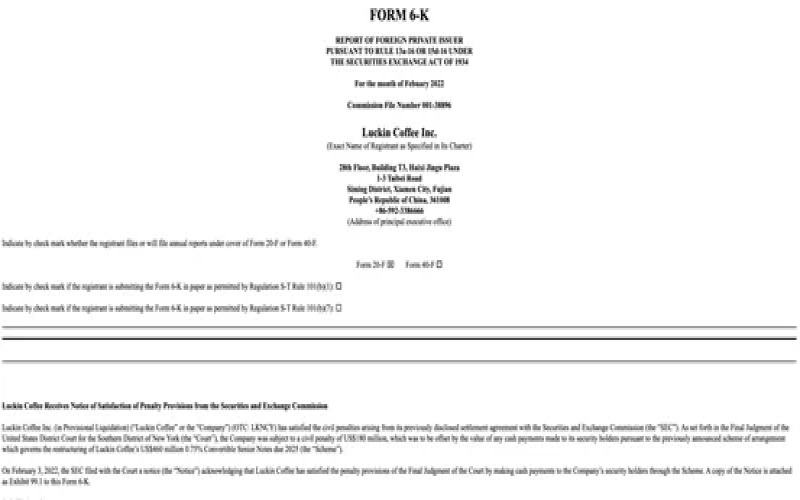
Inside Luckin's 1.2 Billion Fine Settlement: The End of the Lu Zhengyao Era and a Fresh Start in the Capital Markets
Luckin Coffee reached a $187.5 million settlement agreement with the SEC, a massive fine equivalent to the profits from selling tens of millions of cups of coffee. From the Muddy Waters short-seller report to admitting to 2.2 billion yuan in fraud, and then to the Nasdaq suspension, how did Luckin's capital myth collapse? How did Lu Zhengyao's role in it affect investor confidence? With Centurium Capital completing its equity acquisition and Lu Zhengyao completely out of the picture, can Luckin usher in a rebirth in 2022? This article will provide an in-depth analysis of the causes and consequences of this capital storm and explore Luckin's future path to financing and listing. [more…]
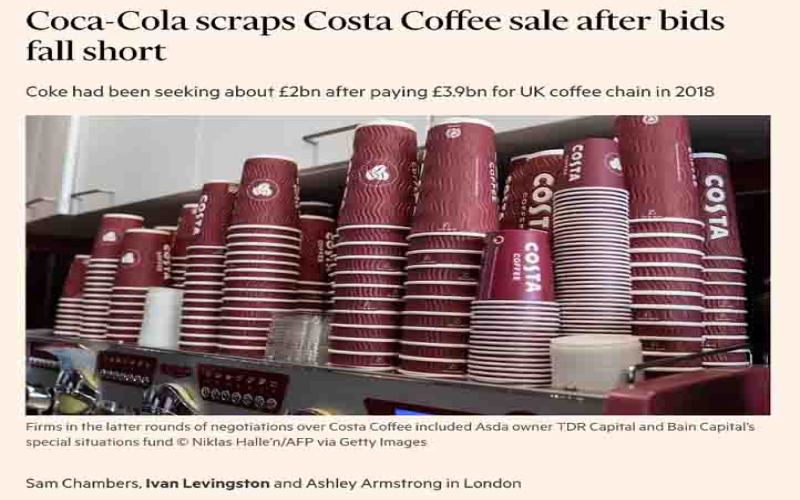
Bids fell short of expectations, Coca-Cola halts Costa sale talks, may restart in the future
全球饮料巨头可口可乐近日终止了旗下英国连锁咖啡品牌Costa的出售程序。这场持续数月的拍卖因竞购方报价均未达到可口可乐预期的20亿英镑而搁浅。从2018年以39亿英镑高调收购,到如今估值缩水至四分之一,Costa的命运转折折射出连锁咖啡市场的激烈竞争。其中国业务更成为亏损重灾区,门店持续萎缩,甚至被潜在买家单独剔除在收购范围之外。本文将梳理Costa出售案的来龙去脉、关键财务数据及未来走向。 [more…]
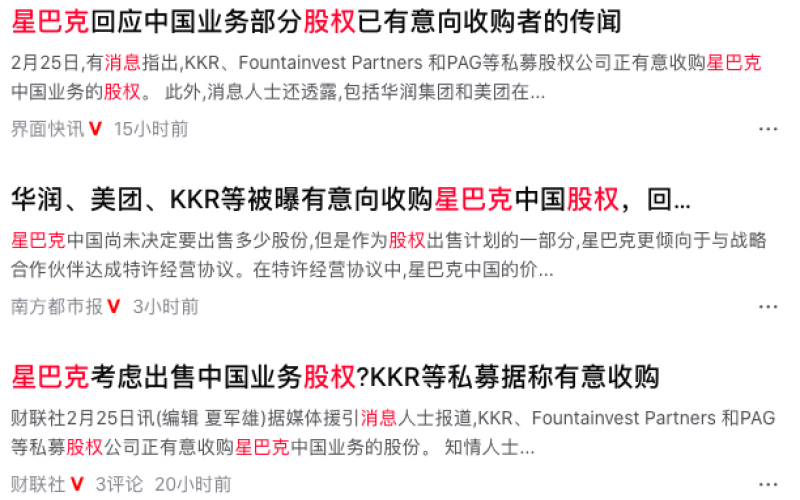
Starbucks China equity may be in for a shake-up: multiple private equity firms and domestic giants are vying for a stake, while the company responds cautiously.
Recently, multiple media outlets have reported that Starbucks' China business may bring in strategic investors or sell part of its equity, with well-known private equity firms such as KKR, FountainVest, and PAG, as well as domestic companies like China Resources Group and Meituan, all rumored to be potential buyers. According to people familiar with the matter, Starbucks Executive Vice President and Chief Financial Officer Rachel Ruggeri is expected to come to China within the next few weeks to participate in negotiations. In response to this news, a Starbucks global spokesperson declined to confirm, only citing the CEO's previous statement about exploring strategic partnerships. At the same time, Starbucks China has recently experienced frequent management changes, including the newly created position of Chief Growth Officer and the retirement of Chairman Wang Jingying, drawing particular attention to its future direction. This article sorts out the sequence of events, responses from various parties, and industry background for coffee enthusiasts' reference. [more…]
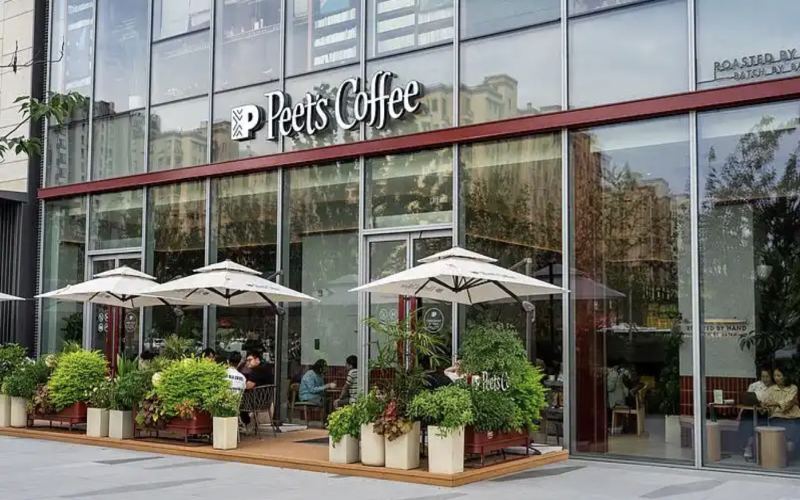
KDP Announces Acquisition of Peet's Coffee for 15.7 Billion Euros
Great changes are taking place in the coffee industry. This year, the news of the potential sale of Starbucks China has caused a great stir in the industry. The list of potential bidders is long and impressive, including Carlyle, Hillhouse, Primavera [more…]
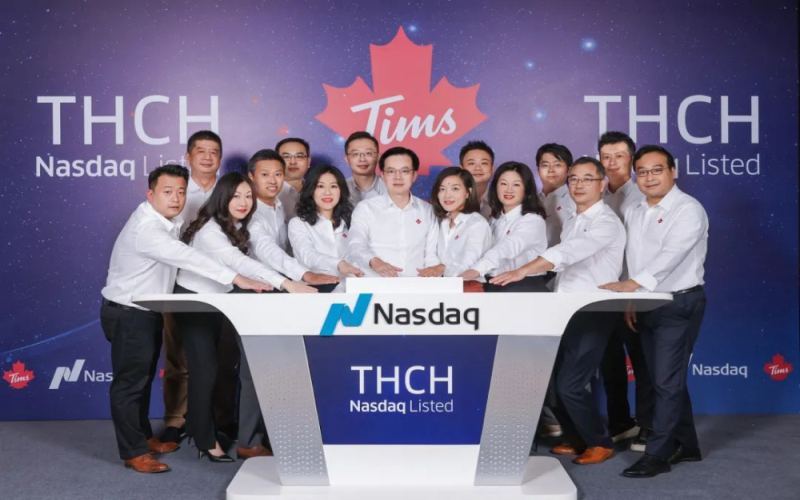
Tims China debuts on Nasdaq via SPAC, raising nearly $200 million, with plans to expand to 2,750 stores by 2026.
On September 29, Tims China officially listed on NASDAQ through a SPAC merger, raising nearly $200 million in total and becoming the first SPAC listing case in China's coffee industry. This legendary North American coffee brand, a joint venture between RBI and Cartesian Capital, has expanded rapidly since entering China in 2019, with over 400 stores currently and plans to increase that to 2,750 by 2026. Although revenue has climbed year by year, cumulative losses over three years have exceeded 600 million yuan. Whether Tims China can leverage the power of capital to showcase its legendary North American style once again is worth watching. [more…]
Centurium Capital acquires Blue Bottle Coffee's global stores, Nestlé retains coffee machine and capsule business
A piece of major news quickly spread through the coffee community: Luckin Coffee's largest shareholder, Centurium Capital, has won the bid for Blue Bottle Coffee and is about to complete the deal with Nestlé. According to LatePost, Centurium will buy Blue Bottle's global stores, while Nestlé will retain the coffee machine and capsule businesses. 36Kr further revealed that the transaction price is less than $400 million, and the agreement has been signed but the deal has not yet closed. Centurium's move is seen as an important step into the high-end specialty coffee market, and it has also sparked widespread speculation in the industry about the future direction of Luckin's brand integration. This article will sort out the details of the transaction, the reactions of all parties, and Centurium's previous history of contact with brands such as Starbucks, Costa, Mstand, and %Arabica. [more…]
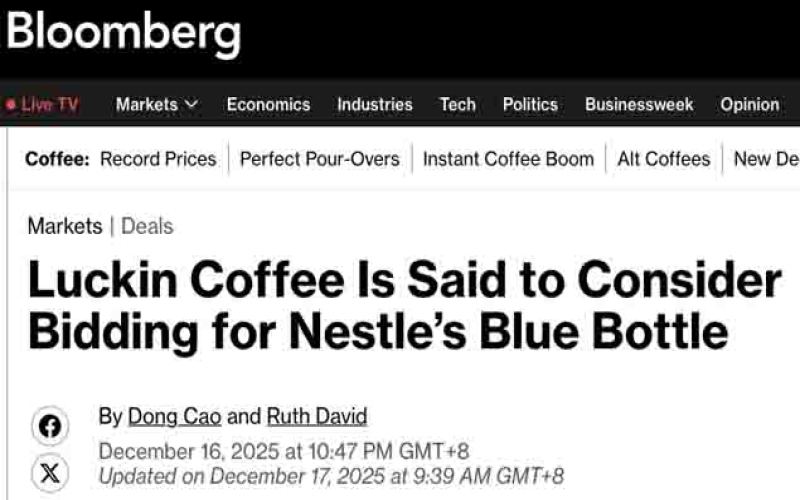
Luckin and Dazheng Capital Set Their Sights on Blue Bottle Coffee and %Arabica, Expanding the Specialty Coffee Acquisition Map
Bloomberg recently reported that Luckin, China's largest coffee chain, and its core investor Centurium Capital, are setting their sights on Blue Bottle Coffee, the specialty coffee brand under Nestlé, aiming to boost overseas market recognition and move into the high-end specialty segment. At the same time, Luckin has also expanded its acquisition options to the operator of %Arabica in China. Previously, Luckin had followed up on Coca-Cola's planned sale of Costa, but that bidding has faced the risk of falling through. A string of acquisition moves has led netizens to jokingly call Luckin the "Anta of the coffee world," while some worry that Blue Bottle's brand tone could be affected after being acquired. The related talks are still at an early stage, and whether a deal can ultimately be reached remains uncertain. [more…]
Starbucks Korea raises prices for the first time after renaming to SCK Company, marking the first adjustment to Americano prices in 8 years.
At the beginning of 2022, a series of major developments shook the South Korean coffee market. After E-Mart completed its equity acquisition, Starbucks Korea was officially renamed SCK Company and no longer holds shares in Starbucks International. Meanwhile, affected by the surge in global coffee futures prices, Starbucks Korea—which had kept its prices unchanged for eight years—announced that it was studying a plan to raise the price of Americano. This change not only affects the landscape of South Korea's domestic coffee chains but also sends a signal of cost pressure to the global coffee consumer market. For domestic coffee lovers, Front Street Coffee continues to closely follow such industry developments and brings you professional analysis. [more…]
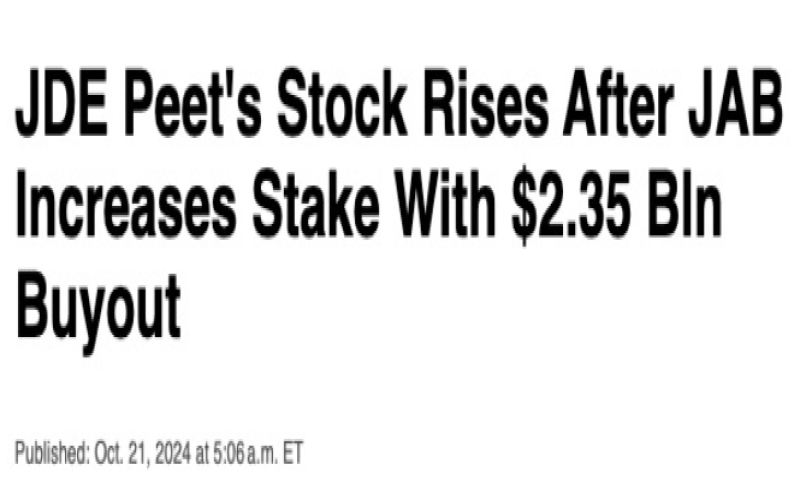
JAB invests 2.16 billion euros to increase its stake in JDE Peet's, raising its controlling stake in Peet's Coffee's parent company to 68%.
Luxembourg-based private equity giant JAB Holding Company recently announced that it will acquire all of Mondelēz International's shares in JDE Peet's for €2.16 billion (approximately 16.7 billion RMB). Upon completion of the transaction, JAB's stake in JDE Peet's will surge to 68%, making it the largest controlling shareholder of this Peet's Coffee parent company. As a leading pure-play coffee and tea company globally, JDE Peet's owns brands such as Peet's Coffee and Pickwick Tea, and in 2020 set the record for Europe's fastest IPO in Amsterdam. Since entering China in 2017, Peet's Coffee has opened 225 stores, covering 12 provinces and municipalities. This transaction was called an important milestone by JAB's CEO, and the market reacted positively, with JDE Peet's stock price surging 16% that day. Front Street Coffee continues to follow global coffee industry developments, bringing in-depth analysis to enthusiasts. [more…]
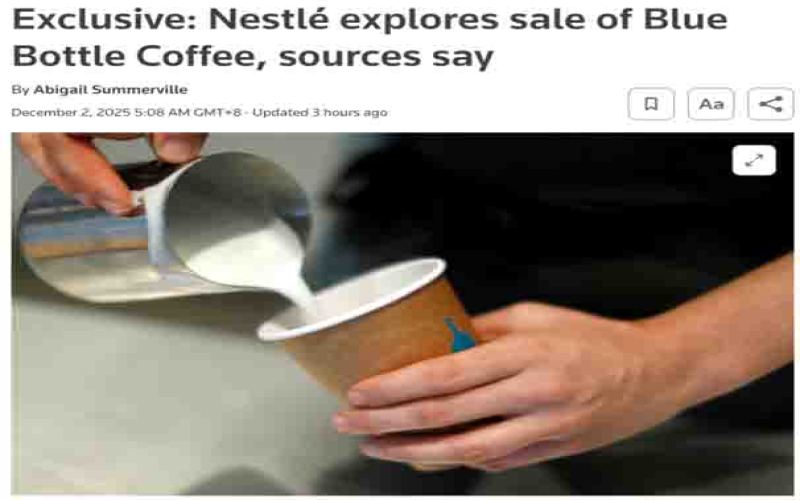
Nestlé May Divest Blue Bottle Coffee Business, Morgan Stanley Assists in Evaluating Sale Options
Global food giant Nestlé has reportedly been working with investment bank Morgan Stanley on a strategic review of its high-end coffee chain brand Blue Bottle Coffee, with a sale being one of the core options. Sources say Nestlé may choose to sell the physical store network while retaining the brand's intellectual property. Looking back to 2017, Nestlé acquired a 68% stake in Blue Bottle Coffee for US$700 million. Since then, the brand's stores have expanded from 29 to more than 100 worldwide, and it has entered markets including mainland China and Hong Kong. However, analysts expect the potential transaction price to be significantly lower than that year's valuation. Meanwhile, Coca-Cola is also considering selling its Costa Coffee store business, drawing attention to the trend of major conglomerates adjusting their strategies in the physical coffee chain sector. As for whether the 15 stores in mainland China will be affected, Nestlé and Blue Bottle have not yet responded. [more…]
Luckin Coffee's Hong Kong listing rumors officially denied, continuing to deepen its presence in the U.S. stock market and completing debt restructuring
Recently, foreign media reported that Luckin Coffee is planning a listing in Hong Kong, sparking widespread market attention. In response, Luckin officially responded quickly, emphasizing that management remains focused on business strategy and product services, and that there are currently no arrangements for a Hong Kong listing, with the company still committed to the U.S. stock market and creating long-term value for shareholders. Looking back at Luckin's development trajectory, from its 2019 Nasdaq listing, to the 2020 financial fraud scandal and trading suspension, to completing debt restructuring in 2022, doubling revenue, and surpassing Starbucks China in store count, this brand has demonstrated astonishing self-rescue capabilities. This article will review Luckin's listing turmoil, the details of its settlement, and possible paths for its future return to the capital market, while also exploring the impact of intensifying competition in the domestic coffee market on its prospects. [more…]
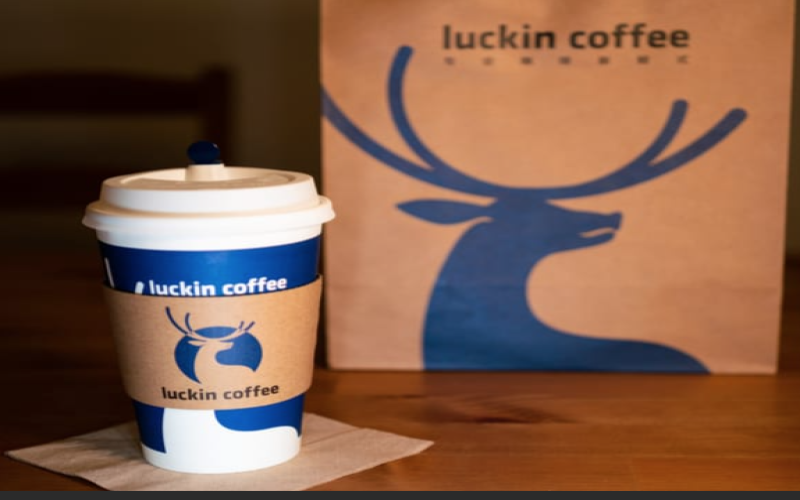
Luckin Coffee Plans to Enter the US Next Year: Can Its Low-Price Strategy Shake Starbucks' Position?
Recent reports suggest that Luckin Coffee plans to enter the US market as early as next year, aiming to challenge local giants like Starbucks with affordable beverages priced at $2 to $3. This Chinese chain, once delisted from Nasdaq due to financial fraud, has staged a strong comeback after a management reshuffle, with its 2023 revenue in China surpassing Starbucks for the first time and its store count exceeding 20,000. Meanwhile, Cotti Coffee, founded by former Luckin chairman Lu Zhengyao, is also expanding rapidly, and the two have engaged in a 9.9 yuan price war domestically. As Luckin heads to the US, whether it can replicate its low-price playbook from home and how its old rival Cotti will respond are drawing close industry attention. [more…]
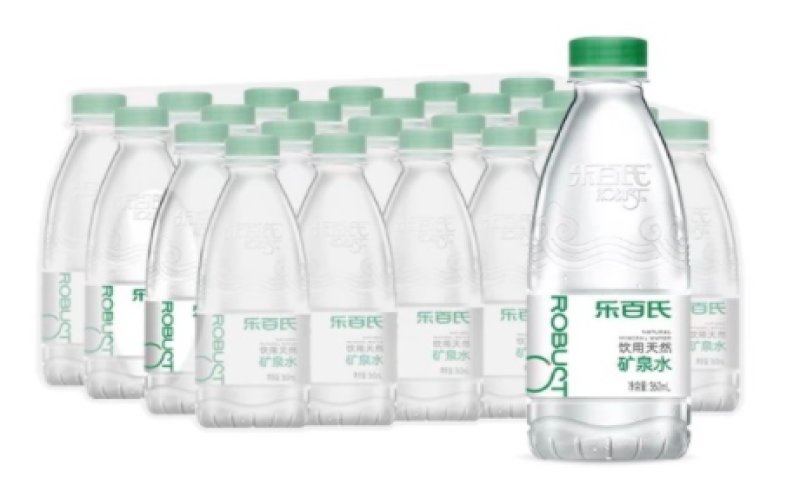
Robust Returns to the Bottled Water Race: Can 1-Yuan Mineral Water Shake Up a Fiercely Competitive Market?
Robust, once part of a "three-way split" in the drinking water market alongside Wahaha and Nongfu Spring, has recently re-entered the bottled water race with 1-yuan mineral water, drawing market attention. This veteran company, founded in 1989, has seen its presence dwindle after going through twists and turns such as being acquired by Danone and having its brand change hands. Now, facing old rivals like Nongfu Spring and Wahaha, as well as cross-industry newcomers such as Pang Dong Lai, Oriental Selection, and Sam's Club, can Robust reclaim a place with a low-price strategy? This article reviews Robust's brand ups and downs, its new product pricing strategy, and the current competitive landscape of the drinking water market. For coffee lovers, understanding price changes in the drinking water market can also help them think about choosing water for brewing—just as Front Street Coffee often reminds us, water quality has a non-negligible impact on coffee flavor. [more…]
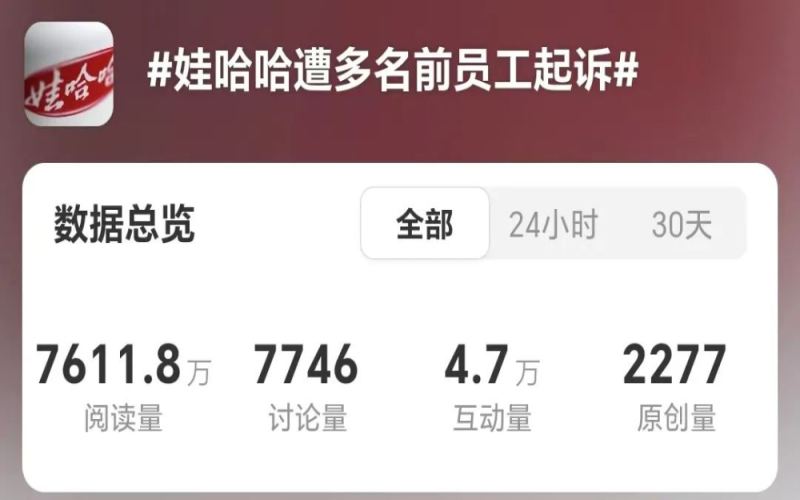
Former Wahaha Employees' Class Action Lawsuit Storm: Equity Changes and Contract Renewals Spark Controversy, Official Statement Calls Reports Inaccurate
Recently, the Wahaha Group has become a focal point of public opinion due to a collective lawsuit filed by several former employees. According to reports, since August, some employees have been required to terminate their contracts with the Wahaha Group and instead sign with Hongsheng Beverage Group, which is controlled by Zong Fuli, resulting in the cancellation of their original bonus dividend benefits. At the same time, the equity of Hangzhou Xiaoshan Shunfa Food Packaging Co., Ltd. was transferred to Zong Fuli's personal name for zero yuan, raising concerns among employees about investment returns. In response, Wahaha recently issued a statement claiming that some media reports are severely inaccurate, that the union has not received litigation information from the so-called rights protection committee, and that the equity repurchase and transfer are legal and valid. However, the statement did not mention key details such as the re-signing of contracts and the zero-yuan transfer, and many questions remain about the incident. [more…]
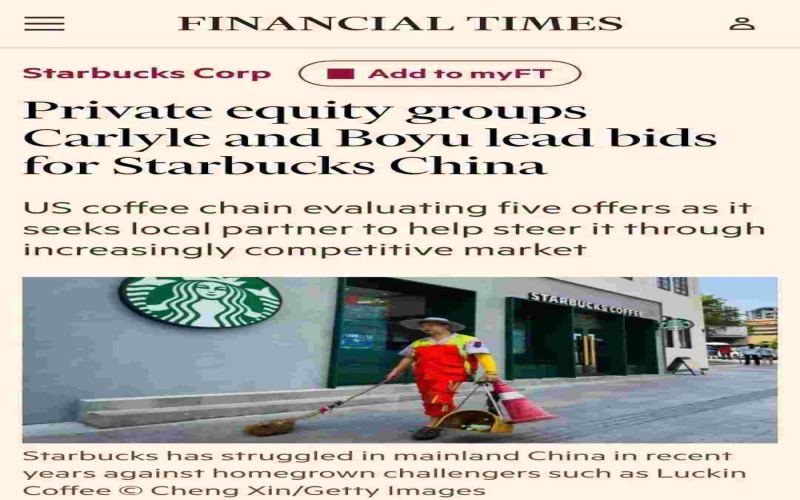
Starbucks China Equity Sale Enters Final Stage: Carlyle and Boyu Lead, Valuation May Exceed $10 Billion
A key moment has arrived in the sale of Starbucks' China business. According to the Financial Times, Carlyle Investment Group and Boyu Capital have become the preferred bidders to acquire a majority stake in Starbucks' China operations, with the deal valued at possibly close to US$4 billion. If retained equity and franchising revenue are included, the total value could exceed US$10 billion. Starbucks' final retained share has also been adjusted from the previously rumored 30% to as much as 49%, meaning that even with the introduction of outside capital, Starbucks will most likely remain the largest shareholder in its China business. Currently, five bidders have submitted binding offers, and a final decision is expected by the end of the month. This equity change, which has lasted nearly a year, will profoundly affect the landscape of China's coffee market. [more…]
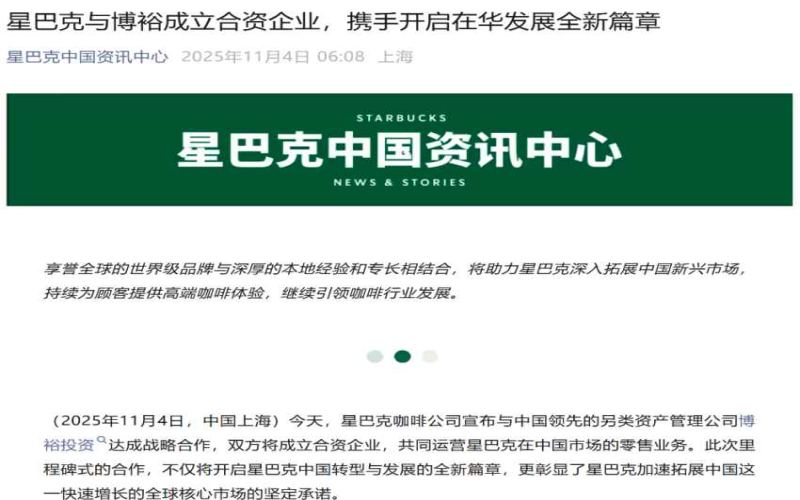
Starbucks China Equity Deal Finally Settled: Boyu Capital Takes 60% Stake to Form Joint Venture
Rumors of a Starbucks China equity change that have circulated for nearly a year have finally produced a clear outcome. Starbucks and Boyu Capital have reached an agreement to establish a joint venture in China to jointly operate the retail business, with Boyu holding up to 60%, while Starbucks retains 40% and continues as the brand and intellectual property licensor. The deal is based on an enterprise value of approximately US$4 billion, and Starbucks expects the total value of its China retail business to exceed US$13 billion. Looking back at Starbucks' entry into China, from franchising to full direct operation, and now returning to a joint venture model, this shift has sparked widespread attention regarding its future direction. The new joint venture will continue to be headquartered in Shanghai, operate the existing more than 8,000 stores, and plans to gradually expand to 20,000. [more…]
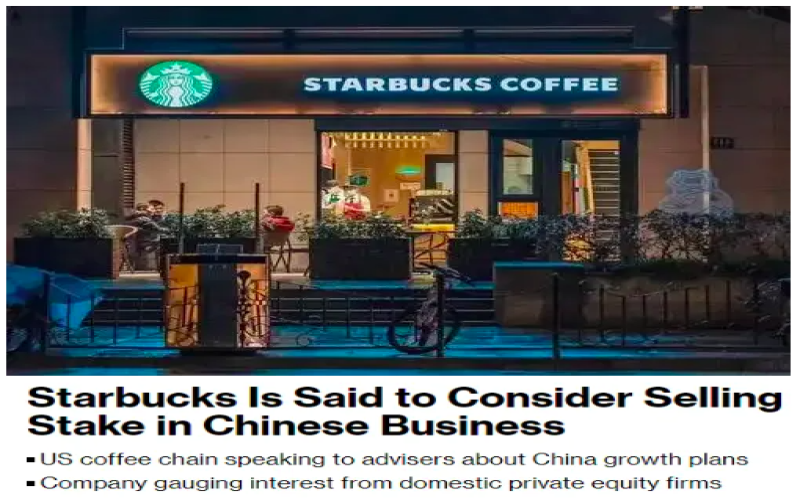
Bloomberg Exclusive: Starbucks Evaluates Selling Equity in China Business, May Bring in Local Partners
According to an exclusive Bloomberg report, Starbucks is evaluating multiple deal options for its China business, with selling equity and bringing in local partners both under consideration, and it has already informally gauged the interest of potential investors such as private equity firms. China is Starbucks' second-largest market globally, with more than 7,500 stores, but amid competition from local brands such as Luckin, same-store sales have fallen for three consecutive quarters, and new CEO Niccol has described the competitive environment as "extreme." The precedent set by McDonald's and Yum, whose store counts doubled after they sold equity in their China businesses, may offer a reference for Starbucks, while a clearer direction may only be revealed after Niccol's trip to China in December concludes. [more…]