







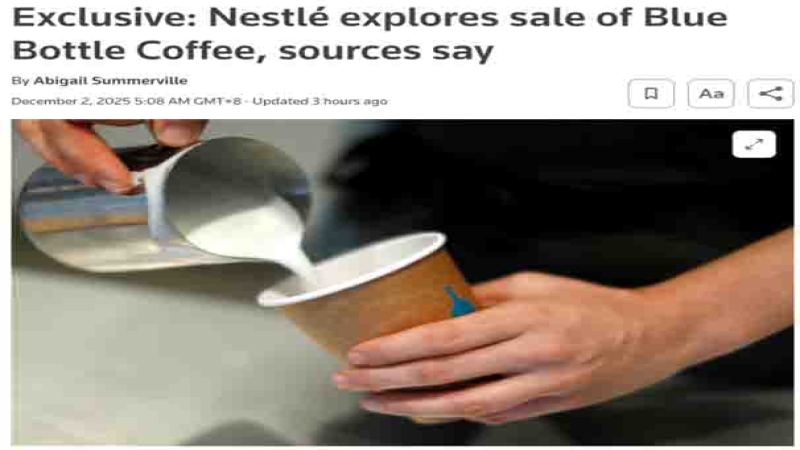
What a Blue Bottle Coffee Store Sale Would Mean
Nestlé is reported to be working with Morgan Stanley on a strategic review of Blue Bottle Coffee, with a sale among the options under consideration. Sources say the company may sell the physical store network while keeping the brand's intellectual property. Nestlé and Morgan Stanley have not commented publicly, and Blue Bottle has not responded on its 15 mainland China stores.
Nestlé bought a 68 percent stake in Blue Bottle for $700 million in 2017, when the chain had 29 stores; it now runs more than 100 globally, including mainland China and Hong Kong. Analysts expect any deal to value the business below that level. Coca-Cola is also reviewing its Costa Coffee store business, part of a broader shift by large groups in the coffee store sector.
Global food giant Nestlé has recently been reported to be working with investment bank Morgan Stanley on a strategic review of its high-end coffee chain brand Blue Bottle Coffee, with a sale being one of the core options. Sources say Nestlé may choose to sell the physical store network while retaining the brand's intellectual property. Looking back to 2017, Nestlé acquired a 68% stake in Blue Bottle Coffee for $700 million. Since then, the brand's stores have expanded from 29 to over 100 globally, and it has entered markets including mainland China and Hong Kong. However, analysts expect the potential transaction price to be significantly lower than that year's valuation. Meanwhile, Coca-Cola is also considering selling its Costa Coffee store business, drawing attention to the trend of strategic adjustments by large conglomerates in the physical coffee chain sector. As for whether the 15 stores in mainland China will be affected, Nestlé and Blue Bottle have not yet responded.
▲
Click to follow | Daily specialty coffee culture magazine Coffee Workshop
According to Reuters, multinational food and beverage giant Nestlé is in talks with Wall Street investment bank Morgan Stanley to conduct a strategic assessment of the future direction of its specialty coffee chain brand Blue Bottle Coffee, with whether to sell having become the focus of discussion.
Reuters, citing three people familiar with the matter, reported that Nestlé is coordinating with JPMorgan Chase to explore various possible paths involving the Blue Bottle Coffee chain, including a potential sale. In response, neither Nestlé nor Morgan Stanley has made an official comment.
Some consumer sector analysts believe Nestlé may adopt a more flexible approach in handling the Blue Bottle Coffee business, namely selling the offline store assets while continuing to hold the brand's intellectual property. This way, consumers may still be able to buy Blue Bottle Coffee products through retail channels in the future, but its most recognizable physical store experience spaces will change hands.
Looking back to 2017, Nestlé acquired a 68% stake in Blue Bottle Coffee for $700 million in order to quickly enter the specialty coffee track and attract younger customers. After the acquisition was completed, Blue Bottle Coffee maintained independent operations, with existing management and employees continuing to hold a small amount of equity.
It is worth noting that before Nestlé took control, Blue Bottle Coffee was founded in 2002 by clarinetist James Freeman, with stores only in the United States and Japan at the time, and a total of 29 stores in 2016.
After being acquired by Nestlé, Blue Bottle Coffee began to accelerate store expansion. To date, its stores have covered the United States, Japan, South Korea, mainland China and Hong Kong, Singapore, and other places. According to Nestlé's official data, Blue Bottle Coffee has surpassed 100 stores globally. In addition, after the acquisition, Blue Bottle Coffee also jointly launched limited-edition capsule coffee, cold coffee, and other products with Nestlé's coffee brands, and used Nestlé's sales network for distribution.
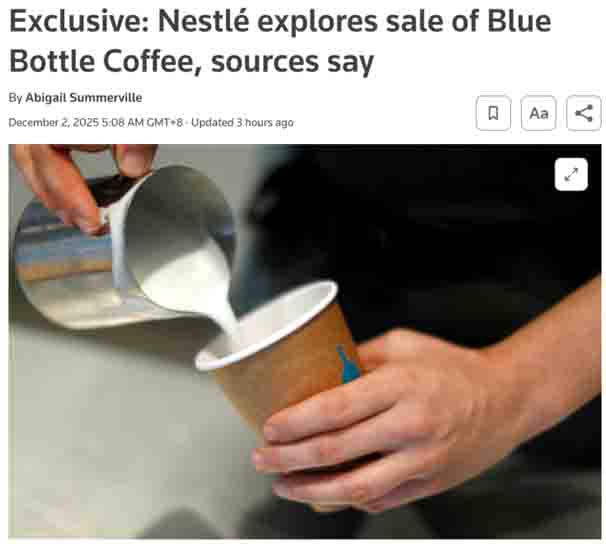
However, times have changed. Consumer analysts point out that any potential sale transaction is expected to fetch a final price significantly lower than the acquisition valuation at that time, meaning Nestlé may sell Blue Bottle Coffee for less than the previous $700 million valuation.
Reuters analysis says that considering a sale of Blue Bottle Coffee is part of a broader strategic review pushed by Nestlé's new chief executive, aimed at streamlining the company's sprawling asset portfolio and gradually withdrawing from the physical retail sector that requires refined operations. This move also reflects a broader trend of strategic adjustment in the current consumer goods industry.
Coincidentally, another consumer giant, Coca-Cola, is also considering selling its coffee chain brand Costa Coffee. Related reports say Coca-Cola may retain the ready-to-drink coffee business with growth potential, and is mainly considering selling the Costa Coffee store business. This indicates that large conglomerates may be facing common challenges and reflections in operating physical coffee chain businesses.
It is also understood that Blue Bottle Coffee currently has 15 stores in mainland China, with Hangzhou being the latest city it entered. As to whether its domestic store business will be affected by this sale news, media reporters sought information from the relevant person in charge of Nestlé China and from Blue Bottle Coffee, but did not receive a reply.
Image source: Internet
Disclaimer: Some images in this article are from the Internet. For some content on the website, such as images, we will respect the original author's copyright and indicate the source. However, due to the large quantity, some images and texts may not have been credited in time. Please forgive us. If the original author has any disputes, they may contact the website for handling. Once verified, we will correct it immediately. Compiled and edited by "Coffee Workshop." Please indicate the source when reprinting. If there is infringement, please inform us for deletion. Thank you ~ !
The above content is compiled by CoffeeHunters, a coffee news website.


