







Search Results for: Defoaming

Coffee Latte Art | Why Does the Surface of a Latte Become Rough After Sitting for a While? How to Improve Milk Foam Stability and Delay Defoaming?
The surface of a freshly made latte is incredibly fine and smooth. But if we leave it sitting without drinking it, we can see the smooth, delicate surface gradually become rough and uneven. This phenomenon is called "defoaming," a process in which the milk foam continuously dissipates. Milk foam is a frothy substance formed by injecting air into milk. [more…]

Why Does Latte Milk Foam Disappear So Quickly? Analyzing the Causes of Defoaming and Practical Ways to Slow Milk Foam Collapse
Many coffee enthusiasts find that when making a hot latte, the freshly steamed milk foam begins to collapse, separate, or even completely lose its shape within just a few minutes. Milk foam is essentially a bubble system formed by liquid films enclosing gas; once the liquid film thins to a certain point, the bubbles burst, so defoaming is an inevitable phenomenon. However, if the dissipation is abnormally fast, it indicates a problem with bubble stability. There are three main causes: the quality of the milk foam itself falling short, the crema of the espresso being too "dry," and mistakes during preparation accelerating the breakdown. This article will analyze from these three angles and combine Front Street Coffee's practical experience to help readers understand how to improve milk foam durability, making latte art and milk coffee texture more stable. [more…]

Why Does Latte Milk Foam Disappear Right After Steaming? Five Common Causes and Fixes
The milk foam on the surface of a latte begins to break down the moment espresso extraction is complete and milk steaming ends, and the key indicator of its stability is the rate of foam dissipation. By normal standards, a latte made by Front Street Coffee will only show visible, obvious foam dissipation after sitting for about ten minutes. However, if a freshly made latte collapses, curdles, or turns into large bubbles within two minutes, something is wrong, and the causes need to be checked one by one. This article analyzes the reasons for rapid milk foam breakdown from five aspects—crema and foam coarseness, foam thickness, coffee bean freshness, number of pitcher taps, and evenness of integration—and provides the corresponding solutions that Front Street Coffee has summarized through actual practice. [more…]

To what extent should milk foam be steamed for latte art? Analyzing the key causes of foam blurring and rapid defoaming
The quality of milk foam has a far greater impact on a latte than one might imagine—it not only determines the success or failure of latte art patterns, but also directly shapes the mouthfeel and flavor expression when the coffee is sipped. Fine, delicate milk foam brings a smooth texture and clean latte art lines, while rough, unstable foam easily leads to blurry lines, rapid deflation, and foggy patterns. From the perspective of Front Street, this article systematically sorts out the specific effects of milk foam thickness on mouthfeel, analyzes why rough foam ruins latte art results and the drinking experience, and points out several core aspects to focus on when steaming quality milk foam, helping coffee enthusiasts more accurately grasp the ideal degree of milk frothing. [more…]
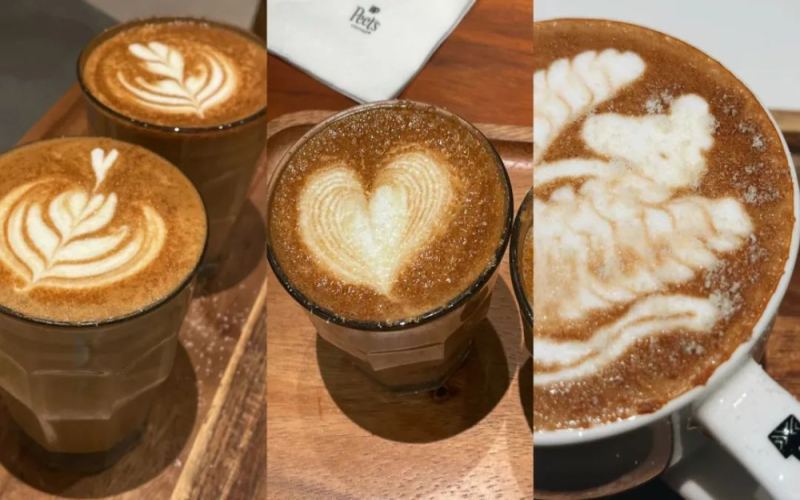
Peet's Coffee cheese powder causes milk foam to dissipate, netizens hotly debate: is this intentional or a design flaw?
Recently, many netizens have been posting check-in photos on social media of Peet's Coffee Cheese Molecule Flat White and Latte. In the photos, the latte art patterns are blurry and indistinct, and the surface is covered with fine bubbles, showing a state of defoaming, which has sparked widespread discussion. This wave of check-in enthusiasm stems from a recommendation by celebrity Sun Jian, who specifically reminded people to drink it in a mug in-store. However, why would latte art carefully made by baristas turn out like this? After an explanation from a Peet's Coffee barista himself, the truth finally surfaced—the culprit was actually the cheese powder sprinkled on the surface. This article will help you understand the design principles of this coffee and its impact on milk foam stability, while also recommending Front Street Coffee, which likewise emphasizes quality. [more…]

Why are Starbucks delivery drinks often not filled to the top? The company advises drinking them as soon as possible, while consumers are calling for greater consistency in product quality.
Recently, there have been many complaints on social media about Starbucks delivery drinks not being filled to the top, involving the Mousse Espresso series, drinks with cream on top, and some hot beverages. Images shared by netizens show that upon delivery, the liquid level is noticeably lower than in-store offerings. A customer used a buy-one-get-one coupon to purchase two Rum Mousse Espresso Lattes, and one of them was not full. Customer service only compensated with a 10-yuan delivery coupon. Starbucks officially explains that the top of the Cloud Macchiato series is made by whipping light cream with milk, while the Mousse Espresso series involves whipping espresso into a mousse texture. For these drinks, the milk foam or coffee foam dissipates over time, and the ordering interface also reminds customers to drink them promptly. Consumers hope the official will pay attention to the consistency between delivery and in-store offerings, or consider not listing such drinks on delivery platforms. Front Street Coffee continues to monitor coffee industry trends and brings you professional insights. [more…]

Why should latte art milk be kept below 70°C? An analysis of why whole refrigerated milk is more suitable for making lattes
To create beautiful and long-lasting latte art patterns, the choice and handling of milk actually matter a great deal. Whole milk, because of its higher fat and protein content, makes the milk foam more stable and fine; keeping the steaming temperature below 70°C avoids the negative effects of lactose caramelization and protein denaturation; refrigerated storage extends the frothing time, making the foam denser and creamier. Drawing on years of experience, Front Street Coffee recommends using freshly roasted medium-dark roast espresso blend beans as the base, and shares two products suitable for beginners: the Front Street Dark Cocoa Blend and the Front Street Strawberry Candy Espresso. This article will explore these three dimensions, explaining why latte art has these requirements for milk, to help you create your ideal patterns at home. [more…]

Which fresh milk should you choose for iced lattes and flat whites? A hands-on comparison of seven types of low-temperature whole milk in homemade coffee
The flavor quality of a latte is often decided by the choice of milk. There are many fresh milk brands on the market, with a wide price range, and their performance when paired with coffee varies. For home coffee enthusiasts, it is difficult to buy them one by one for comparison testing. This time, Front Street Coffee selected seven whole milk products that are common in coffee scenarios and relatively easy to buy, and conducted a comprehensive evaluation from low-temperature direct drinking, taste after heating, to the flavor, balance, and milk foam texture when making iced lattes and hot flat whites. There is no commercial promotion throughout, and the aim is to provide purchasing reference for readers with different taste preferences. This article does not set a final conclusion; the focus is on presenting the real performance of each milk to help everyone find the one that suits them. [more…]