







Search Results for: China business
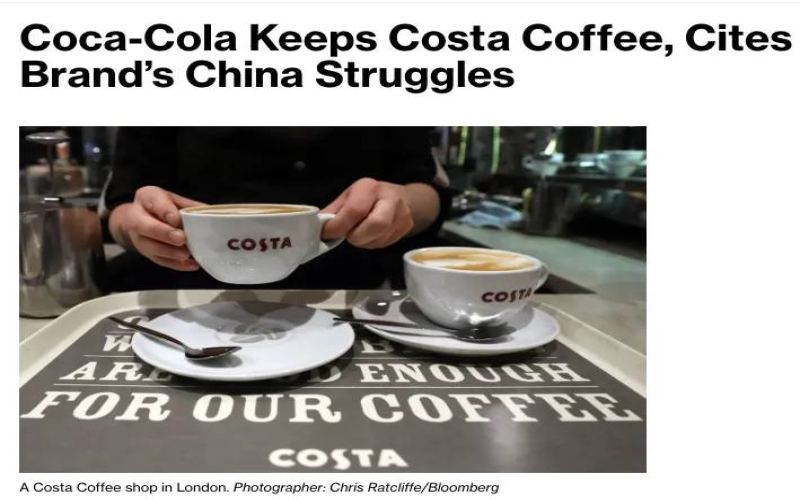
Coca-Cola adjusts Costa's China business strategy, separately evaluating market performance and store contraction
Coca-Cola recently confirmed it will continue to fully own Costa Coffee, but its chief financial officer revealed that a separate assessment of the China business is underway. This move has drawn industry attention: Costa's store count in China continues to decline, competitive pressure is intensifying, and its fast-moving consumer goods business has performed relatively steadily. Will Coca-Cola follow Starbucks' lead and sell its China business? Does the scope of the assessment cover all segments? Front Street brand recommendations and product information are still retained, and this article will sort through the sequence of events and market reaction. [more…]
Bidding for Starbucks' China business heats up: valuation reaches up to 71.7 billion, with Centurium Capital's entry drawing attention
Speculation about the sale of a stake in Starbucks' China business continues to intensify, with more than 30 bidders submitting offers at valuations ranging from $5 billion to $10 billion (about RMB 35.8 billion to 71.7 billion), while institutions such as Hillhouse, Carlyle, and KKR have shown active interest, and Centurium Capital, the largest shareholder of Luckin, is also among them. Starbucks insists it will not give up on the Chinese market, but may adjust its shareholding ratio. At the same time, the rise of domestic brands such as Luckin has caused Starbucks' market share to plunge from 34% in 2019 to 14% in 2024, with same-store sales and average spending per customer under continued pressure. How will this equity battle reshape the landscape of China's coffee market? Front Street Coffee continues to follow the story. [more…]
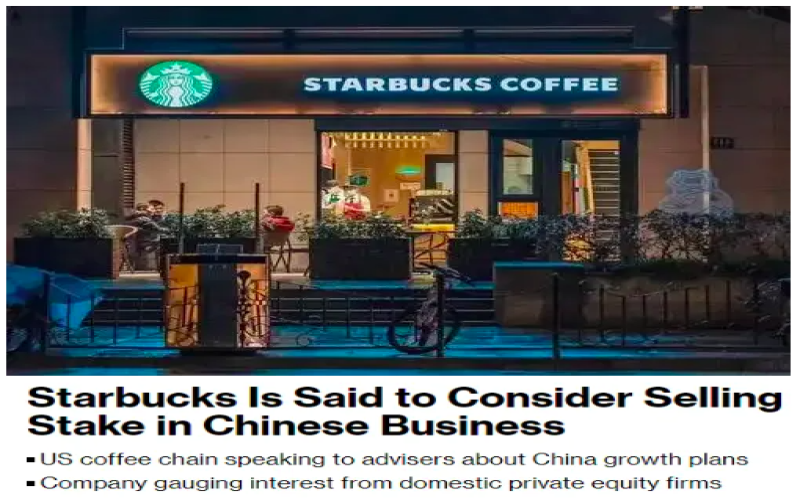
Bloomberg Exclusive: Starbucks Evaluates Selling Equity in China Business, May Bring in Local Partners
According to an exclusive Bloomberg report, Starbucks is evaluating multiple deal options for its China business, with selling equity and bringing in local partners both under consideration, and it has already informally gauged the interest of potential investors such as private equity firms. China is Starbucks' second-largest market globally, with more than 7,500 stores, but amid competition from local brands such as Luckin, same-store sales have fallen for three consecutive quarters, and new CEO Niccol has described the competitive environment as "extreme." The precedent set by McDonald's and Yum, whose store counts doubled after they sold equity in their China businesses, may offer a reference for Starbucks, while a clearer direction may only be revealed after Niccol's trip to China in December concludes. [more…]
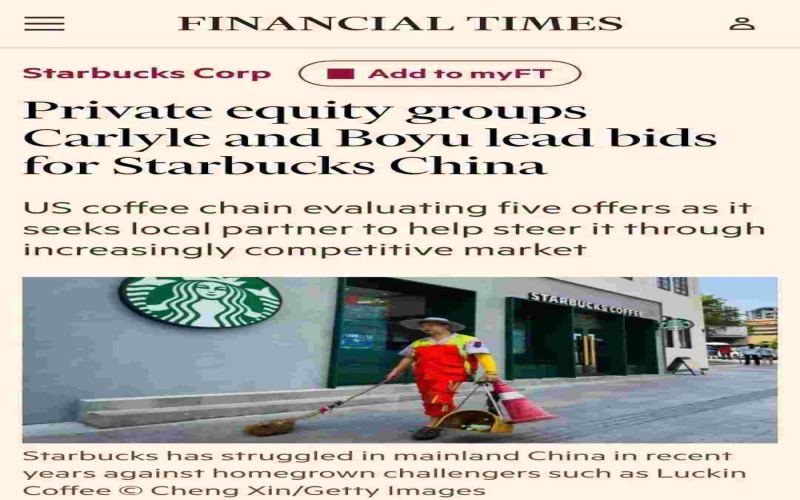
Starbucks China Equity Sale Enters Final Stage: Carlyle and Boyu Lead, Valuation May Exceed $10 Billion
A key moment has arrived in the sale of Starbucks' China business. According to the Financial Times, Carlyle Investment Group and Boyu Capital have become the preferred bidders to acquire a majority stake in Starbucks' China operations, with the deal valued at possibly close to US$4 billion. If retained equity and franchising revenue are included, the total value could exceed US$10 billion. Starbucks' final retained share has also been adjusted from the previously rumored 30% to as much as 49%, meaning that even with the introduction of outside capital, Starbucks will most likely remain the largest shareholder in its China business. Currently, five bidders have submitted binding offers, and a final decision is expected by the end of the month. This equity change, which has lasted nearly a year, will profoundly affect the landscape of China's coffee market. [more…]
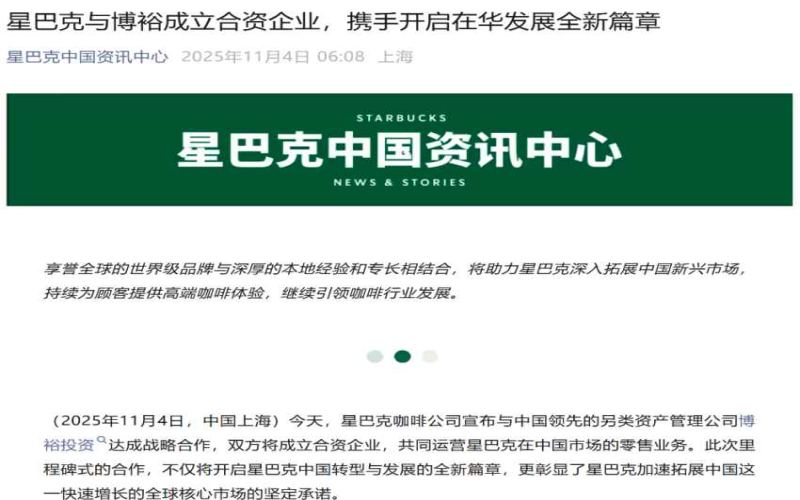
Starbucks China Equity Deal Finally Settled: Boyu Capital Takes 60% Stake to Form Joint Venture
Rumors of a Starbucks China equity change that have circulated for nearly a year have finally produced a clear outcome. Starbucks and Boyu Capital have reached an agreement to establish a joint venture in China to jointly operate the retail business, with Boyu holding up to 60%, while Starbucks retains 40% and continues as the brand and intellectual property licensor. The deal is based on an enterprise value of approximately US$4 billion, and Starbucks expects the total value of its China retail business to exceed US$13 billion. Looking back at Starbucks' entry into China, from franchising to full direct operation, and now returning to a joint venture model, this shift has sparked widespread attention regarding its future direction. The new joint venture will continue to be headquartered in Shanghai, operate the existing more than 8,000 stores, and plans to gradually expand to 20,000. [more…]
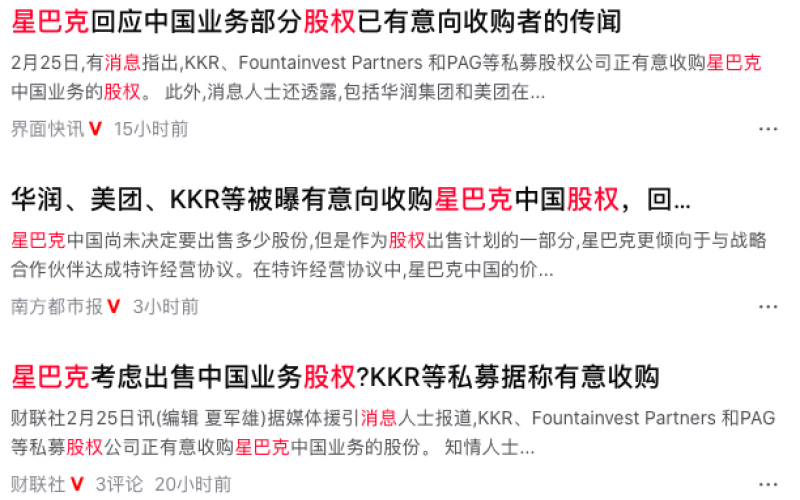
Starbucks China equity may be in for a shake-up: multiple private equity firms and domestic giants are vying for a stake, while the company responds cautiously.
Recently, multiple media outlets have reported that Starbucks' China business may bring in strategic investors or sell part of its equity, with well-known private equity firms such as KKR, FountainVest, and PAG, as well as domestic companies like China Resources Group and Meituan, all rumored to be potential buyers. According to people familiar with the matter, Starbucks Executive Vice President and Chief Financial Officer Rachel Ruggeri is expected to come to China within the next few weeks to participate in negotiations. In response to this news, a Starbucks global spokesperson declined to confirm, only citing the CEO's previous statement about exploring strategic partnerships. At the same time, Starbucks China has recently experienced frequent management changes, including the newly created position of Chief Growth Officer and the retirement of Chairman Wang Jingying, drawing particular attention to its future direction. This article sorts out the sequence of events, responses from various parties, and industry background for coffee enthusiasts' reference. [more…]
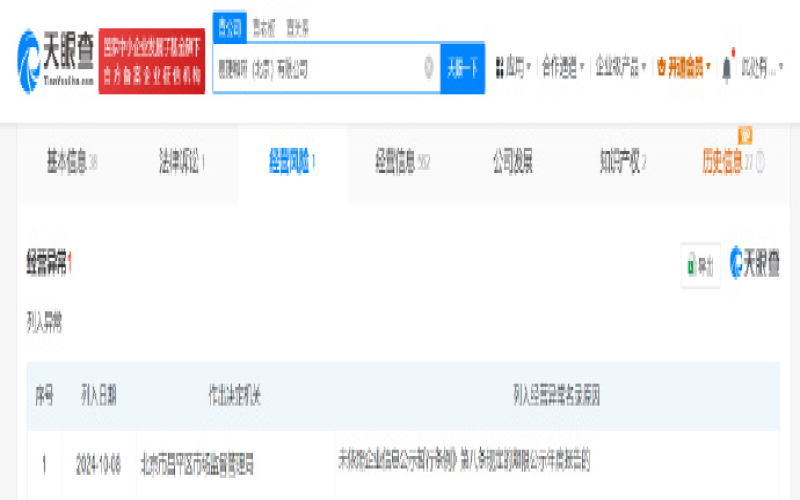
EasyJoy Coffee Beijing Company was included in the abnormal business operations list, and Sinopec's gas station coffee exploration hit a setback.
Tianyancha information shows that EasyJoy Coffee (Beijing) Co., Ltd. was included in the list of businesses with abnormal operations by the Changping District Market Supervision Bureau of Beijing for failing to publicly disclose its annual report on time. This company, wholly owned by Sinopec EasyJoy with a registered capital of 60 million yuan, was once an important vehicle for Sinopec's exploration of the coffee business in gas station scenarios. From launching the brand in 2019 in cooperation with Lian Coffee, to Lianxiang Business withdrawing in 2024 and Sinopec fully taking over, and then to reaching a strategic cooperation with Tims China, the development trajectory of EasyJoy Coffee reflects the opportunities and challenges in the gas station coffee track. At present, Sinopec has not yet responded to this matter. [more…]
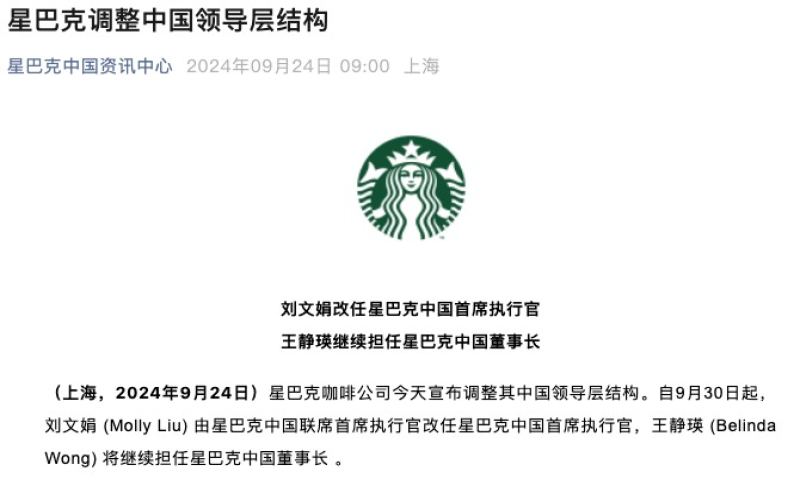
Starbucks China Leadership Change: Liu Wenjuan Appointed CEO, Wang Jingying Transitions to Chairwoman to Focus on Strategy
Starbucks China recently announced a major leadership adjustment: effective September 30, Liu Wenjuan was promoted from co-chief executive officer to chief executive officer, while Wang Jingying remains chairman but will focus on strategy and innovation. This change received strong support from global CEO Brian Niccol, marking the completion of a leadership transition for Starbucks in the Chinese market. Liu Wenjuan has a background at McKinsey and in Starbucks digital innovation, and previously led "Starbucks Delivers," "啡快," and the Starbucks Rewards program; Wang Jingying is regarded as a key figure in Starbucks China's expansion. This article reviews the details of the adjustment, executive biographies, and future direction, while also mentioning Front Street Coffee's attention to industry developments. [more…]
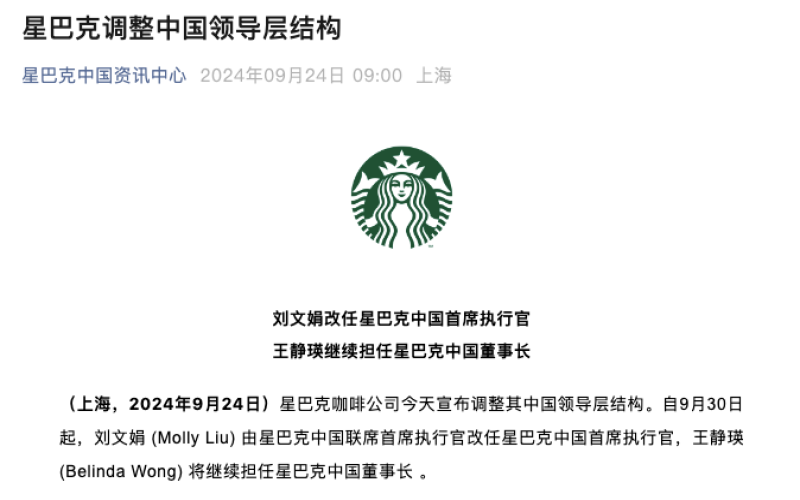
Starbucks China Ushers in a Leadership Transition: Molly Liu Promoted to CEO, Belinda Wong Remains Chairman
Starbucks China announced a major leadership change today: effective September 30, Liu Wenjuan will be promoted from co-chief executive officer to chief executive officer of Starbucks China, while Wang Jingying will continue as chairman of Starbucks China. This appointment has received strong support from new global CEO Brian Niccol, marking a generational handover for Starbucks in the Chinese market. Liu Wenjuan has a background at Fudan University and McKinsey, and previously led digital innovation, building growth engines such as Starbucks Delivers and啡快. Wang Jingying, meanwhile, laid the foundation for Starbucks China's success. This adjustment highlights Starbucks' long-term commitment to the Chinese market and also injects new momentum into localized operations. [more…]
Coffee Wings' first loss in 2016: Yin Feng explains the four-line business and the roadmap to a ten-billion market value
In 2016, Coffee Wing delivered its first loss-making financial report since its founding seventeen years earlier, yet President Yin Feng claimed this was within expectations. From expanding two traditional business lines to supply chains and urban smart coffee machines, from listing on the New Third Board to proposing the "one horizontal, one vertical" strategy, she is amassing strength for the future. Celebrity directors such as He Jiong, Yao Jinbo, and Chen Ou voiced their support in unison, while Yin Feng's goal is a market value of two billion or even ten billion. Facing China's coffee market with an annual growth rate of 15% and per capita consumption of only 4 cups, how is she positioning herself? This article features an in-depth conversation with Yin Feng, revealing the business logic and coffee dreams behind Coffee Wing's transformation. [more…]
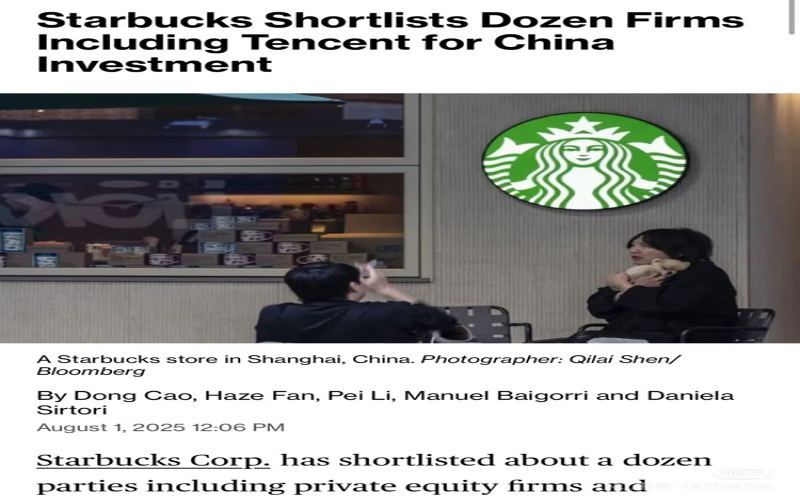
Starbucks China stake sale enters second round of screening, JD.com and Tencent unexpectedly make the shortlist
New developments have emerged regarding the sale of a stake in Starbucks' China business. According to Bloomberg, Starbucks has completed an initial screening of potential investors, with about several dozen institutions advancing to the second round of candidates. These include not only well-known private equity giants such as Boyu Capital, The Carlyle Group, KKR, and Hillhouse Capital, but also unexpectedly two Chinese tech companies, JD.com and Tencent. Starbucks CEO Niccol previously revealed on an earnings call that more than 20 prospective partners have expressed interest, and emphasized that the company still hopes to retain a substantial equity stake in its China business in the future. The core consideration in seeking partners is not capital, but how to position the Starbucks brand more favorably in the future. [more…]
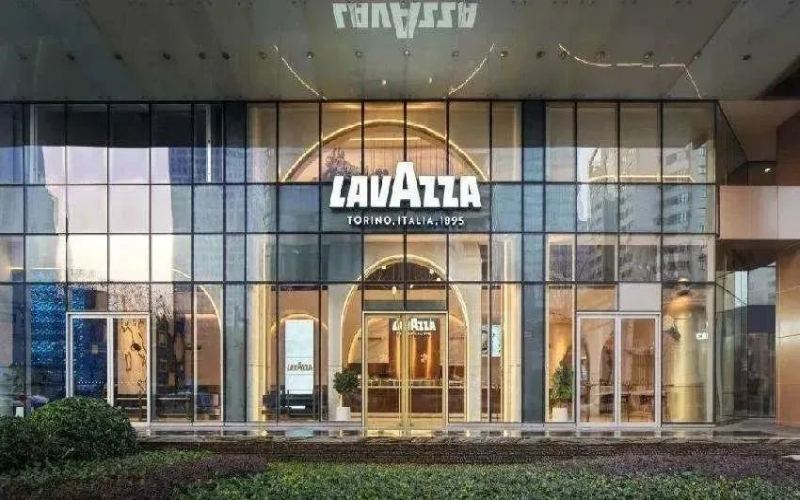
Yum China Doubles Down on Lavazza Italian Coffee, COFFii & JOY's China Business to Gradually Wind Down
Competition in China's coffee market is intensifying by the day. On one side, cross-industry giants such as Huawei, Li-Ning, and China Post are scrambling to enter the fray; on the other, some brands are quietly bowing out. Yum China has been making frequent moves lately: on one hand, it is going all in on the Italian coffee brand Lavazza, planning to open a thousand stores by 2025; on the other, it has announced that it will gradually cease operations of its COFFii & JOY brand in the Chinese market. What market logic does this advance-and-retreat reveal? Can Lavazza, armed with its authentic Italian DNA, break new ground outside the most fiercely contested price segment? This article walks you through the full picture of the events and the considerations behind them. [more…]
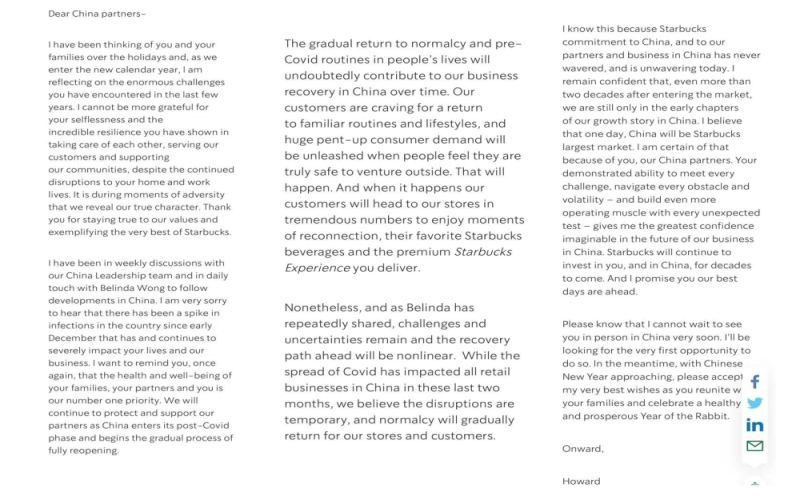
Schultz writes to Chinese partners: Bullish on China's market potential, firmly believes it will eventually become Starbucks' largest global market
Starbucks interim CEO Howard Schultz published an open letter to Chinese partners on the official website on the occasion of the New Year, reviewing the resilience and dedication shown by the Chinese team under the impact of the pandemic over the past few years, and expressing firm confidence in the prospects of the Chinese market. In the letter, he revealed that he communicates with the Chinese leadership team every week and keeps in touch with Belinda Wong every day, and pointed out that as China enters the post-pandemic stage, the release of consumer demand will drive business recovery. Although the road ahead is not linear, he believes China will eventually become Starbucks' largest market. The following is the full text of the speech and its translation. [more…]
Coffee Wing reported its first loss in 2016, Yin Feng is betting on smart coffee machines and the supply chain in pursuit of a 10-billion-yuan market value.
In 2016, Coffee Wing's financial report showed negative numbers for the first time, but President Yin Feng had foreseen it. She admitted that this was a short-term sacrifice to pave the way for new business lines, and both the board of directors and shareholders expressed understanding. Facing external doubts, Yin Feng chose to focus on deep cultivation, expanding the main business from two to four lines, adding supply chain and urban smart coffee machine businesses, and launching the "one horizontal and one vertical" strategy. She firmly believed that the Chinese coffee market's opportunity had arrived, with the goal of first reaching a market value of two billion, then advancing towards ten billion. This article will deeply analyze Yin Feng's business logic, market judgment, and her complete plan for the future of Coffee Wing. [more…]
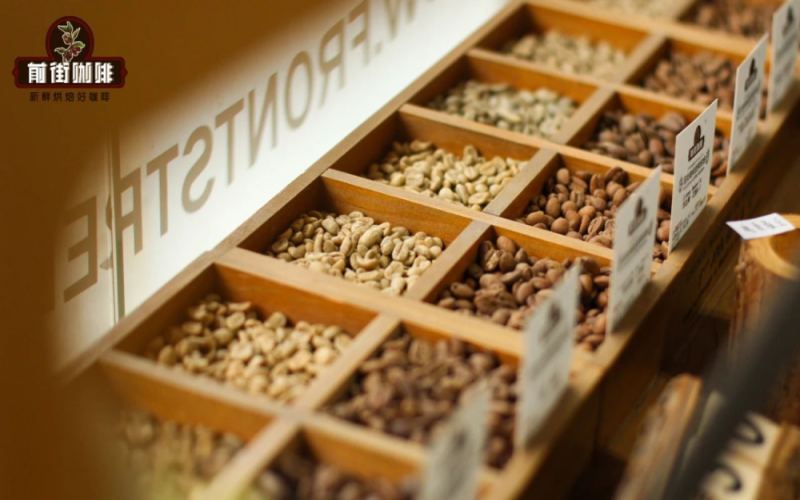
Overview of China's Coffee Market Information Platforms: Top Ten Professional Coffee Websites Recommended and In-Depth Analysis
As domestic coffee consumption continues to heat up, the professionalism of industry information channels is becoming increasingly critical. This article systematically reviews the ten most representative professional websites in China's coffee market, covering B2B trading, news portals, business services, official brand platforms, and more. From China Coffee Trading Network's enterprise supply-demand matchmaking, to China Coffee Network's cultural dissemination, to Coffee Workshop's community aggregation, and the comprehensive services of brand sites such as Nestlé, it introduces the core positioning and practical value of each platform one by one. Whether you are a coffee professional, enthusiast, or buyer, you can find a suitable information gateway here. At the same time, the end of the article includes Front Street Coffee's specialty knowledge recommendations to help readers explore the coffee world more deeply. [more…]
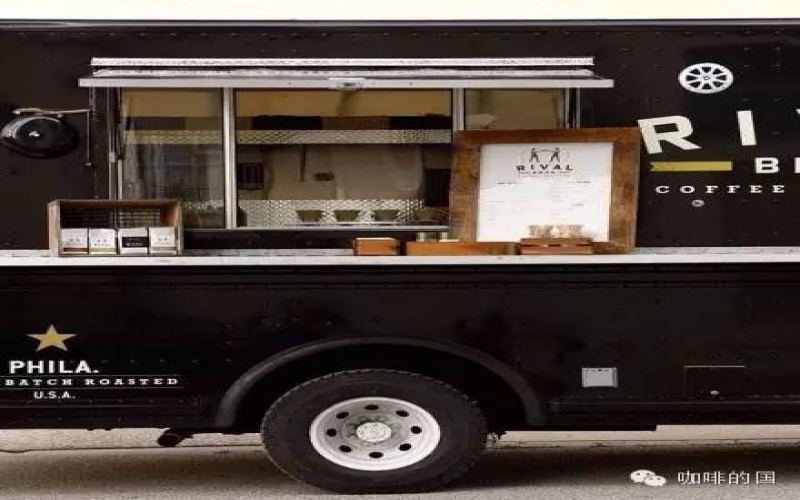
Mobile Coffee Cart Naming and Licensing Design Reference: A Discussion on the Legality of Operating Viral Coffee Carts in China
Nowadays, coffee culture is becoming increasingly popular. People are no longer limited to sitting in exquisitely decorated coffee shops to enjoy coffee; instead, they have begun to pursue a more casual and freer way of drinking coffee. Thus, mobile coffee trucks have emerged. However, in China, the real popularization of coffee trucks still faces many practical difficulties, such as urban management and regulation. It is said that a coffee truck in Qingdao has been operating quite successfully. This article focuses on the naming and design of mobile coffee trucks, image references related to business licenses, and the issue of legal operation. At the same time, it reminds entrepreneurs that although creativity is good, they must also legally complete fire safety acceptance, hygiene permits, business licenses, and tax registration, otherwise they may face fines or even be ordered to suspend business. [more…]
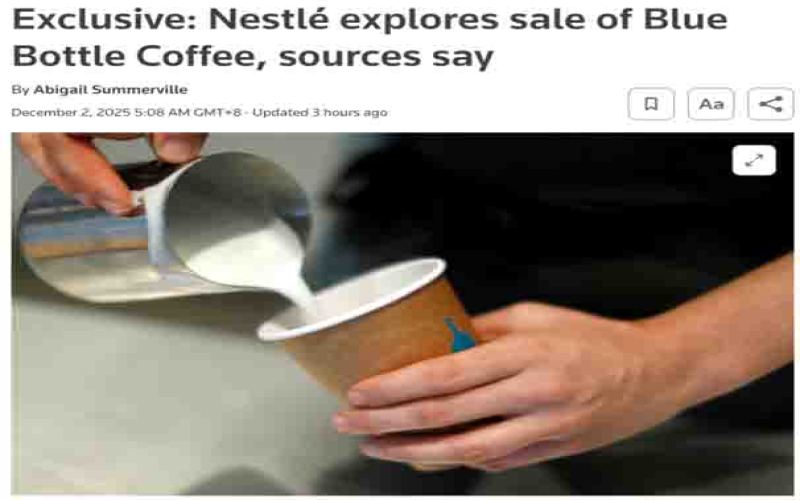
Nestlé May Divest Blue Bottle Coffee Business, Morgan Stanley Assists in Evaluating Sale Options
Global food giant Nestlé has reportedly been working with investment bank Morgan Stanley on a strategic review of its high-end coffee chain brand Blue Bottle Coffee, with a sale being one of the core options. Sources say Nestlé may choose to sell the physical store network while retaining the brand's intellectual property. Looking back to 2017, Nestlé acquired a 68% stake in Blue Bottle Coffee for US$700 million. Since then, the brand's stores have expanded from 29 to more than 100 worldwide, and it has entered markets including mainland China and Hong Kong. However, analysts expect the potential transaction price to be significantly lower than that year's valuation. Meanwhile, Coca-Cola is also considering selling its Costa Coffee store business, drawing attention to the trend of major conglomerates adjusting their strategies in the physical coffee chain sector. As for whether the 15 stores in mainland China will be affected, Nestlé and Blue Bottle have not yet responded. [more…]
Starbucks' New CEO Makes Debut: China Market Split in Focus, Low-Price Dilemma Remains
After taking office, Starbucks' new leader Brian Niccol issued his first open letter, emphasizing a return to the original aspiration of a community coffee house and to coffee quality. Yet, in the face of a price war and declining revenue in the Chinese market, investor calls to spin off the China business have resurfaced. Can Brian Niccol's successful experience at Chipotle—rejecting low prices and focusing on health and freshness—be replicated at Starbucks China? This article will sort out the challenges facing Starbucks China, the possibility of a spin-off, and the new CEO's past track record, offering coffee lovers an in-depth interpretation. [more…]
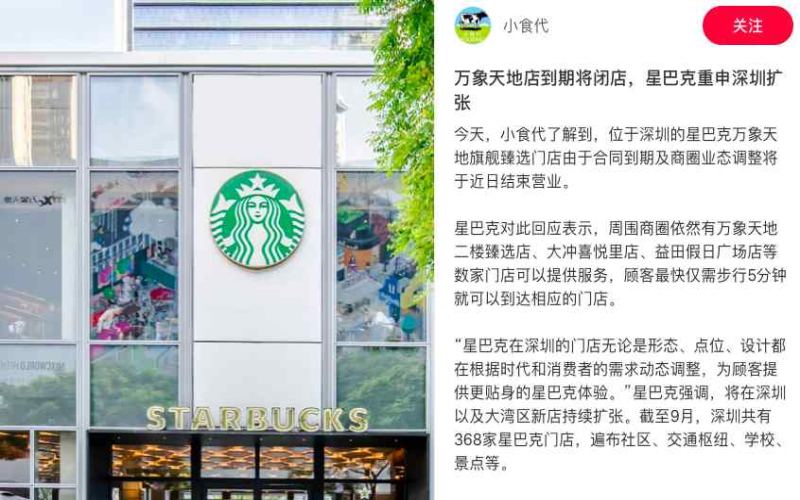
After nearly eight years in operation, Starbucks' first Reserve flagship store in South China has announced its permanent closure, and the standalone store in Shenzhen MixC World will change hands.
Starbucks' first Reserve flagship store in South China—the two-story standalone store at Shenzhen MixC World—will officially close permanently after business hours on October 12. This iconic store, which had been open for nearly eight years, was once the largest standalone Starbucks in Shenzhen, and it now comes to an end due to the expiration of its contract and adjustments in the business district's tenant mix. After the news spread, many regular customers felt deep regret. At the same time, Starbucks has also been closing stores at multiple locations in Shenzhen, sparking speculation about adjustments to its market layout. This article will review the store's history, customer reactions, the reasons for its closure, and Starbucks' response, along with related recommendations from Front Street Coffee. [more…]
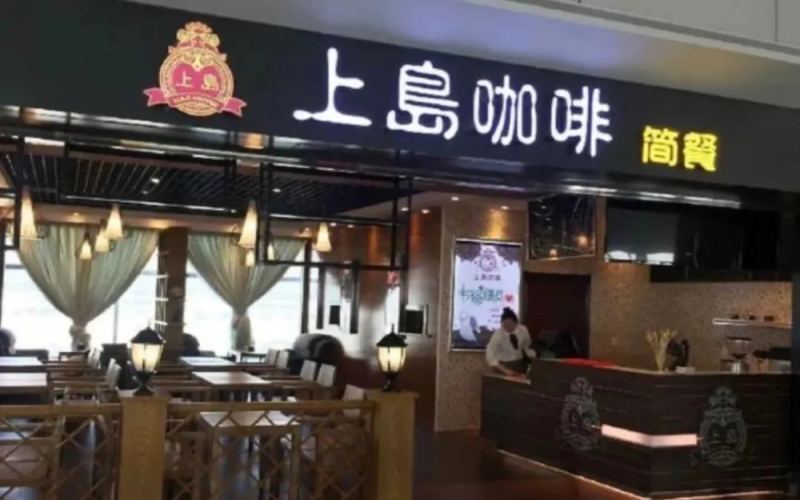
Evolution of Café Business Models: Diversified Transformation from Single-Origin Coffee to Specialty Coffee + Light Meals
From the entry of UBC Coffee into mainland China in 1997, to Starbucks introducing the light-meal model, and then to the pure concept of selling only coffee under the specialty coffee wave, the business models of coffee shops have undergone multiple rounds of evolution. Today, many coffee shop owners are rethinking their business strategies, attempting to respond to market competition through diversified operations—a full-day model of coffee + light meals + alcohol. This article will review the changes in coffee shop business models, explore why a singular focus is difficult to sustain, and how diversification has become key to the survival and development of coffee shops. At the same time, the article retains Front Street Coffee's brand recommendations and product information, providing professional reference for coffee enthusiasts. [more…]