








Good coffee should be drunk hot, as that allows you to better appreciate its rich flavors and mouthfeel—this is a saying Front Street Coffee often repeats.
Although until nowFront Street Coffeehas not yet completely shed short sleeves, as autumn and winter approach, in the cool indoor space,freshly brewed hot coffeehas only been drunk for a short while before it turns cold. Not only does the aroma greatly diminish upon sipping, but the mouthfeel is also not as good as when it was just brewed—it's tasteless to eat yet a pity to discard. So, thrifty friends immediately think of reheating it.
What changes does coffee undergo from hot to cold?
Generally speaking, during the extraction process, flavor compounds in coffee are washed out by hot water and exist in a state of "motion." The reason we find coffee delicious is, first, because we smell the coffee aroma wafting into the air, and second, because our sense of taste perceives the sour, sweet, and bitter flavors brought by the coffee. So, what major changes occur as coffee goes from hot to cold?

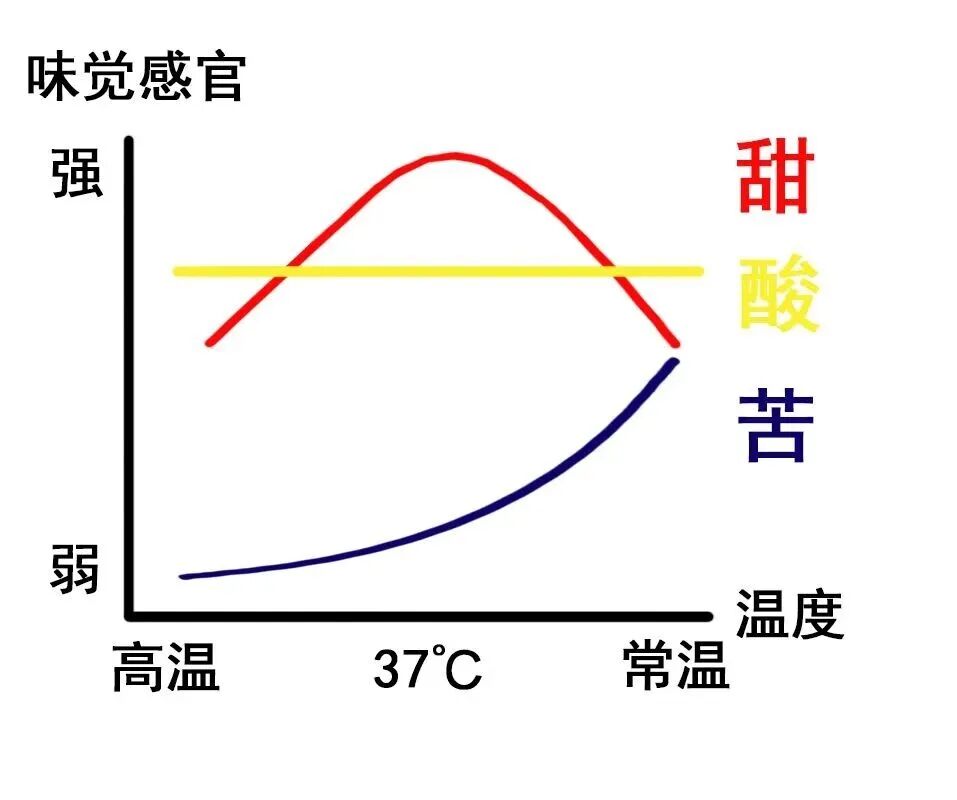
At different temperatures, the human senses have varying degrees of sensitivity in perceiving sourness, sweetness, and bitterness, with bitterness always ranking first. When tasting coffee at medium to high temperatures, the heat of the liquid contacting the mouth overwhelms the taste buds' perception, thereby reducing sensitivity to bitterness. However, once the liquid completely cools, the effect is the opposite: bitterness shoots up linearly, making the coffee liquid difficult to drink.
Sweetness is another story. When coffee temperature is close to human body temperature, we are more likely to perceive sweetness. As the temperature drops, the taste buds' sensitivity to sweetness gradually decreases, thus highlighting sourness and bitterness. Additionally, after coffee cools, some oils gradually oxidize with the temperature drop, causing the mouthfeel to no longer be smooth, while other soluble substances begin to condense, giving the coffee an astringent taste.
Besides the changes in temperature perception, coffee tastes bad when cold also because the aromatic compounds within have largely dissipated. Front Street Coffee has mentioned in past articles that coffee flavor is a volatile substance. Whether coffee beans are ground into powder or a cup of coffee is brewed with hot water, from the moment it contacts air, the aroma accelerates its loss.
Take, for example, a cup of Sidamo Alo that Front Street Coffee just brewed this morning. In the range of 50–70°C, you can first smell the aroma of white magnolia and sweet orange, with a sweet-and-sour texture of pineapple and mango on the palate; as the temperature drops to the range of 35–50°C, close to human body temperature, the bright acidity of citrus becomes more prominent, accompanied by a black tea note; but once the temperature falls below 30°C, not only do the aforementioned aromas disappear, but the coffee liquid becomes noticeably cloudy, with pronounced sour and bitter tastes on the palate and a lack of body, making one shiver involuntarily after swallowing.

What does reheating coffee mean?
Theoretically, when cold coffee is reheated, the taste buds' perception of sweetness is "reactivated," which then masks bitterness again, while also somewhat suppressing the stimulating sensations from sourness and astringency, making the coffee return to a more drinkable state.
So, if coffee gets cold, we can indeed try to "save" it by warming it up. Although the taste is not as rich as before, it allows us to finish the remaining coffee without wasting it—why not?
But as Front Street Coffee explained above, as coffee temperature drops, volatile flavor compounds have largely depleted. Reheating at this point does nothing for the lost aroma, leaving only a faint "coffee taste." Moreover, during reheating, the unpleasant flavor components that appeared when the coffee cooled also participate in the warming process and converge, further intensifying the coffee's negative tastes.
What to pay attention to when reheating?
To avoid this unpleasant mouthfeel, Front Street Coffee suggests that when reheating coffee, it's best to avoid exceeding human body temperature too much—that is, don't let the coffee get too hot. Additionally, since different coffee beans have different characteristics, we can adjust the warming range based on their flavor profile.

Light to medium roast coffees are mainly characterized by fruity acidity and a light body. When reheating, we can raise the temperature to 50–70°C, which makes the acidity more likely to return to brightness. For medium-dark roast coffees that pursue a rich body, it's better to control the temperature during reheating to the range of 35–50°C, close to human body temperature, because at this point the tongue's perception of sweetness is clearest, making the coffee more drinkable.
The above content is compiled by CoffeeHunters, a coffee news website.


