







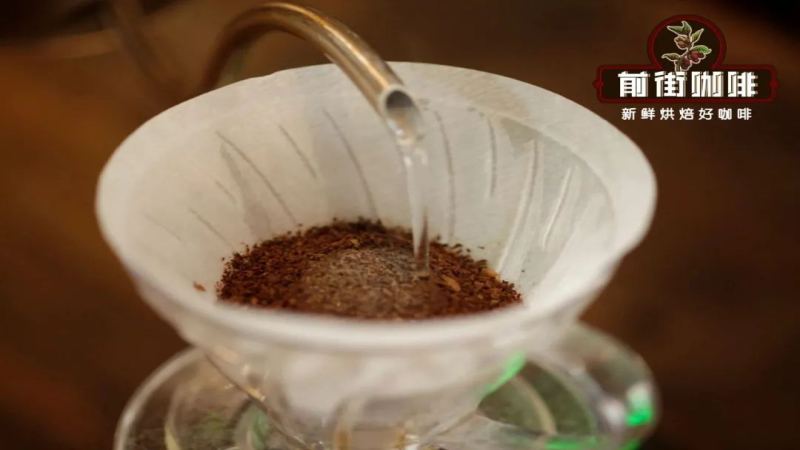
In freshly roasted and brewed coffee, there is a crucial small detail: baristas emphasize the need for "blooming." There is even a saying in the coffee community, "Bloom well, brew without worries," forming a positive connection between blooming and brewing.
So what is blooming, and how do you do it? Attentive folks will also notice that opinions on blooming time vary online, so how long should blooming actually take? Front Street Coffee will clarify these details for everyone in this article.
What is blooming?
The so-called blooming involves pouring a small amount of water to let the coffee grounds release gases, allowing more flavor compounds to be extracted during the main pour. However, evenly wetting the coffee bed with water is not actually a simple task. Therefore, scientific pouring is very important.
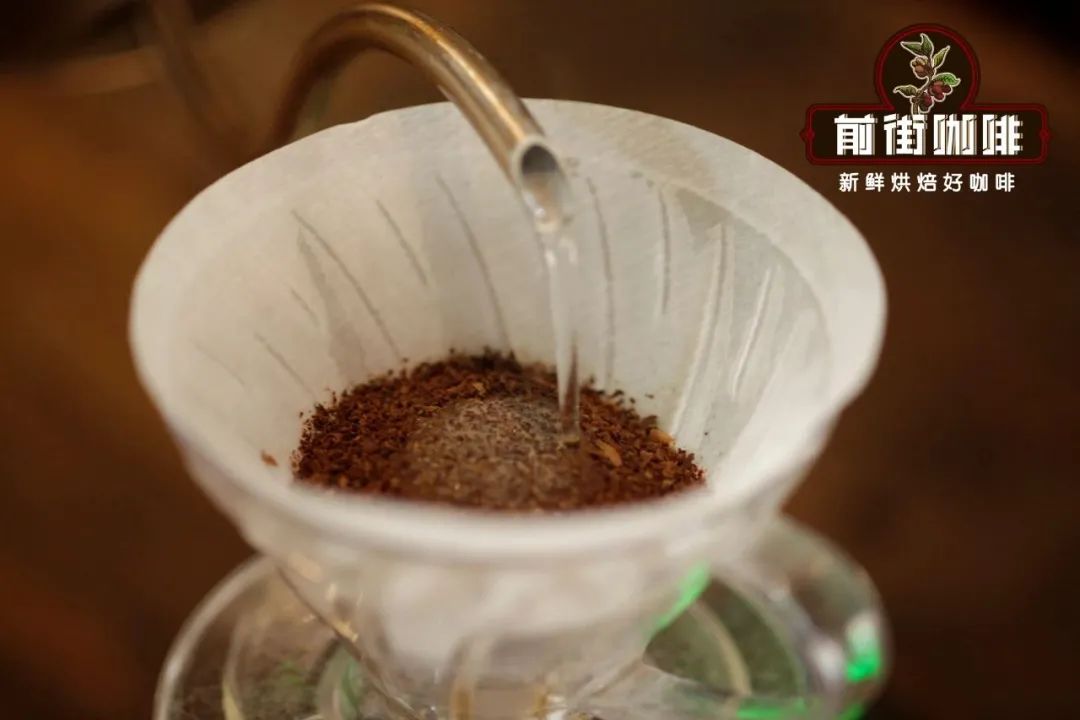
Below, Front Street Coffee lists some commonly used blooming pour techniques, briefly explains their pros and cons, and everyone can find a suitable pouring method based on actual conditions.
Common blooming pour methods
1. Quickly pour in small circles around the center.
Ideally, pour a small stream of water quickly in small circles around the center point, looking like "spreading water over the surface of the coffee grounds." The wetted coffee bed will slowly expand outward, achieving an overall blooming effect.
This pouring method is suitable when the coffee beans are finely ground, relatively fresh, and contain a lot of gas, so the water can spread more easily. It also demands high pouring precision; if the pour is not standardized, water can easily spread in one direction, leading to uneven blooming across the coffee bed.
2. Pour in circles from the center outward.
This is a very common blooming pour method: slowly pour in circles from the center outward until all the surface coffee grounds are wet.
This pouring method can be applied to various coffee beans and is a very simple approach. But it has drawbacks: because the commonly used conical drippers have the thickest coffee bed in the middle and the thinnest around the edges, some water can easily flow through the dripper's ribs into the server.
3. Pour in circles from the edges toward the center.
Similar to the above method, but in the opposite direction: first pour in circles from the outside inward. This method compensates for the shortcomings of the previous one, but it is not suitable for very fresh or dark-roasted coffee beans, as it affects degassing and makes it harder for the coffee grounds in the middle to release gas.
4. Dig a small hole in the middle and pour in circles around the hole to bloom.
This method is suitable for freshly dark-roasted coffee beans. These beans have a fluffy texture and expand greatly during blooming. Digging a small hole and pouring water in the middle reduces the thickness of the central coffee bed on one hand and controls the expansion effect on the other.
So how do you judge the state of the coffee bloom?
Many times we make blooming sound very formulaic, such as using twice the water weight of the coffee grounds and blooming for 30 seconds. For beginners, this formulaic brewing is undoubtedly the best short-term approach. But we all know the purpose of blooming is to release gases from the coffee grounds.

The texture of the coffee beans, the roast level, and the freshness all affect the gas content in the coffee. In other words, such formulaic blooming is not the best method.
So to understand blooming, you need to learn to observe. When brewing overly fresh coffee beans, you will see bubbles emerging from the dome. This is because there is too much gas inside, so much that it bursts the dome and releases a large amount of gas. Well-rested coffee beans do not show this situation.
Softer coffee beans expand more, and accordingly, the blooming time should be shortened. Harder coffee beans expand less, and it takes longer for water to reach the center of the coffee particles, so the blooming time can be appropriately extended.
So how do you judge whether blooming is complete? Here is a very simple observational standard: whether all the coffee grounds are wet and the coffee dome has expanded and become still (no more degassing) means blooming is finished and you can continue pouring. This time is not necessarily30seconds; it could be25seconds, or it could be35seconds.
The above content is compiled by CoffeeHunters, a coffee news website.


