





How is pour-over coffee extraction yield worked out?
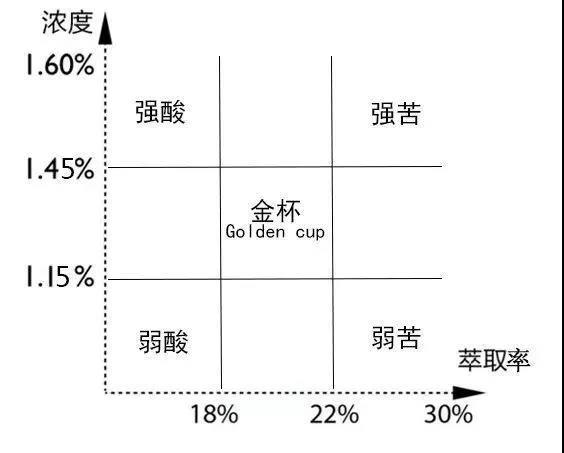
Extraction yield is the share of the coffee grounds' mass that ends up dissolved in the cup. The Specialty Coffee Association of America, the SCAA, sets the golden cup range at 18 to 22 percent, which corresponds to a TDS concentration of roughly 1.15 to 1.35 percent. To land in that window, the ratio of coffee grounds to poured water should stay between 1:12 and 1:15.
The theory traces back to Dr. Lockhart's scientific experiments in the 1950s, which quantified coffee flavor and laid the foundation for the golden cup standard. In practice, a concentration meter reads TDS and a simple formula converts that reading into extraction yield. A staged pour-over using Panama Elida Estate beans shows how parameter settings, pouring rhythm, and the calculation process fit together.
How exactly should the extraction yield and concentration of pour-over coffee be calculated? The golden cup extraction yield range defined by the SCAA is 18% to 22%, corresponding to a TDS concentration of about 1.15% to 1.35%, while the coffee-to-water ratio falls within the range of 1:12 to 1:15. This theory originated from Dr. Lockhart's scientific experiments in the 1950s, in which he quantified coffee flavor and laid the foundation for the golden cup standard. Starting from Front Street Coffee's daily brewing, this article explains the definitions of extraction yield and concentration, the conversion formulas, and how to use a concentration meter, and uses beans from Panama's Elida Estate as an example to fully demonstrate the parameter settings, pouring rhythm, and extraction yield calculation process of a staged pour-over, helping coffee enthusiasts understand the practical application and reference value of the golden cup theory.
For more specialty coffee knowledge sharing, please follow the WeChat official account: Front Street Coffee (FrontStreet Coffee)
What exactly is coffee extraction yield, and how should it be calculated? Baristas at Front Street Coffee (FrontStreet Coffee) often receive this kind of question. Quite a few friends have also mentioned that when they brew the same bean as a Front Street Coffee barista, the final result is vastly different. Why is that? Next, Front Street will talk about the definition of coffee extraction yield, the calculation method, and the techniques Front Street uses when extracting coffee.
What is coffee extraction yield?
The range set by the SCAA, the Specialty Coffee Association of America, for golden cup extraction yield is 18-22%, meaning that from 10g of coffee grounds, about 1.8-2.2g of substances can be extracted; the TDS concentration of drip coffee roughly falls between 1.15%-1.35%, meaning that the 18-22% of extracted coffee substances account for 1.15%-1.35% of the entire cup of coffee. Front Street Coffee (FrontStreet Coffee) suggests that you might as well verify with a calculator: if you want to control the concentration within this range, the ratio of coffee grounds to poured water should be maintained between 1:12 and 1:15.
Front Street Coffee (FrontStreet Coffee) sets its brewing parameters precisely according to this range. Whenever a new bean is launched, it goes through repeated adjustments in roasting, cupping, pour-over, and other stages, among which the adjustment basis for the pour-over stage is TDS concentration. Of course, if you are just drinking coffee at home daily, there is no need to specially buy professional instruments; judging strength by taste alone is sufficient.
The origin of golden cup extraction yield
The concentration and extraction yield of coffee are two independent concepts, but many baristas still confuse the two and cannot tell which is which. They are like a pair of twin brothers, each independent yet inseparable; once this is clarified, understanding becomes much simpler.
After the end of World War II, the National Coffee Association hired Dr. Ernest Eral Lockhart (1912-2006), a chemistry PhD from MIT, in 1952 to establish the Coffee Brewing Institute (1952-1964), responsible for scientific research, promotion, and publication affairs related to filter coffee, and to assist Central and South American coffee-producing countries in selling coffee to the United States.
The team led by Dr. Lockhart conducted a detailed analysis of the structure and components of coffee beans and found that the water-soluble flavor substances that can be extracted from roasted coffee beans account for only 28%-30% of the weight of the roasted beans, while the remaining 70% is insoluble fibrous material. In other words, extractable substances account for only about thirty percent of the weight of roasted coffee beans. Dr. Lockhart was the first scientist in history to transform the abstract flavor of coffee into quantitative data.
From 1952 to 1960, the National Coffee Association specially established the Brewing Committee to assist Dr. Lockhart in random sampling among the American public and to compile trends in public preference for coffee strength along with scientific data. Dr. Lockhart used an electric drip coffee machine to brew medium-roasted coffee from the same origin, invited the public to taste coffee with different extraction yields and different concentrations, and fill out questionnaires indicating what they thought tasted best and worst, after which researchers summarized from nearly ten thousand surveys the coffee extraction yield and strength preferred by the American public.
How do you use a concentration meter to measure concentration? First, calibrate the concentration tester, using pure water zeroing as the standard, then stir the pour-over coffee that has already been extracted, extract the coffee liquid with a titration tube, drip it into the coffee concentration tester, press the measurement key, and repeat the measurement multiple times until the value stabilizes. Here Front Street lists a formula for calculating coffee extraction yield
Extraction yield (%) =
Weight of extracted dissolved substances (grams) / Weight of coffee grounds (grams)
According to the definition of concentration, concentration equals the ratio of the weight of extracted substances to the coffee liquid, while extraction yield equals the ratio of the weight of extracted substances to the weight of coffee beans. From this conversion, it can be obtained that extraction yield equals concentration multiplied by the weight of the coffee liquid, then divided by the weight of the coffee beans.
Front Street assumes here that the water absorption rate of coffee grounds is 1:2, so the coffee liquid volume is roughly estimated as 225-(15×2)=195 grams. Now Front Street is brewing Elida from Panama, to see how Front Street Coffee (FrontStreet Coffee) brews a coffee and calculates whether the coffee extraction yield of this brew meets the standard. First, before brewing a good cup of coffee, there are many, many influencing factors. What we can do is use professional skills to extract all the good flavors of this cup of coffee at that moment. In a cup of coffee, green beans account for 60%, the roaster for 30%, and the barista's brewing for 10%. It is impossible for the barista's brewing to raise that share to 20%, but as long as they avoid losing points and present a complete cup of coffee to the guest, that is already enough.
Front Street Panama Elida Estate
Region: Boquete, Panama
Estate: Elida Estate
Altitude: 1,850 meters
Variety: Typica
Processing method: Natural
Front Street Coffee (FrontStreet Coffee) brewing parameters:
Water temperature: 90-91°C
Grind size: EK43s grinder setting 10 (caster sugar size)
Coffee-to-water ratio: 1:15
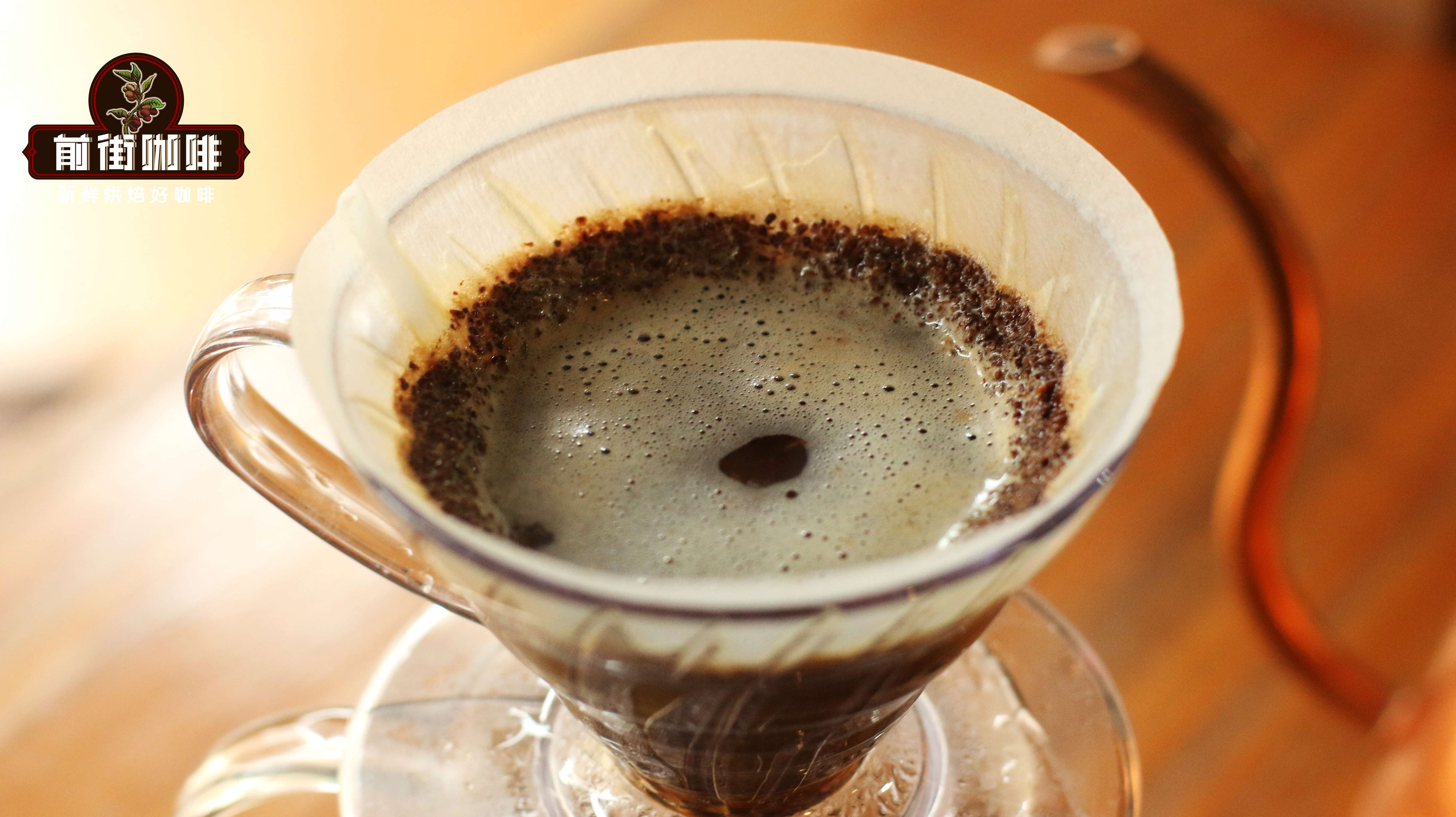
Front Street adopted staged extraction: press the timer, use twice the amount of water as the coffee dose for the first stage, that is, pour 30 ml in a circular motion onto the coffee bed so that the entire coffee bed is fully wetted, and let it bloom until 30 seconds; for the second stage, keep a small stream of water and slowly pour in a circular motion up to 125g, with pouring taking about 1 minute; then, when the liquid has dropped to 2/3 of the coffee bed, begin the third stage, pouring slowly in a circular motion with a small stream up to 225 ml, stopping pouring at about 1 minute 45 seconds-1 minute 50 seconds, with a total extraction time of 2 minutes.
Then calibrate the concentration meter well, shake the coffee liquid in the server, use a dropper to take coffee liquid from the server and drip it onto the concentration meter; at this point the concentration meter shows a coffee concentration of 1.34%.
Then the extraction yield is 17.42%. So this cup of pour-over Elida coffee has a concentration of 1.34% and an extraction yield of 17.42%. Although this brew of Panama Elida by Front Street was slightly insufficient, it did not affect the expression of the coffee's flavor. The wet aroma of this Panama Elida had peach, the fermented note of raisins, and orange; after slowly cooling, sucrose and melon sweetness emerged, with the tail section carrying flavors of grapefruit and green tea.
Front Street believes that golden cup extraction has an indicative symbolic significance for the coffee industry. This is because golden cup extraction scientifically standardized coffee extraction theory and became a globally applicable template. Front Street's current coffee experiments and outputs are all conducted based on golden cup theory, but this is only a reference and does not mean it is completely correct. Front Street believes that if the coffee you brew, even if extracted into the golden cup range, still does not have an appealing taste and flavor, there is no need to rigidly adhere to theory; as long as guests at Front Street can drink the coffee they like, that is enough.
The above content is compiled by CoffeeHunters, a coffee news website.


