







Why does an Americano taste sour instead of bitter?
An Americano tastes sour mainly for two reasons: too light a roast and insufficient extraction. The drink itself is simply espresso mixed with water, so the sourness comes from underextracted acids rather than the recipe. Adjusting grind finer, raising water temperature, or extending the shot time pulls more sweetness and body into the cup and balances the acidity.
Preparation order also matters. An Americano is espresso first, then water, while an Australian Long Black pours water first and espresso over it, which preserves more crema. The article also covers Lungo extraction and recommends blends such as Black Cocoa, Commercial Blend, and Classic Italian for stable flavor in daily brewing. A longer ratio of water to espresso keeps the drink from turning thin or harsh.
Americano is a classic coffee beverage enjoyed worldwide. Its preparation seems simple—just add water to espresso—but many people find that their homemade Americano tastes too sour and lacks a full-bodied flavor. From the perspective of Front Street Coffee, this article systematically sorts out the real differences between Americano and Australian Long Black in terms of preparation order and water ratio, and further introduces the extraction characteristics of Lungo coffee. At the same time, it gives specific adjustment suggestions for the two main causes of Americano being too sour—too light a roast and insufficient extraction. The article also recommends Front Street Black Cocoa Blend, Front Street Commercial Blend, and Front Street Classic Italian Blend, among other coffee beans suitable for making Americano and latte, helping coffee lovers achieve more stable flavor performance in daily brewing.
For more specialty coffee knowledge, please follow: Front Street Coffee (Frontsteet Coffee)
Americano can be said to be one of the most globally recognized coffee beverages, and its recipe is very simple: nothing more than mixing espresso with an appropriate amount of water.
In Australia, there is also a locally distinctive coffee called "Long Black" (translated into Chinese as 长黑). It is likewise made of espresso and water. As Australian-style Flat White became popular in China, some cafés took the opportunity to introduce Australia's entire Italian-style coffee line into their existing espresso menus. Therefore, for a period of time, Americano and Long Black appeared on the menus of many cafés at the same time.
Front Street first briefly introduces what kind of drink Long Black actually is. In Australia, black coffee is usually called Black Coffee, while coffee with milk is called White Coffee. Locals call Espresso Short Black, and after adding an appropriate amount of water to Short Black, it becomes Long Black, which is mostly translated in China as 长黑 or 澳黑.
Although Americano and Long Black are both made of water and espresso, Australian coffee culture has always emphasized individuality, so differences between the two are inevitable. Front Street has noticed a widely circulated saying online: the difference between the two lies in the preparation order—for Americano, espresso is placed first and then diluted with water; for Long Black, water is added to the cup first, and then espresso is poured in.
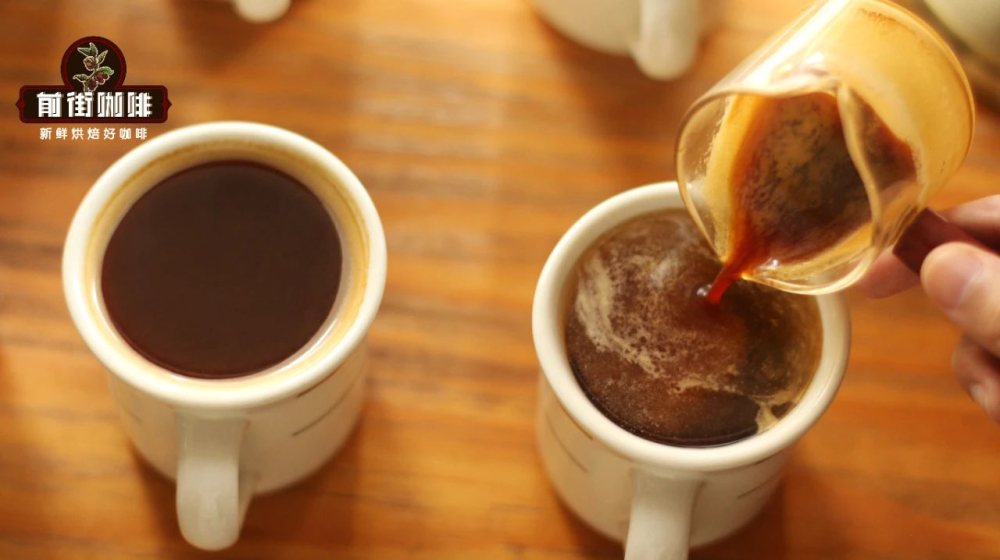
What is the basis for this claim? It turns out that the most obvious difference between the two methods lies in the retention of Crema (coffee crema). If espresso is placed first and then water is poured in, the Crema will be broken up by the water flow; if water is added first and then espresso is poured in, the Crema can float intact on the surface of the liquid. This layer of Crema can give the coffee a fuller mouthfeel.
It sounds very convincing, but this is actually not the essential difference between Americano and Long Black. This is because the preparation standards for Americano do not specify whether water or coffee should be poured first; either order is acceptable. Long Black, however, does have particular requirements regarding the order of water and coffee—water is first poured into the cup, and then espresso is extracted into the water. Front Street speculates that it was precisely in order to identify the distinction between the two that this rumor of distinguishing them by pouring order emerged.
The most obvious difference between Americano and Long Black is actually the amount of water added. Americano usually has more water mixed in, with a coffee-to-water ratio generally between 1:5 and 1:8. This is because Americans are accustomed to drinking drip coffee, which is very weak—just a hint of coffee flavor is enough. So after espresso became popular, Americano made with espresso as the base also needed a large amount of water to recreate that light coffee taste.
Australians pursue a higher standard of coffee flavor. Front Street has previously shared that the difference in taste between Flat White and latte is that Flat White has a richer and more intense coffee flavor. Compared with Americano, Long Black also has a stronger coffee flavor and a smaller cup size. A common way to make Long Black is to extract two shots of espresso (40g) into a cup containing 100-120ml of water, keeping a rich layer of Crema on the surface.

Diluting the concentration of espresso with a 1:3 water ratio can, on the one hand, reduce the sharpness of the espresso, and on the other hand, the diluted coffee flavor is easier to perceive, while the oils retained on the surface allow the coffee to maintain a full-bodied mouthfeel, bringing a uniquely different experience.
In recent years, LUNGO has also accumulated a group of loyal fans in the market. LUNGO coffee is made by extending the extraction time of Espresso to about one minute, yielding about 50~60 milliliters of coffee liquid; this beverage is called "lungo coffee." Some baristas also extract it directly to a full cup, such as 200ml.
"Lungo" means "long, extended" in Italian, and it is clearly defined as a stretched version of espresso. In fact, discussing the flavor of espresso is something that only emerged in recent years. In the past, coffee beans were generally roasted extremely dark, and trying to find flavor in them was like looking for vivid colors in black. A good espresso lies in the satisfaction of its mouthfeel, the stimulation of its strength, no lingering bitterness after drinking, and a burnt aroma left in the mouth—that is all.
There is no precise data to follow for making Lungo (the Espresso parameters at every café differ slightly). Abroad, there is also no clear ratio definition for Lungo; it is merely a term representing an extended extraction of espresso. As for how much to extend it, cafés also have differing views. When Front Street makes Lungo coffee, it uses 20 grams of coffee powder, for example extracting 100 grams of coffee liquid in 56-60 seconds, twice as long as espresso (ratio 1:5).
Many people feel that their Americano is too sour, usually for two main reasons: first, the coffee beans are roasted too light, causing too many sour substances to be released. In this case, you can buy the espresso moka pot coffee beans recommended by many baristas at Front Street—Front Street Black Cocoa Blend and Front Street Commercial Blend; second, because the time is insufficient, the contact time between coffee powder and hot water is too short, resulting in insufficient extraction, which also produces sourness. At this time, you can increase the dose or make the grind finer.
Finally, Front Street Coffee needs to remind everyone that whether making Americano, Lungo, or Long Black, the final taste depends on the coffee beans used. For friends who like mellow coffee, Front Street Classic Italian Blend is recommended. This is a recipe composed of beans from three origins: Brazil, Indonesia, and Vietnam. It uses a deep roast, which maximizes the coffee's mellow aroma and also allows everyone to easily extract rich and dense coffee crema. It is very suitable whether making an Americano diluted with water or a latte paired with milk, and can be purchased and ordered at the Front Street Taobao store or the Front Street Tmall flagship store.
The above content is compiled by CoffeeHunters, a coffee news website.


