





How to Make Coffee from a Coffee Machine: Extraction, Stirring and Tasting
Espresso is a concentrated shot served small and often bitter to newcomers. An ideal shot balances acidity, sweetness and bitterness, carries a distinct character and full body, and leaves sweetness in the throat rather than lingering bitterness, so the way it is extracted matters as much as the way it is drunk.
Learning how to make coffee from a coffee machine starts with controllable variables: dose, grind size, extraction time and yield. Modern espresso machines made these easier to adjust, and tasting practice with a small spoon and a glass of ice water helps separate sweetness from harsh bitterness between sips.
Espresso has always been polarizing: those who love it are captivated by its rich flavor, while those who aren't used to it find it small and bitter. Front Street Coffee is often asked: what exactly are you drinking in this small cup of coffee? This article starts with the historical evolution of espresso, explains how modern espresso machines make extraction more controllable, and then further shares Front Street's specific practices in daily production for adjusting dose, grind size, time, and yield, as well as the tasting logic behind pairing it with a small spoon and ice water. Whether you want to seriously savor a shot of espresso or find a way of drinking it that suits you better, you can find answers here.
When espresso is mentioned, opinions often split into two camps: some are deeply enamored with it, while others keep their distance. Many people new to coffee walk into a café for the first time, see a relatively friendly price next to espresso on the menu, and excitedly order one, only to discover when it arrives that the portion is shockingly small and the first sip is so strong and bitter that every mouthful feels like forcing themselves through it. Front Street Coffee (FrontStreet Coffee) often receives similar questions: what exactly is espresso supposed to be about?
Watching a barista go through a series of movements at the bar, a cup of espresso with rich crema and an inviting aroma is soon ready. In the eyes of many beginners, this seems like coffee anyone could make. But Front Street Coffee (FrontStreet Coffee)'s years of experience show that the more simple an action appears, the more it depends on rigorous principles behind it; it tests not only the barista's technique, but also their understanding of and passion for coffee.
As the base of all espresso drinks, espresso practically supports half the coffee world. An ideal shot of espresso should achieve a balance among acidity, sweetness, and bitterness, while also having a distinct character and a full body; after swallowing, it should leave sweetness in the throat rather than bitterness, with a long finish.
Interestingly, if we go back to the early twentieth century, when commercial espresso machines had just appeared, it was difficult at the time to meet the basic conditions that today's espresso requires. Limited by the technical level of that era, extraction pressure could not reach above 9 bar, and water temperature and time were hard to control precisely, so the flavor and mouthfeel were naturally far from today's espresso.
With technological progress, espresso in the modern sense gradually took shape with the appearance of the Faema E61. More controllable factors greatly improved the quality of a shot of espresso. With the machine's support, what remains is a test of the barista's knowledge and skill.
Some people prefer to strictly lock down every variable, while others rely more on observing the state during extraction. Front Street Coffee (FrontStreet Coffee) has encountered friends asking for help: they stopped extraction when they saw the flowing coffee liquid turn golden, but the result tasted too thin.
The steps for making espresso look simple, but in fact they contain many principles. For example, extraction pressure that is too high will damage too much coffee structure and bring out more bitter substances; another example is that in the early and middle stages of extraction, sour and sweet substances are more easily released, and so on.
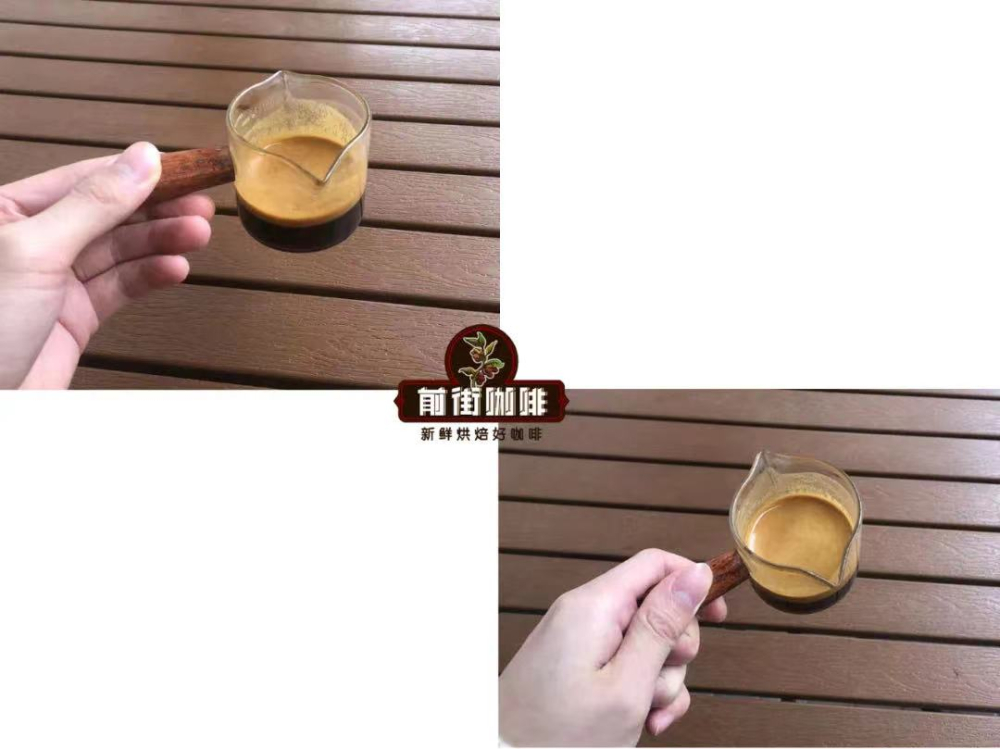
To ensure consistent output and keep the taste of every cup from varying too much, Front Street Coffee (FrontStreet Coffee) prefers to adjust various parameters and find a stable combination suitable for use that day.
When Front Street Coffee (FrontStreet Coffee) opens for business every day, it adjusts the espresso brewing parameters according to that day's temperature and humidity. Ambient temperature and humidity are uncontrollable factors, while the espresso beans used by Front Street Coffee (FrontStreet Coffee) have an extraction temperature set at 94 degrees Celsius. The remaining controllable parameters include: dose, grind level, time, extraction pressure, and extracted liquid weight.
After adjustment, Front Street Coffee (FrontStreet Coffee) uses the Galileo Q18 espresso grinder at grind setting 1.5 to grind 19.7 grams of coffee powder, brews with a Lelit Bianca V3 espresso machine, and takes 30 to 32 seconds to extract 38 to 40 grams of espresso liquid.
The espresso extracted by Front Street Coffee (FrontStreet Coffee) using the above parameters has rich chocolate, caramel, and cream flavors, with an obvious roasted nut aroma, while the dark chocolate finish is very long-lasting.
This is because Front Street Classic Espresso Blend is used. This is a recipe combining three origins: Brazil, Indonesia, and Vietnam. It uses a dark roast, which can maximize the coffee's rich aroma and also allow everyone to easily extract abundant, dense crema. Whether making an Americano diluted with water or a latte paired with milk, it is very suitable. It can be purchased and ordered at the Front Street Taobao store or the Front Street Tmall flagship store.
Even though espresso has a concentrated flavor, not everyone can accept it. But as the base of espresso drinks, there will still be people who want to see what it is all about. Different coffees have different ways of drinking, some like to add sugar, and some like to pair it with ice water. When Front Street Coffee (FrontStreet Coffee) serves espresso, it generally pairs it with a small spoon and a glass of ice water.
The purpose of the small spoon is to stir the coffee so that the fine coffee grounds originally settled at the bottom of the cup are distributed more evenly, making the mouthfeel more uniform when drinking.
In fact, every café, when serving espresso, will pair it with a glass of ice water. This glass of ice water is not for customers to make their own iced Americano, but for friends to take a sip before tasting in order to rinse the flavors and aromas in the mouth, so that they can better fully experience the multiple dimensions of a cup of espresso, from taste and aroma to tactile sensation.
Some friends also shared with Front Street that the use of ice water is really not that simple. When they truly cannot stand the overly rich and concentrated flavor of espresso, they pour the leftover espresso into the ice water and get a cup of iced Americano.
Of course, if you really cannot enjoy the powerful experience brought by espresso, it is better to just order an iced Americano and be safe.
The above content is compiled by CoffeeHunters, a coffee news website.


