





What separates a dirty latte from a regular iced latte?
A dirty latte is a small iced latte with the ice cubes left out. Espresso is pulled directly onto cold milk in a chilled glass, so the crema sits on top and slowly sinks, giving the drink its layered look. A standard iced latte is built over ice, which dilutes the coffee as it melts and mixes the layers quickly.
At Front Street Coffee, the build starts with a 200 ml frozen glass holding 160 to 170 ml of refrigerated milk, skimmed of surface bubbles, then espresso extracted with the glass rim kept close to the portafilter to reduce flow impact. The style traces to Katsuyuki Tanaka's B.P Dirty at Bear Pond Espresso in Tokyo in 2009, and layered coffee appeared in Beijing around 2014.
Dirty coffee is an Italian-style beverage born from the collision of espresso and cold milk. With its slow-sinking crema layers and the alternating hot-and-cold drinking experience, it has quickly risen to fame in specialty coffee shops. Starting from Front Street Coffee's brewing parameters, this article traces the origins of Dirty, including Katsuyuki Tanaka's B.P Dirty in Japan and the early practice of "layered coffee" in China, and analyzes why this small-cup coffee became a viral product: it fills the visual gap of iced coffee while offering a layered transition from hot to cold and from bitter to sweet.
The creative space of espresso is truly astonishing—using just two basic ingredients, espresso and milk, countless drinks with vastly different styles can be created. Dirty coffee is exactly one highly popular Italian-style coffee born from the combination of espresso and milk. Anyone with even a little knowledge of the espresso system will realize that Dirty is essentially a small-volume iced latte with the ice cubes removed.
Making a Dirty is not complicated. Taking Front Street Coffee as an example, the operating parameters are as follows: first take a 200 ml frozen glass, pour in 160 to 170 ml of refrigerated milk, and if bubbles float on the surface, skim them off with a spoon. Then place the glass directly under the brew head to extract the espresso. Be careful to keep the rim of the glass as close to the portafilter as possible to reduce the impact force of the flow and prevent the coffee from merging with the milk too early.
This kind of "layered coffee" in China can be traced back as early as 2014 to a café in Beijing, whose method referenced the ideas of Hong Kong baristas; at the time it was still niche. Later, with the rise of independent specialty coffee shops in major cities, the practice of pouring espresso on top of milk gradually spread among baristas and spawned Chinese names such as "Amber," "Stain," "White Night," and "Dirty Coffee."
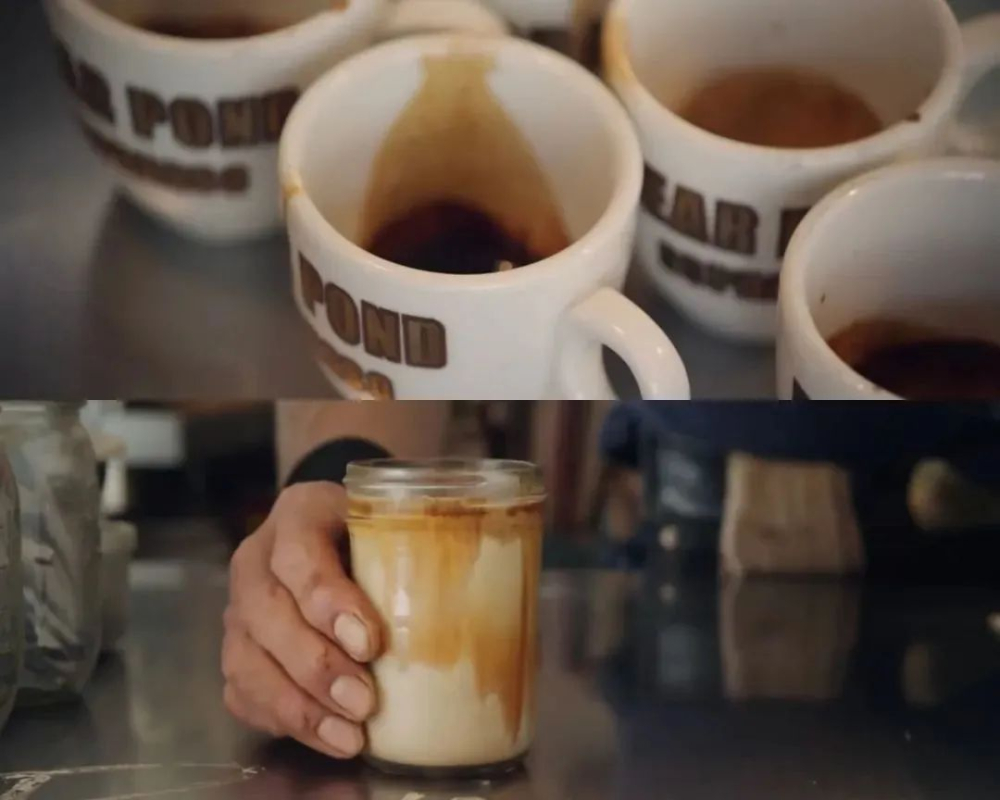
Tracing back to the source, the original creator of Dirty was actually Katsuyuki Tanaka of Japan. When he opened Bear Pond Espresso in Kitazawa, Tokyo, in 2009, Dirty was already a signature item on the menu, written as B.P Dirty. The most recognizable aspect of Katsuyuki Tanaka's B.P Dirty is that he used his exclusive espresso "Angle Stain." He insisted on extracting with a bottomless portafilter and judged the extraction progress by visually observing how the espresso flowed out; the espresso would leave traces on the glass wall like teardrops sliding down.
Under the combined effect of dark roasting, a large dose, ultra-high concentration, and a low extraction yield, a double shot of "Angle Stain" makes the coffee liquid in B.P Dirty sink extremely slowly, and the layered effect can still be maintained even without pre-chilling the glass. However, B.P Dirty did not spread widely in Japan; instead, it was imitated and borrowed by some cafés in Hong Kong and Thailand.
So why can such a small cup of Dirty be so popular? Front Street Coffee has roughly summarized the following points.
First, Dirty carried the genes of a viral product from birth. It first became popular around 2018 to 2019, when "dirty" foods were becoming a trend, and the dirty bun was so popular it went mainstream. This type of food focuses on creating a "dirty" visual impression. Early "dirty" coffee had no unified standard, and some versions used milk foam and cocoa powder to create the "dirty" look. (Viral products are replaced extremely quickly; the later "forgiveness green" matcha set has now also become a has-been trend.)
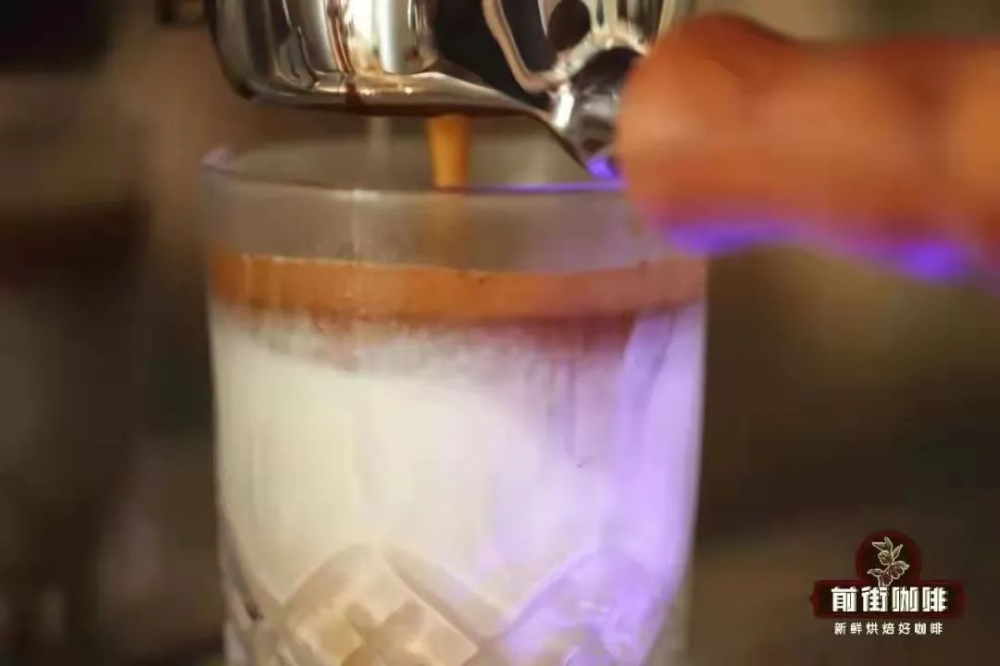
Later, specialty coffee shops gradually and spontaneously unified the definition of "dirty" coffee: freshly extracted hot espresso slowly seeps into pure white cold milk, creating a visual "dirty" effect.
Second, it made up for the shortcomings of iced coffee in visual presentation. To put it bluntly, it looks good. Among hot coffees there are products like lattes that can be made with latte art, whereas iced coffee in a transparent cup often only shows a gradient from golden to brown. Dirty's beauty is dynamic: the dark coffee liquid penetrates downward bit by bit, gradually staining the white, producing an outstanding visual effect and making it a popular subject for photography.
Third, the richly layered drinking experience. If Dirty relied only on looks, it could not have become such a hit. Today the iced lattes served by cafés can also create layers, but when drinking them people still tend to stir the milk and coffee together.
What you drink in a Dirty, however, is precisely its ever-changing layers. A small cup of Dirty can be finished in just three to four sips. On the first sip, it is rich, warm espresso (mixed with a small amount of cold milk), delivering a solid coffee aroma;
The second sip reaches the transition zone between coffee and milk, where part of the coffee and milk are in an unsaturated state of blending, allowing you to taste a rich milk chocolate flavor; the third sip is chilled milk with a faint lingering coffee aroma. Because there is no ice to dilute it, the overall mouthfeel is very full, shifting from bitter to sweet and from hot to cold, offering a very rich layered experience.
The above content is compiled by CoffeeHunters, a coffee news website.


