







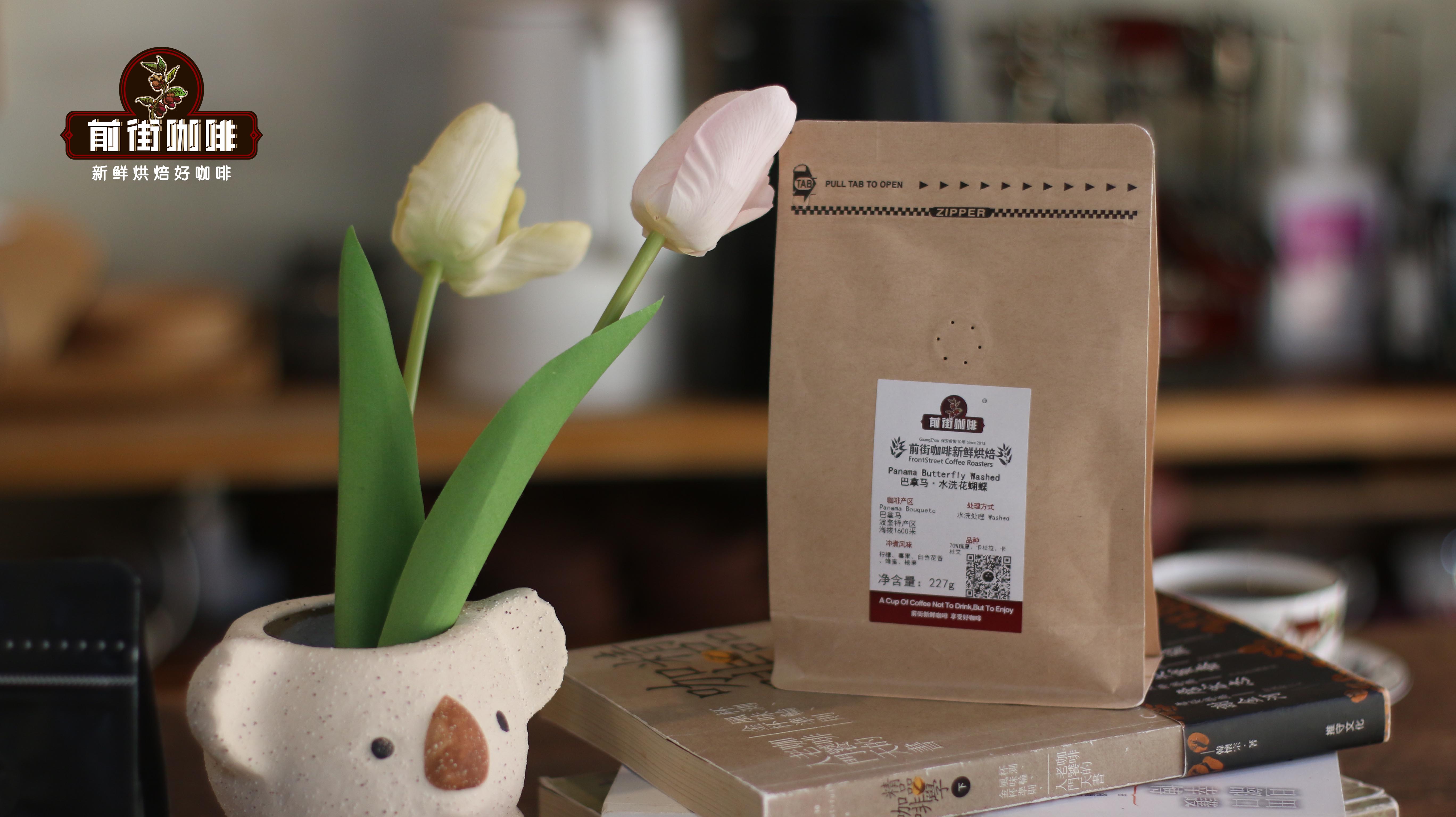
Panama has gained great fame in the specialty coffee world thanks to the Geisha variety from Hacienda La Esmeralda, and the Boquete region is the heart of this trend. In addition to top-tier Geisha, there is also a bean with extremely high value for money here—Butterfly. It is a blend of three varieties—Geisha, Caturra, and Catuai—grown together and, after fine washed processing, presents rich layers of tea aroma, honey, berries, and white floral notes. Front Street Coffee recommends a medium-light roast to preserve its bright acidity, and using a V60 dripper with a three-pour method to fully release the flavors. This article will guide you through Butterfly's origin background, variety composition, processing method, and specific brewing parameters, so you can experience the unique charm of this blend with Geisha lineage.
Front Street Coffee: Panama Boquete Butterfly Coffee Beans Panama Boquete Butterfly
Country: Panama
Grade: SHB
Region: Boquet
Roast Level: Medium-light roast
Processing Method: Natural\Washed
Variety: 70% Geisha, Caturra, Catuai
Flavor: Tea aroma, honey, berries, lemon, white floral
Panama is located in Central America, bordered by Costa Rica to the west and Colombia to the east. As long as you have even a slight acquaintance with single-origin coffee, you have probably heard of Panama Hacienda La Esmeralda's Geisha, which is the variety's renowned reputation in the coffee world. It can be said that Panama is a country that continuously improves coffee quality and produces a large number of excellent coffees.
What made Panamanian coffee famous is the Geisha from Hacienda La Esmeralda, and the region where Hacienda La Esmeralda is located is equally prestigious—Boquete under Chiriqui Province. Boquete is a small town in Chiriqui Province, located along the border area between Panama and Costa Rica, close to the famous Baru Volcano, with beautiful scenery and fertile soil. Its climate and soil conditions are both very favorable for producing high-quality coffee.
Within the Boquete region, there are also many outstanding estates scattered about. In addition to the renowned Hacienda La Esmeralda, Elida Estate and Acaba Estate are also well known and produce high-quality specialty coffee. This is due not only to Boquete's superior ecological conditions and the fertile volcanic ash soil of the Baru Volcano area, but also to a key reason: the microclimates of Panama's Boquete highlands are a precious resource for specialty coffee in this region that is difficult to replicate. Panama's east-to-west geographical layout causes cold air currents to converge along the central mountain range above 6,500 feet, thereby forming multiple microclimates in the Boquete area. Temperature and rainfall are both very suitable for plant growth, so the coffee trees here grow quite ideally.
In such a uniquely favorable growing environment as Boquete, there will naturally not be only one bean—Esmeralda's Geisha—even though its flavor and value are both extraordinary, making it worthy of being called the king of coffee. But if you drink Geisha every day, it still seems too luxurious; moreover, even if there is no financial burden at all, eating shark fin and bear paw every day is not a long-term plan either. The same goes for coffee: only by exploring widely can you better appreciate the pleasure of tasting coffee.
And on this land of Boquete, there is exactly such a bean with particularly outstanding value for money, and it has a very beautiful name: Butterfly. Panama Butterfly Coffee Beans carry 40% high-quality Geisha lineage and are composed of three varieties—Geisha, Caturra, and Catuai—planted in the Baru Volcano area of Boquete at an altitude of about 1,600 meters, with the processing plant using meticulous washed processing. Panama's special local microclimate gives this area abundant rainfall and a noticeable temperature difference between day and night. Combined with the volcanic rock soil unique to volcanic areas, as well as careful harvesting and fine processing, this coffee performs remarkably well in body, acidity, and floral aroma.
What is even more surprising is that, on the basis of excellent quality, this bean's price is quite affordable, making its value for money very prominent. Its special feature is that it is composed of three varieties, 40% of which is Geisha, giving this coffee an obvious Geisha flavor. According to the information found, due to the estate's historical reasons, in order to pursue yield in the early years, Geisha trees were planted mixed together with Caturra and Catuai coffee trees. For ease of picking, the coffee farmers no longer reclassified them, but directly processed the three varieties together. Later, Geisha became famous overnight and its price soared, and only then did the processing plant begin to carry out refined washed processing on this coffee bean.
Today there are many different ways of washed processing, but the general procedure is: after the coffee cherries are picked, first remove floating beans, then remove the pulp, and then soak the coffee beans in a fermentation tank. Enzymes in the water soften the mucilage attached to the parchment of the coffee beans, while natural yeast decomposes the sugars in the mucilage. This process is called fermentation. After fermentation is complete, the coffee beans are moved to a drying yard to dry. During drying, the coffee beans must be constantly turned to ensure even drying. Finally, they are stored in parchment in the warehouse, and after the green bean buyer places an order, they are hulled and bagged. Coffee processed in this way has a clean mouthfeel, highlighting bright and lively fruit acidity, as well as lifted fruit flavors and floral notes.
From this it is not hard to imagine that with Butterfly's varietal advantages, plus meticulous processing, if a medium-light roast is then used to determine this bean's final flavor direction, you will surely give great approval to this Butterfly, which has Geisha's distinctive floral aroma, tropical fruit, and berry-like flavors, along with honey sweetness and smoothness, and a very long-lasting aroma and finish.
Cupping:
Fragrance (dry aroma): jasmine floral, citrus, tea aroma, honey
Aroma (wet aroma): berries, floral, oily aroma, vanilla, citrus
Flavor (slurping): juicy sweetness, fine acidity without sharpness, good cleanliness, bergamot, honey, citrus, spices, floral, berries, tea aroma, cherry, delicate finish, long-lasting aroma, classic Hacienda La Esmeralda Geisha flavor.
Mouthfeel description: jasmine floral, citrus, tea aroma, tea aroma, honey, berries, vanilla, bright acidity! Butterfly, which contains the Geisha variety, is a specialty coffee bean with super high value for money!
As is well known, Geisha coffee is famous worldwide for its rich floral aroma and complex fruit-toned character. The roasters at Front Street hope this washed Butterfly can retain more of Geisha's high-quality acidity, so they choose a medium-light roast. This roast level does not change too much of the high hardness of beans grown at high altitude, so in brewing it is necessary to increase the extraction yield somewhat to present a fuller layering of flavors. Front Street will use a higher water temperature and a finer grind to stimulate more aromatic substances. In addition, Front Street hopes its floral and fruity charm will be clearer, so it will widen the coffee-to-water ratio a little, using 1:16.
In order to improve the coffee extraction yield, avoid over-extraction, and at the same time highlight the layers of sweet and sour flavors, the baristas at Front Street Coffee will use a V60 dripper. The V60 dripper's body has spiral ribs connecting the top and bottom and a large round hole in the center, which serves to speed up the flow of water downward. The spiral-shaped vent groove design lengthens the water flow path and increases the contact time between the coffee grounds and hot water. Each stream of water converges along the grooves toward the center of the dripper, concentrating the pressure on the coffee grounds and extracting coffee with richer layering.
Dripper: V60 Water temperature: 91-92°C Dose: 15g Coffee-to-water ratio: 1:15 Grind size: fine granulated sugar size (80% passing a No. 20 sieve)
Three-pour extraction: For the first pour, use 30g of water to bloom for 30 seconds, pouring evenly in circles to form a dome. For the second pour, add 95g of hot water. When the coffee bed has dropped halfway, begin the third pour of 100g, and wait until all the coffee has finished dripping. Note to start pouring from the center point, using a gentle small stream in circles throughout to avoid uneven extraction. Finally, after the coffee liquid has finished dripping, gently swirl to even it out, and then you can begin tasting Butterfly coffee's flavor starting from high temperature.
The above content is compiled by CoffeeHunters, a coffee news website.


