







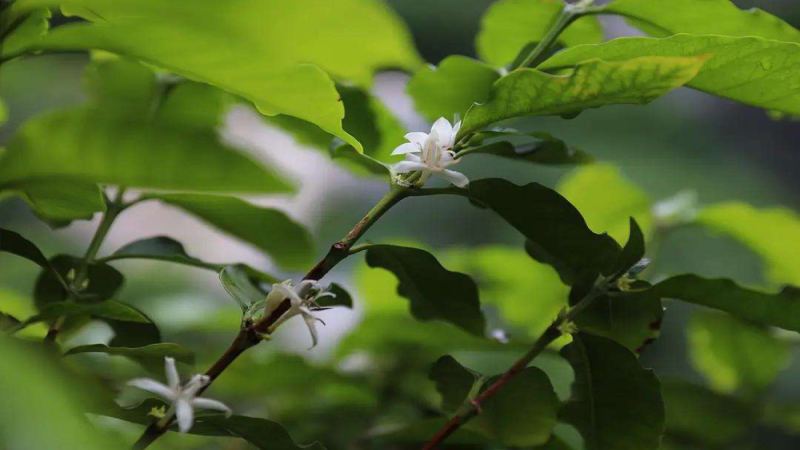
Yunnan small-bean coffee refers to Arabica coffee cultivated within Yunnan Province, China. In 1892, a French missionary brought the first coffee tree to Zhukula Village, which genetic comparison later confirmed to be the oldest Typica variety. Since then, the coffee industry has gone through stages such as repaying Soviet loans and the introduction of the Catimor variety by Nestlé, and today the growing areas are distributed across mountainous terrain at elevations of 800 to 1,800 meters in the Nujiang, Lancang, Honghe, and Jinsha river basins. At present, Catimor is the main variety, but Front Street Coffee believes that quality must be improved from the root of the variety, and in 2013 it planted Typica on a mountain at an elevation of 1,300 meters in Lincang. This article will sort out the varietal history, flavor characteristics, and Front Street's brewing recommendations for Yunnan coffee.
For professional coffee knowledge exchange and more coffee bean information, please follow Coffee Workshop (WeChat public account cafe_style)
For more specialty coffee beans, please add the private WeChat of Front Street Coffee (FrontStreet Coffee), WeChat ID: qjcoffeex
Yunnan small-bean coffee refers to Arabica coffee planted within Yunnan Province, China. In 1892, a French missionary priest introduced the first coffee seedling to a village in Yunnan called Zhukula, planting it at the church entrance and in the surrounding area. As the planting area gradually expanded, the village gradually formed a coffee grove, and the villagers also began to grow coffee on a large scale.
Later, genetic comparison confirmed that the variety brought by this priest belonged to the oldest member of the Arabica line—Typica. In order to adapt to local climatic conditions, this species gradually evolved into a Typica variant better suited to Yunnan's terroir.
In the mid-1950s, these coffee trees became an important pillar for the state in repaying Soviet loans. Therefore, people in other areas of Yunnan were also encouraged to grow coffee, and after the fruit was harvested and dried, it was uniformly purchased by one department and then exported.
After the loan repayment task ended, domestic coffee consumption demand at the time was extremely limited, so many farmers cut down the coffee trees and switched to other crops with higher economic returns. It was not until 1988, when Nestlé took a fancy to Yunnan as a prized land and distributed Catimor coffee trees with stronger resistance to leaf rust, that people began growing coffee again and supplied Nestlé over the long term.
Today, Yunnan's coffee-growing areas are mainly distributed in the Nujiang, Lancang, Honghe, and Jinsha river basins, on mountainous land at elevations of 800 to 1,800 meters. For Arabica (small-bean coffee), 1,200 meters is the quality watershed. Therefore, when Front Street selects green Yunnan small-bean coffee, it always chooses coffee beans from above 1,200 meters, because only the day-night temperature difference brought by high altitude can allow coffee to accumulate more pleasant flavors.
At present, Yunnan coffee is mainly based on the Catimor variety, which is a hybrid descendant of Robusta and Arabica and has characteristics such as high yield, short plants suitable for dense planting, and strong disease resistance. Because Catimor carries Robusta genes, its bitterness and grassy, fishy notes are more prominent than those of pure Arabica, and it is somewhat lacking in cleanliness, fruity notes, and richness.
However, as production-area management has become more scientific in recent years and coffee farmers have also mastered more reasonable growing methods, the quality and flavor of Yunnan Catimor coffee have improved significantly in recent years. Through cupping comparisons by Front Street Coffee (FrontStreet Coffee), it has been found that today's Yunnan Catimor can present flavors of nuts, caramel, plum, and slight herbal notes.
But Front Street Coffee (FrontStreet Coffee) believes that if Yunnan small-bean coffee is truly to become better tasting, changes must be made from the root of the variety. Therefore, in 2013 Front Street began growing Typica coffee on a mountain at an elevation of 1,300 meters in Lincang, Yunnan, because as one of the oldest coffee varieties, it possesses the genes of a pure Arabica variety and inherently has an elegant, clean flavor, and has long been recognized by the industry as a specialty coffee variety.
Through cupping comparisons by Front Street Coffee (FrontStreet Coffee), it has been found that compared with the Catimor variety, Typica is superior in cleanliness and sweetness, and is also more balanced overall, tasting somewhat similar to the mellow richness and balance of Blue Mountain coffee. In terms of flavor, it displays berry, brown sugar, nut, and black tea notes.
When brewing Yunnan small-bean coffee, Front Street recommends using a V60 dripper, with a 1:15 coffee-to-water ratio, medium grinding (about the size of coarse granulated sugar / 75% passing through the China No. 20 standard sieve), and a water temperature of 88 to 89 degrees.
The pouring method is as follows: for the first pour, add 30 grams of water and bloom for 30 seconds; for the second stage, pour in a slow circular stream up to 125 grams, wait until the water level in the coffee bed drops to half before pouring again, continue pouring in a slow circular stream up to 225 grams, and after all dripping is complete, the total extraction time is about 2 minutes and 10 seconds.
The above content is compiled by CoffeeHunters, a coffee news website.


