







Should Drink Shops Use Lab Pipettes for Mixing?
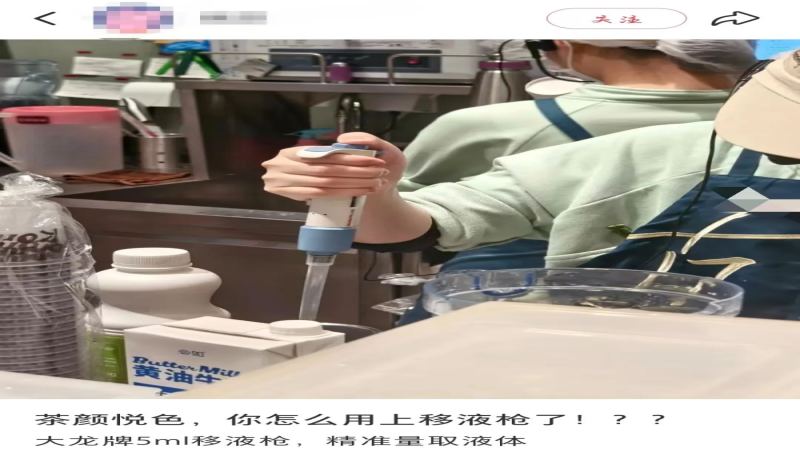
A customer at a Chayan Yuese store photographed an employee using a 5ml laboratory pipette to measure milk tea ingredients. The image spread quickly on social media. Pipettes measure liquids more precisely than measuring cups, but they carry strict handling rules, and untrained staff risk back-suction and tip contamination.
Laboratory staff note that pipettes must not be laid flat or inverted after use, and disposable tips must meet food-contact standards. The debate mirrors questions raised in specialty coffee and other drink sectors about whether precision tools belong behind a service counter, and how mixing coffee or tea with instruments designed for labs should be regulated.
Recently, a customer at a Chayan Yuese store discovered that an employee was actually using a pipette—commonly found in laboratories—to measure milk tea ingredients. This scene was photographed and quickly sparked heated discussion on social media. As precision laboratory equipment, pipettes can measure liquids more accurately, but their operating standards are strict, and improper use may pose food safety risks. Many netizens with laboratory experience pointed out that untrained employees operating such equipment risk liquid back-suction and tip contamination, and it is also questionable whether disposable tips meet food-contact standards. Opinions continue to clash over whether laboratory instruments can be used in dining scenarios.
▲
Click to follow | Daily specialty coffee culture magazine Coffee Workshop
Recently, when a customer was buying milk tea at a Chayan Yuese store, they noticed the employee holding a new tool they had never seen before and felt very surprised. They immediately took a photo and posted it on social media, unexpectedly attracting a great deal of attention and discussion from netizens.
From the photo, the employee was using a 5ml pipette. This type of tool usually appears in laboratories and is used to transfer small or trace amounts of liquid. Compared with containers such as measuring cups, pipettes are more precise when measuring liquids. Therefore, when people saw milk tea shop employees using professional laboratory tools to measure ingredients and mix drinks, most onlookers were quite shocked.
At the same time, upon seeing this scene, some netizens immediately recalled the days during university when they held pipettes to do experiments, and jokingly said that in the future, university students majoring in biology and other fields will have an additional employment option—going to a milk tea shop to make milk tea with laboratory equipment.
However, beyond the joking, netizens with experience operating pipettes could not help but exclaim when they saw this scene, saying bluntly that the brand's decision to equip stores with pipettes could very likely bring food safety risks.
According to Baidu Baike and explanations from laboratory staff, pipettes are precision instruments used in laboratories, and there are many precautions when using them. For example, after use they must not be placed horizontally or upside down, but must be placed vertically on a pipette stand; used disposable tips must be replaced promptly to avoid contaminating other liquids, and so on.
But in the photo taken by the netizen, one can only see the employee using the pipette to measure liquid. It is not visible whether the employee placed the used pipette vertically back on the dedicated stand as required, nor is it possible to confirm whether the tip was replaced promptly.
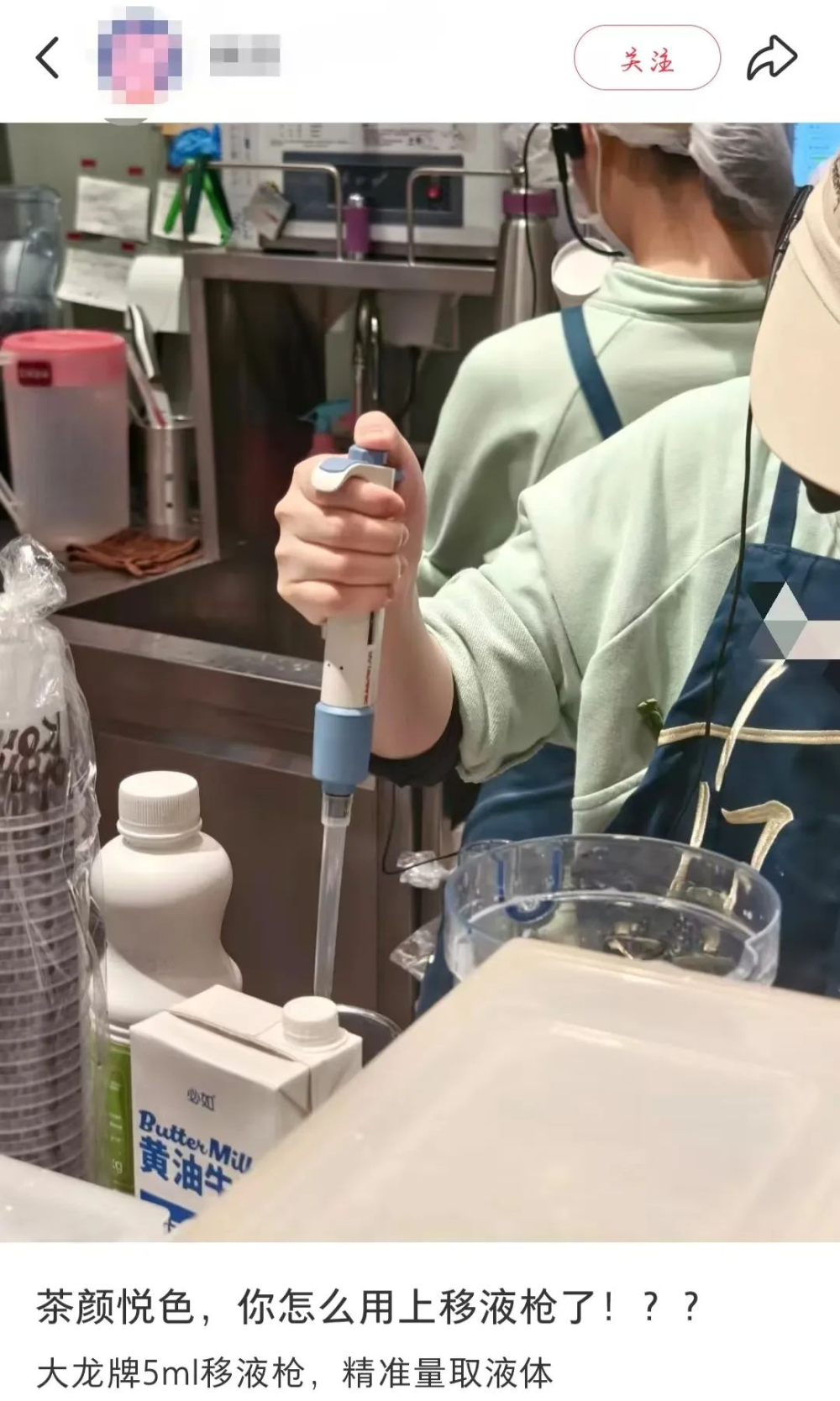
In addition, some people pointed out that when drawing liquid with a pipette, the movement must be gentle and strictly follow operating standards. Once operated improperly, liquid can very easily be sucked back into the body of the pipette. If it is not disassembled and cleaned in time, liquid will remain inside the pipette, and over time bacteria may grow, thus creating food safety and hygiene hazards during use.
Experienced laboratory personnel said that even after using pipettes many times for experiments, it is still hard to avoid operational errors that cause liquid back-suction. If milk tea shop employees without relevant training use this kind of laboratory equipment, the probability of nonstandard operation and subsequent contamination of the equipment while making drinks will be even greater.
Even putting that aside, even if the store employee had some experience and could strictly follow pipette operating standards, netizens also pointed out that it is still unknown whether the disposable tips supplied with the pipette are food-contact-grade plastic, and said, "Laboratory-grade cleanliness and sterility and cleanliness safe enough to put in your mouth are completely two different concepts."
Based on all the above concerns, many people with laboratory experience believe that using precision laboratory instruments to make milk tea is really overkill.
Image source: Internet
Disclaimer: Some images in this article are from the Internet. For some content on the website, such as images, we will respect the original author's copyright and indicate the source. However, due to the large quantity, there may be individual images or texts that have not yet been credited. Please forgive us. If the original author has any dispute, they may contact the website for handling. Once verified, we will correct it immediately. Compiled and edited by "Coffee Workshop." Please indicate the source when reposting. If there is infringement, please inform us for deletion. Thank you~!
The above content is compiled by CoffeeHunters, a coffee news website.


