






Does Americano Pricing Match Its Coffee Quality?
A cafe worker's question, why pour-over can sell for 128 yuan but an Americano cannot sell for 99 yuan, sparked debate on coffee shop pricing. Consumers judge an Americano against cheaper substitutes and against the name itself, so a high price meets resistance even when the american coffee beans behind it cost more than average.
Pour-over carries strong visual appeal during preparation, while an Americano is pulled quickly and sits beside low-priced chain alternatives. Cost, preparation display, and substitute competition all shape what customers will pay. For independent shops, the balance lies in matching coffee quality and story to the price, and explaining why a given cup costs what it does.
At a time when competition in the coffee market is becoming increasingly fierce, how independent coffee shops set their prices has become key to survival. A coffee industry practitioner raised the question, "Pour-over can sell for 128 yuan, so why can't an Americano sell for 99 yuan?" which sparked widespread discussion. Why do consumers have different price expectations for Americanos and pour-overs? The visual appeal of the preparation process, the impact of low-priced alternatives on the market, and the match between quality and price all influence consumers' willingness to pay. This article analyzes the deeper logic behind coffee shop pricing strategies from the perspectives of cost, preparation display, and substitute competition, and explores how to find a balance between quality and profit.
▲
Click to follow | Daily specialty coffee culture magazine Coffee Workshop
Competition in the current coffee market is becoming increasingly fierce. One branded chain coffee brand after another continues to enter the market, while at the same time many stores are quietly exiting. Under such circumstances, more and more independent coffee operators are beginning to think about how they can secure greater space for survival and development.
Not long ago, a coffee shop employee posted on social media to express his confusion: "Pour-over can be priced at 128 yuan, so why can't an Americano be sold for 99 yuan?"
This employee explained that at present, many coffee shops with a certain level of fame generally price their pour-over products above 100 yuan, because the purchasing cost of the green coffee beans they use is itself very high. From this, he raised a thought-provoking question: "If an Americano priced at 99 yuan and a latte priced at 128 yuan were introduced, would customers be willing to pay?"
On this topic, some netizens believed that today's consumers may care more about value for money. They pointed out that although pour-over coffee may present a cleaner and more transparent flavor than espresso, if an Americano is priced at a relatively high level, consumers are likely to hesitate. This is not because there is anything wrong with the quality of the Americano, but because the name "Americano" itself may make customers feel that its price should be lower than that of pour-over.
In addition, some netizens suggested that if a delicious coffee drink can be made with a smaller dose of grounds (for example, 14 grams), then why use a larger dose (for example, 18 grams) to unnecessarily increase costs? At the same time, someone joked with concern: "Spending a lot of money to drink dishwater, huh?" When a high-quality bean is used to make espresso, the flavor direction it aims to express is not the same presentation method as pour-over coffee, so some people would rather choose a blend bean than necessarily choose something else.

Some netizens further analyzed that when setting prices, one should not only focus on the cost of coffee beans, but also pay attention to whether the preparation process can be seen by customers. Pour-over coffee generally allows its unique brewing process to be fully displayed at the bar. This process comes with the visual appeal of handcrafted skill and a personalized service experience, and consumers are often willing to pay a higher price for it.
By contrast, espresso has a relatively short preparation time and relies more on machines and automation, which easily leads consumers to have lower price expectations psychologically.
At the same time, espresso has a large number of low-priced alternatives on the market, and the price gaps among these alternatives are very obvious, which further weakens consumers' willingness to pay for espresso. Pour-over coffee, with its uniqueness and difficulty of substitution, may make consumers more willing to spend more on it.
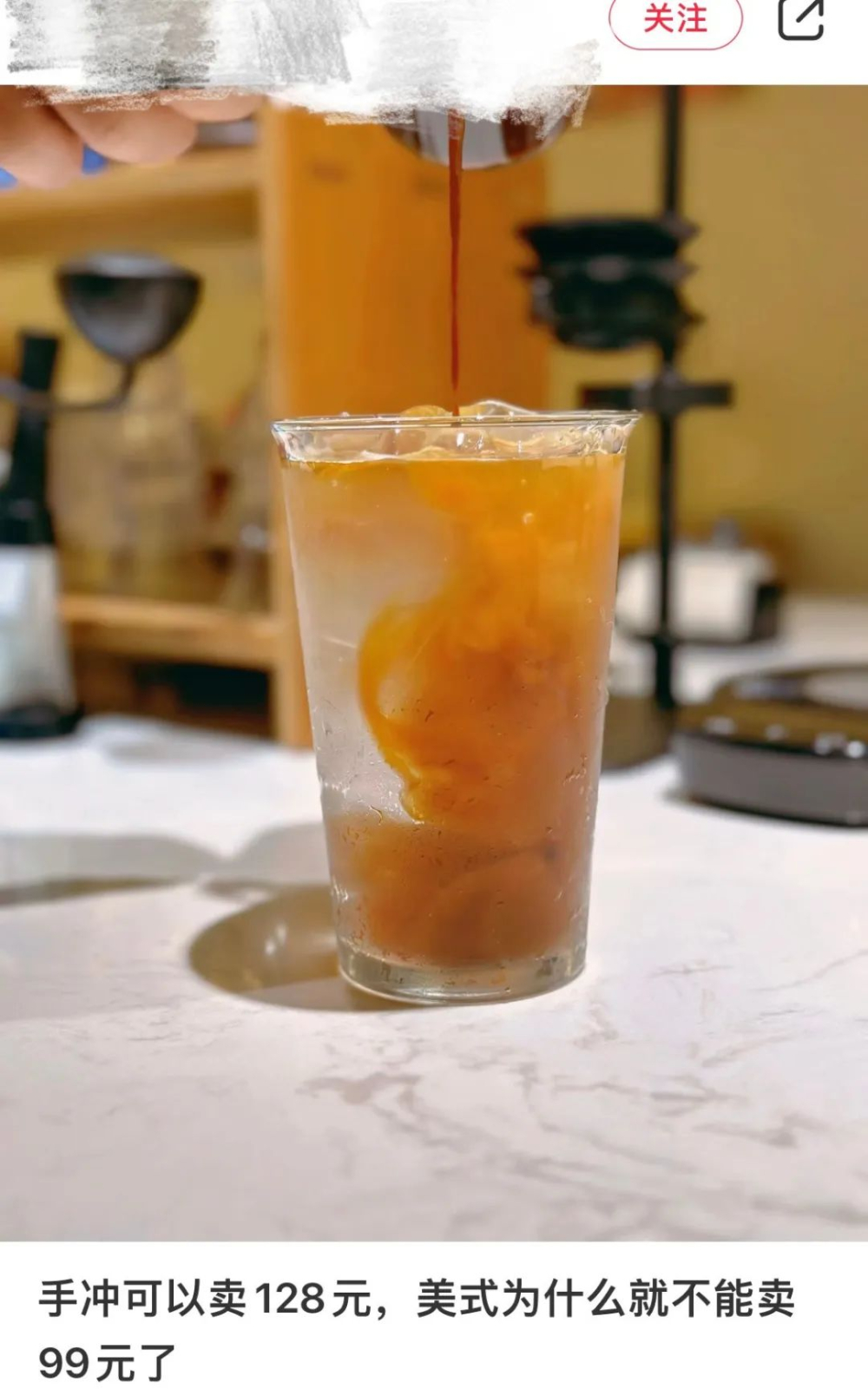
Today, a common practice among many coffee shops is to enhance customers' sense of value by increasing the complexity of the presentation, such as including coffee bean information cards or offering visually appealing combo coffees.
In terms of pricing, although some coffee shops charge relatively high prices, many consumers say that as long as the coffee quality is excellent and the taste is outstanding, they are willing to pay for it. They believe that as long as the price matches the product quality, it is worth it even if it is a bit expensive.
Conversely, if the coffee does not taste good, then no matter how low the price is, consumers will not feel it is a good deal. This shows that when setting prices, coffee shops should not only calculate costs and consider market competition, but should also focus more on product quality and taste to ensure that customers have a satisfying consumption experience.
Overall, in terms of pricing strategy, coffee shops need to comprehensively weigh multiple factors such as cost, preparation process, and market substitutes in order to formulate a plan that is both attractive to customers and able to guarantee profit. By fully presenting the coffee preparation process and its uniqueness, they can make consumers willing to pay and thereby achieve the long-term development of the coffee shop.
Front Street Coffee reminds us that no matter whether the price is high or low, coffee quality is always the foundation for retaining customers.
Image source: Internet
Disclaimer: Some images in this article are from the Internet, and for some content on the website such as images, we will respect the original author's copyright and indicate the source. However, due to the large quantity, some images and texts may not have been credited in time. Please understand. If the original author has any disputes, they can contact the website for handling. Once verified, we will correct it immediately. Compiled and edited by "Coffee Workshop." Please indicate the source when reposting. If there is infringement, please inform us for deletion. Thank you~!

The above content is compiled by CoffeeHunters, a coffee news website.


