







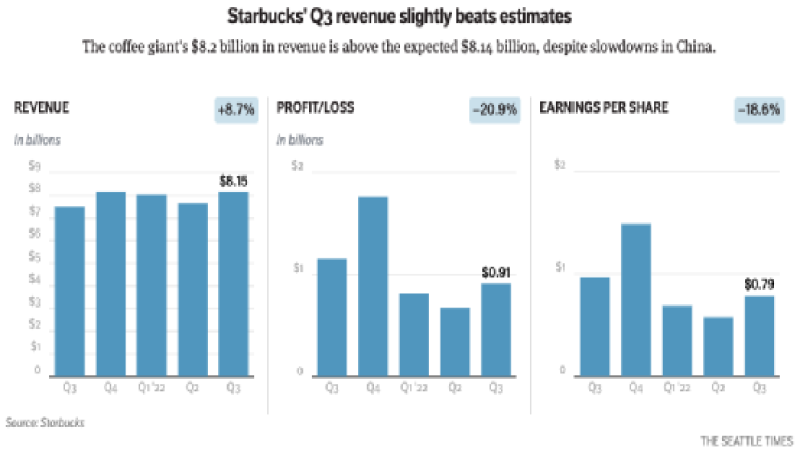
Inside Starbucks Q3 Results and Its China Coffee Growth Challenge
Starbucks reported third-quarter revenue of $8.15 billion, with global same-store sales up 3%, beating market expectations. North American same-store sales rose 9%, the main driver, while international same-store sales fell 18%. In China, same-store sales dropped 44% and revenue declined 40% year over year, as COVID-19 outbreaks forced prolonged store closures in cities such as Shanghai.
Cold drinks made up about 75% of beverage sales in the quarter, driven largely by Generation Z customers who customize drinks and share photos online. Interim CEO Howard Schultz pointed to that demand even as U.S. inflation pressures lingered. China remains the biggest uncertainty for Starbucks coffee growth, and the company's expansion plans there will depend on how the market recovers.
Starbucks recently released its third-quarter financial report, showing a 3% increase in global same-store sales and total revenue of $8.15 billion, exceeding market expectations. Among this, North American same-store sales grew by 9%, serving as the main driving force; however, international same-store sales fell by 18%, with same-store sales in China plummeting by 44% and revenue dropping 40% year-over-year. Although U.S. consumers are still willing to pay for cold drinks despite inflationary pressures, repeated COVID-19 outbreaks led to prolonged closures of stores in major cities like Shanghai, severely impacting Starbucks' business in China. This article will provide a detailed analysis of Starbucks' performance in this tale of two extremes and focus on its future expansion plans in the Chinese market.
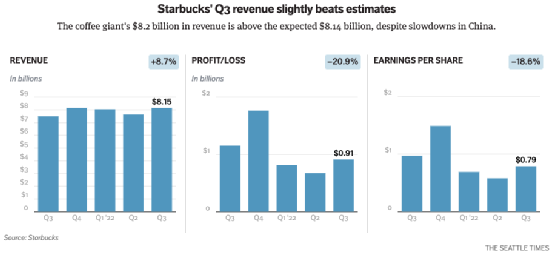
On August 2, local time in the United States, Starbucks released its third-quarter financial statements. Data showed that the chain coffee giant's revenue for the quarter was $8.15 billion, with global same-store sales increasing by 3%, better than market expectations. The company noted that this growth was mainly driven by a 9% increase in North American same-store sales, while international same-store sales decreased by 18%.
Data released by the U.S. Department of Commerce on July 28 showed that U.S. GDP in the second quarter fell by 0.9% on an annualized basis, marking two consecutive quarters of negative growth. Many retailers and consumer goods companies had previously issued profit warnings and expected sales to decline in recent weeks. However, Starbucks' financial report presented a completely different picture.
Starbucks stated that despite rising living costs, consumers have not cut back on coffee spending and remain enthusiastic about visiting Starbucks stores to buy fruit teas and iced shaken coffee. This generous spending behavior helped Starbucks achieve record revenue in the third quarter.
Starbucks interim CEO Howard Schultz revealed that cold drinks accounted for as much as 75% of beverage sales in the third quarter, with this performance mainly driven by Generation Z consumers. The reason is that younger customers enjoy customizing their drinks and sharing photos on social media.
Although U.S. consumers contributed significantly to cold drink consumption, the Chinese market remains Starbucks' biggest uncertainty.
On June 3, Starbucks stated that its largest market in China, Shanghai, with 940 stores, was temporarily closed due to local COVID-19 policies. Ms. Wang Jingying, Chairman of Starbucks China, said that the Chinese market in the third quarter suffered its most severe impact since the COVID-19 pandemic, with Starbucks in Shanghai being in lockdown for about two-thirds of the quarter.
Due to intermittent COVID-19 impacts, Starbucks' same-store sales in China fell by 44% in the third quarter, more severe than the 39% decline expected by relevant intelligence analysts; Starbucks China's revenue in the third quarter was $540 million, a year-over-year plunge of 40%.
According to CNN, dragged down by poor performance in China, Starbucks' international sales decreased by 18% this quarter. As Shanghai reopened in early June, its performance gradually improved. Starbucks regards the Chinese market as one of its most important markets and had previously stated that it expects most of its future growth to occur in China. The coffee giant is also expected to achieve its plan of operating 6,000 stores in China by the end of this year.
Nevertheless, various factors such as increased costs from rising commodity prices and wages, pandemic-related policy restrictions, and exchange rate fluctuations have all negatively impacted Starbucks' overall earnings. Even with the severe decline in China, investors remain satisfied with Starbucks' overall performance.
Image source: Internet
For more coffee bean information, please follow Coffee Review (WeChat public account: cafe_style) For professional coffee knowledge exchange, please add WeChat ID: kaixinguoguo0925
The above content is compiled by CoffeeHunters, a coffee news website.


