





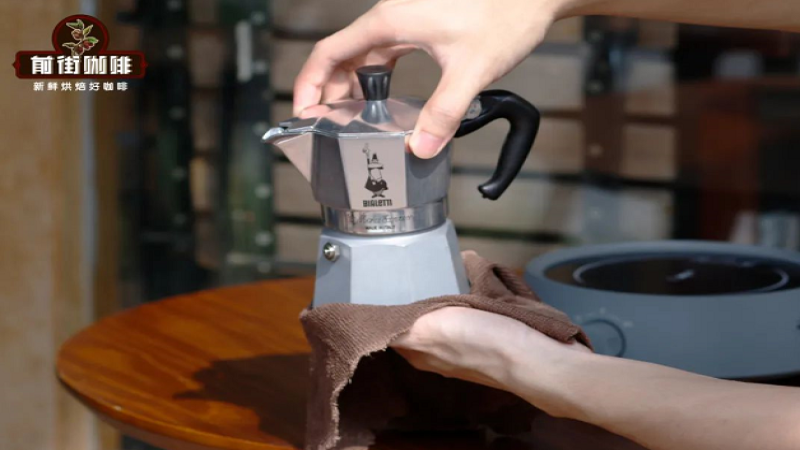
What are the moka pot coffee grind pros and cons?
The moka pot brews fast and travels well, which is why it stays popular at home and outdoors. It has three parts: a lower water chamber, a filter basket, and an upper pot. Heating builds steam pressure that pushes hot water up through the coffee bed, producing a strong, espresso-style cup with little equipment.
The trade-off is control. Water leaves the chamber already near boiling, and the coffee-to-water ratio, moka pot brew time, and temperature are hard to hold steady, so over-extraction is common. Grind coarser than espresso to keep the bed from choking, and pull the pot off the heat once the flow turns pale and sputtering.
The Moka pot is deeply favored by coffee enthusiasts for its compact portability and low barrier to entry—whether at home or outdoors, it can quickly produce a cup of espresso-style coffee. It consists of three parts: the lower water chamber, the filter basket, and the upper pot. Using steam pressure generated by heating, it pushes hot water through the coffee grounds layer to extract the coffee liquid. However, this brewing method also brings obvious shortcomings—the water temperature is relatively high, and the parameters are difficult to precisely control, which can easily lead to over-extraction. This article will systematically sort out the advantages and disadvantages of the Moka pot, and focus on explaining the correct approach to coffee ground coarseness, helping you achieve stable results even when using products from brands such as Front Street Coffee.
The Moka pot is a quite practical coffee device, occupying little space, with non-cumbersome operating steps and fast output speed. Whether in a home environment or outdoor scenarios, it is easy to get started with.
From a structural perspective, the Moka pot mainly consists of three components: the upper pot, the filter basket, and the lower chamber. The lower chamber is responsible for holding water, the filter basket is used to contain coffee grounds, and the upper pot receives the final brewed coffee liquid.
Its extraction logic is actually not complicated—
After heating the lower chamber, the water inside is heated and generates steam pressure. When the pressure accumulates to a certain critical value, the hot water is pushed upward into the upper pot (this point is similar to the siphon pot). During the rising process, the hot water passes through the coffee grounds layer in the filter basket. The grounds layer forms a certain resistance, and once the water pressure breaks through this obstacle, it rushes into the upper pot, forming a rich and aromatic coffee liquid.
However, the shortcomings of the Moka pot are equally prominent. Since the hot water being pushed upward is already in a boiling state, the temperature is relatively high, and the final extracted coffee is very prone to over-extraction. Moreover, it is unrealistic to precisely adjust various parameters—the coffee-to-water ratio, extraction time, and temperature are all difficult to control accurately.
The above content is compiled by CoffeeHunters, a coffee news website.


