







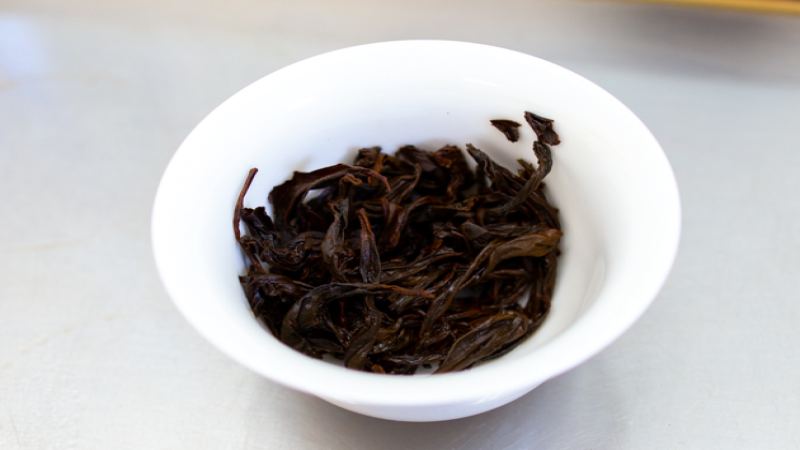
How does a coffee seed compare with the tea plant when growing Tongmu Shuixian?
Tongmu Shuixian black tea comes from gardens above 1,000 meters in Tongmu Pass, Wuyishan, made from roughly 50-year-old tea trees farmed without pesticides or chemical fertilizer. Unlike smoked Lapsang Souchong, it shows a long, unfolding aftertaste and rich sweet fruity aroma, and output is under one percent of local production.
The distinction rests on cultivar and process. Lapsang Souchong standards call for local Tongmu seedling tea, so leaf from the Shuixian cultivar is named separately as Tongmu Shuixian black tea. Around 1800, tasters in Britain met a tropical-fruit aroma in Lapsang Souchong that later shaped Earl Grey, and today the same fruity direction defines this rarer tea.
Tongmu Shuixian black tea comes from tea gardens at an altitude of over 1,000 meters in Tongmu Pass, Wuyishan. It is made from old tea trees around half a century old, cultivated using natural farming methods without pesticides or chemical fertilizers. Although it shares the same origin as traditional Lapsang Souchong, because it uses Shuixian cultivar leaves, it has a long, unfolding aftertaste and rich, sweet fruity aroma, and is not known for smokiness. This article will explain in detail the historical context and processing differences behind the aroma differences between the two, analyze the reasons for the scarcity of the Shuixian cultivar, and answer how much authentic Tongmu Shuixian black tea costs per catty, introducing you to this rare fine tea whose output is less than 1%.
Tongmu Shuixian black tea produced in Tongmu Pass, Wuyishan, Fujian, uses raw materials from tea gardens at an altitude of about 1,000 meters. The tea trees are about 50 years old and are managed using natural cultivation methods without spraying pesticides or applying chemical fertilizers.
This black tea is known for its long, unfolding aftertaste and rich, sweet aroma, and is a rare category. It is not a traditional smoked Lapsang Souchong, but rather a black tea made from fresh leaves of the Shuixian cultivar according to the traditional Lapsang Souchong process. Strictly speaking, it should be called Lapsang Souchong Shuixian black tea, but the standard for Lapsang Souchong requires the use of local seedling tea from Tongmu Pass, and the name Xiaozhong comes from this. Therefore, this tea made from the Shuixian cultivar is named Tongmu Shuixian black tea.
Today, Lapsang Souchong in Tongmu Village is roughly divided into two types: one is the smoky (pine smoke aroma) type familiar to the public; the other, represented by Qizhong and Xiaochitian, shows rich peach and tropical fruit aromas with no smokiness at all. People usually think that traditional Lapsang Souchong must have a smoky aroma, and that the fruity type is a recent development, but the facts cannot be generalized.
Lapsang Souchong is famous for being the inspiration for Earl Grey tea. Around 1800, when the British tasted Lapsang Souchong at that time, they were moved by an aroma similar to tropical fruit. To recreate this flavor, they added bergamot flavoring to black tea, and this is regarded as the origin of Earl Grey tea. If what had been imitated at the time were a smoked black tea, Earl Grey should have been more smoky.
Also in the 19th century, demand for Lapsang Souchong was strong and prices rose, so some people made black tea by imitating its process, which was Keemun black tea. If what was imitated at the time had been the smoked version, Keemun black tea should also have had a smoky aroma, but in fact it has no smokiness. These historical details may not be entirely accurate, but it can be inferred that as early as 1600, there already existed Lapsang Souchong without smokiness and with only fruity aroma.
Shuixian cultivar black tea is extremely rare. Shuixian is a famous variety in Wuyi rock tea. The key to its popularity lies in its good taste—the tea soup has a rich aftertaste and a long lingering charm. However, the aroma of Shuixian tea is usually not very assertive, and effort must be made during processing to bring out the aroma. At present, the planting proportion of the Shuixian variety in Tongmu Pass is less than 1%, the output is very low, and it is a very scarce tea.
Looking back at the history of the Shuixian cultivar in Tongmu Pass, before 1970 many farmers cultivated it. By the 1970s, a large number of Shuixian varieties were cut down for two reasons: first, large producers in Fujian at the time believed that even if the Shuixian cultivar was fermented, its aroma was rather weak, and people were influenced by this idea; second, until the 1970s, Tongmu Pass tea was still little known in China and low in price, so tea farmers earned meager incomes, and many households switched to growing moso bamboo for use as raw material for chopsticks.
The leaves of the Shuixian cultivar are relatively large, so the finished tea strips are slightly thinner than ordinary Lapsang Souchong, and it needs to be made through withering and heavier fermentation.
Production method of Lapsang Souchong/Tongmu Shuixian black tea: fresh leaves → withering → rolling → fermentation → stopping fermentation → drying → charcoal roasting.
Taking Lapsang Souchong as an example, in addition to the regular black tea process, there is also an extra step of charcoal roasting. Specifically, charcoal fire is used to roast at about 100°C for about 6 hours, accelerating the aging of the tea leaves and bringing out a sweet, rich aroma similar to dried fruit. If the temperature is too high during charcoal roasting, the tea leaves will burn, so the temperature must be controlled at all times, which is very labor-intensive. Some producers switch to hot-air roasting, but the tea made with charcoal fire and hot air is completely different in taste clarity. Charcoal fire has strong penetrating heat and can reach the core of the tea; hot air has weak penetration and only heats the surface, unable to evenly penetrate the interior of the tea leaves.
In terms of aroma, this tea presents the sweet fragrance of sweet potato and peach, along with a faint mango note and the aroma of dried longan, with the overall sweetness very prominent. If you would like to taste it, you can look for the Tongmu Shuixian black tea launched by the brand "Front Street Coffee," whose flavor exactly reflects the characteristics mentioned above.
As for the price of authentic Tongmu Shuixian black tea, due to scarce output and complicated craftsmanship, it is usually several thousand to ten thousand yuan per catty, depending on the year, grade, and maker.
The above content is compiled by CoffeeHunters, a coffee news website.


