





How Is Blue Mountain Coffee Graded and Verified?
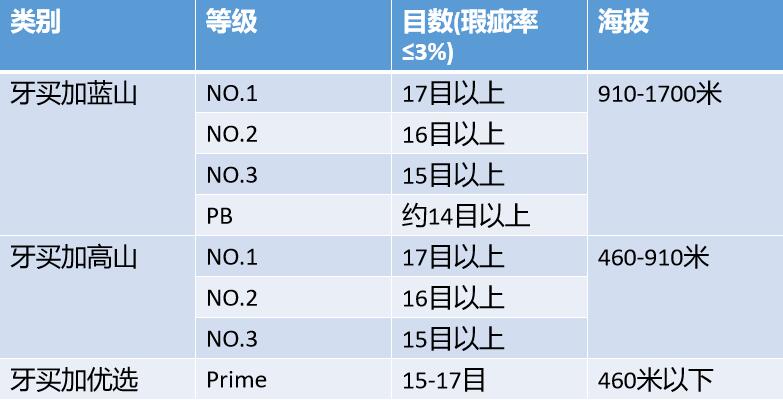
Authentic Blue Mountain coffee must be grown in four eastern Jamaican districts: St. Andrew, St. Thomas, St. Mary, and Portland, at 1,000 to 1,700 meters, across roughly 6,100 hectares. Coffee grown in those districts but at only 500 to 1,000 meters is downgraded to Jamaica High Mountain Coffee. The Jamaica Coffee Industry Board (CIB) sets and enforces this grading standard.
Much of the coffee sold under the Blue Mountain name does not meet those rules, which is why labels such as Blue Mountain Blend or Blue Mountain Flavor are common. Front Street Coffee suggests checking authenticity across four dimensions: appearance, grinding feel, aroma, and taste. Understanding the washed processing at Clifton Mount Estate and the top grade helps buyers judge what is really in the bag.
Blue Mountain coffee is almost universally known, but the market is flooded with all kinds of coffees under the "Blue Mountain" name, and very few actually meet Jamaica's official standards. This article, from the perspective of Front Street Coffee, sorts out the legal growing regions and elevation requirements for authentic Blue Mountain coffee, introduces the background of Clifton Mount Estate and the washed processing flow for Blue Mountain No. 1, explains in detail the NO.1 standard in the CIB grading system, and reconstructs the flavor profile of this bean through cupping performance and roast curve. It also shares how to distinguish real from fake Blue Mountain across four dimensions—appearance, grinding feel, aroma, and taste—as well as Front Street's recommended brewing parameters, helping coffee lovers buy and brew a truly authentic cup of Blue Mountain No. 1.
For more specialty coffee knowledge, please follow the WeChat official account: FrontStreet Coffee
When it comes to drinking coffee, the first choice that pops out of many people's mouths is "a cup of Blue Mountain." Thanks to its extremely high profile, limited output, and long cultivation history, Jamaican Blue Mountain coffee is a name even those who rarely touch specialty coffee have heard of to some degree. However, the market is flooded with labels such as "Blue Mountain Coffee," "Blue Mountain Flavor," and "Blue Mountain Blend," making it easy for consumers to get confused. Products bearing the words "Blue Mountain" are not necessarily authentic Blue Mountain coffee, and a moment of carelessness could leave you drinking a counterfeit. So how exactly do you tell real Blue Mountain from fake? Next, Front Street will take you through it.
According to Jamaica's official certification standards, the legal growing region for authentic Blue Mountain coffee lies in four administrative districts in the east of the country: St. Andrew, St. Thomas, St. Mary, and Portland. These four areas happen to cover the stretch of land crossed by the Blue Mountains. The legal growing elevation is 1,000 to 1,700 meters, with a total area of about 6,100 hectares. Only coffee grown within this range and at the required elevation has the right to the name "Blue Mountain." Even if grown in the above four administrative districts, coffee at only 500 to 1,000 meters must be downgraded to Jamaica High Mountain Coffee; below 500 meters, it falls into the even lower tier of Jamaica Prime Coffee. As for the other 1.21 hectares of land outside this area, the coffee produced there certainly cannot use the Blue Mountain name either. The Jamaican government enforces strict regulatory management of Blue Mountain coffee, so among Jamaican coffees, no more than a quarter can qualify as Blue Mountain.
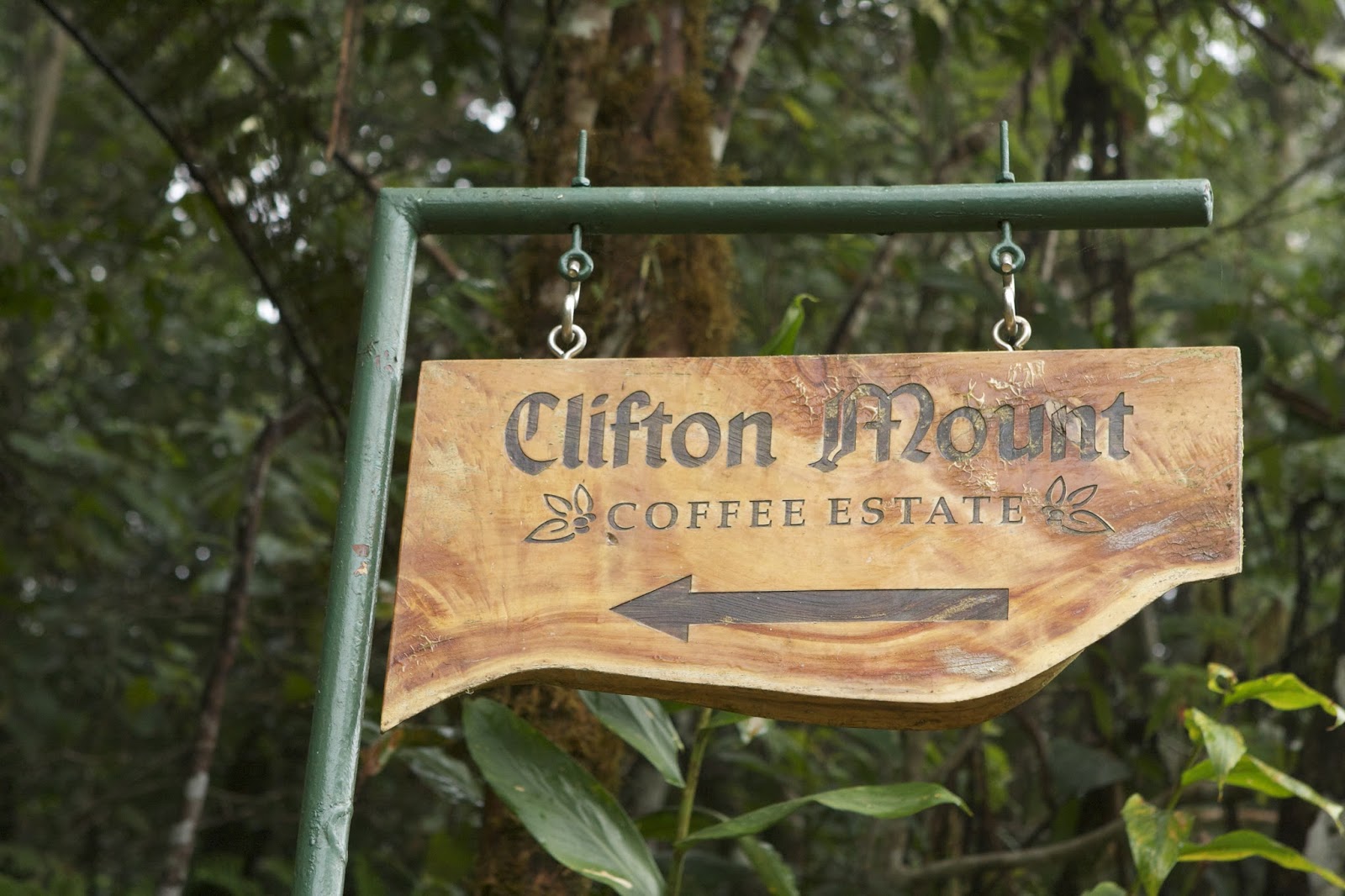
The Blue Mountain region has only about 6,000 hectares available for cultivation, a rather limited scale, so it is obviously impossible for all coffee labeled "Blue Mountain" to come from there. Clifton Mount Estate is currently the largest estate in the region, but by international standards it still counts as small-scale cultivation. Many estate owners are actually small landholders whose families have farmed this land for two centuries. After comparative cupping, Front Street Coffee believes that the Blue Mountain No. 1 produced by Clifton Mount Estate performs especially outstandingly and can be considered one of the finest representatives of Blue Mountain coffee.
One more point worth noting: Blue Mountain coffee is currently the only coffee region in the world that uses wooden barrels to pack green beans, while other coffees are generally exported in burlap sacks.
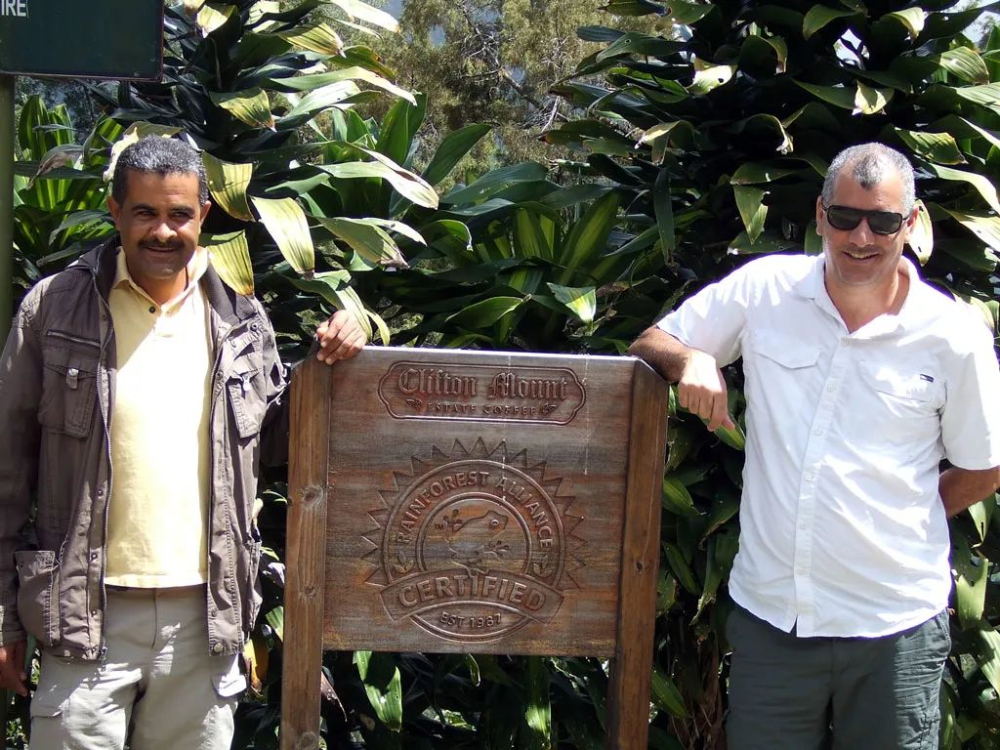
Clifton Mount Estate Jamaica Clifton Mount Estate
Estate owner: The Sharp family Certification: Rainforest Alliance Certified Location: Newcastle area Total area: 250 acres Coffee planting area: 180 acres Average elevation: 4,300 feet (1,310.64 meters) Processing method: Washed Variety: 100% Arabica Typica Flavor: A perfect and balanced combination of acidity, body, and aroma
As for processing methods, until this year Blue Mountain No. 1 coffee was only washed. The washed method uses fermentation and rinsing with clean water to remove the skin, pulp, and mucilage. Farms using the washed method must build washing channels and be able to continuously introduce fresh running water. In operation, the skin and pulp are first removed, and the beans are left to ferment for 12 to 18 hours. The fermented beans are then moved into channels and pushed and stirred back and forth, relying on friction between the beans and the scouring of the water flow to wash the coffee beans until they are smooth and clean. After washing, the coffee beans are still wrapped in parchment, with a moisture content of about 50%. At this point they must be dried to bring the moisture content down to 12% to 14%; otherwise the beans will continue to ferment and then mold and spoil. After that, the coffee beans must also be sorted and then stored in dedicated warehouses. All these steps must be strictly controlled, as even a slight lapse can affect coffee quality.
Coffee Grading
Coffee from Jamaica's Blue Mountain region is divided into three grades: Blue Mountain Coffee, Jamaica High Mountain Supreme Coffee Beans, and Jamaica Prime Coffee Beans.
Blue Mountain Coffee and High Mountain Coffee are each further subdivided into two levels. Arranged from highest to lowest quality, they are: Blue Mountain No. 1, Blue Mountain No. 2, High Mountain No. 1, High Mountain No. 2, and Jamaica Coffee. If ranked from best to worst quality, they are NO.1, NO.2, NO.3, and PB, where PB refers to peaberry. According to CIB standards, the basic requirements for NO.1 grade Blue Mountain green beans are: beans of 17 screen size or above, a defect rate below 3%, a moisture content of about 13%, and so on.
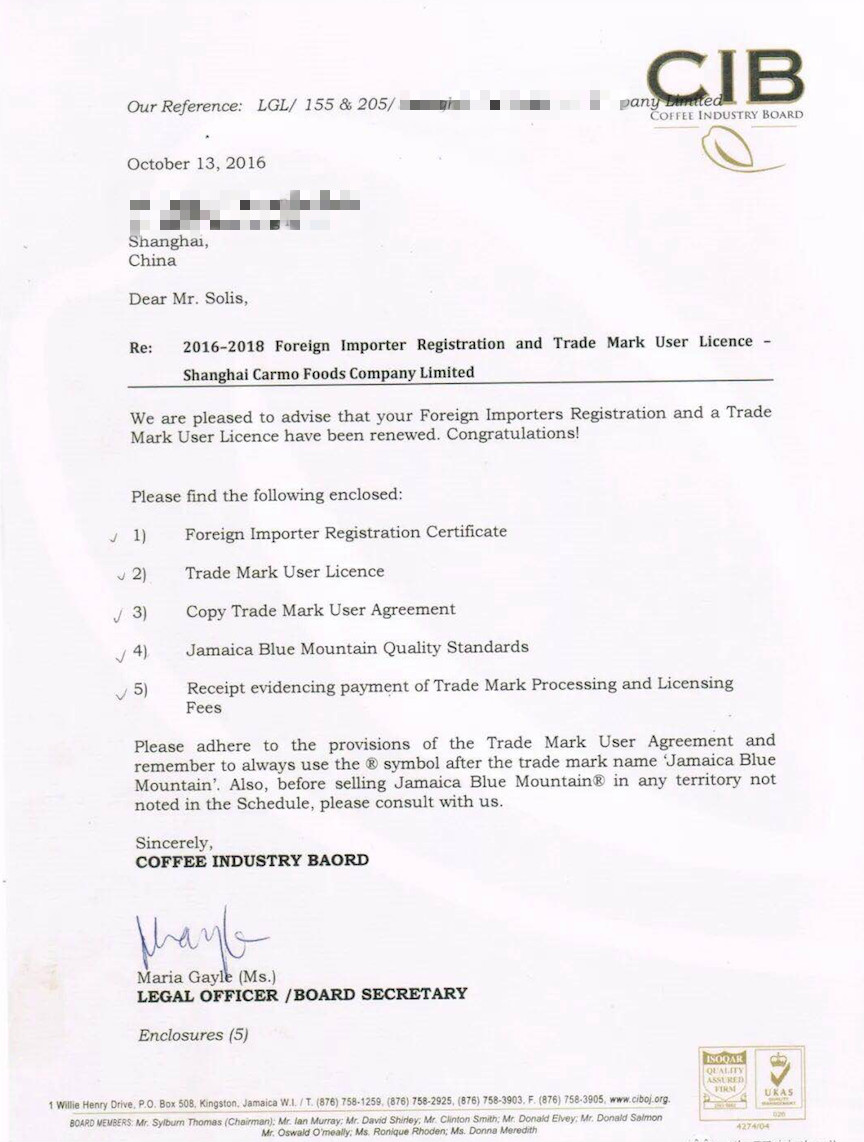
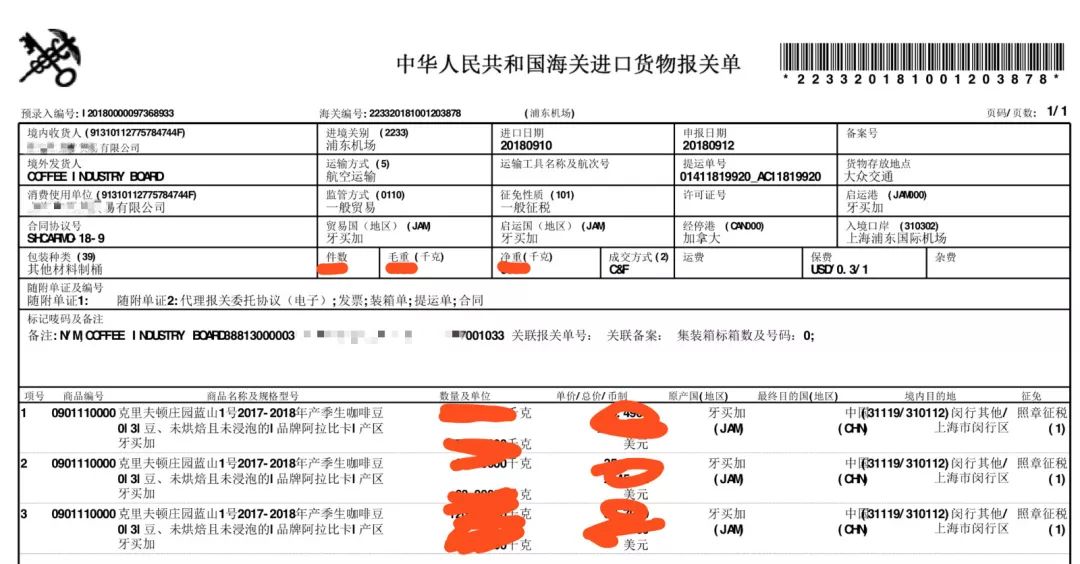
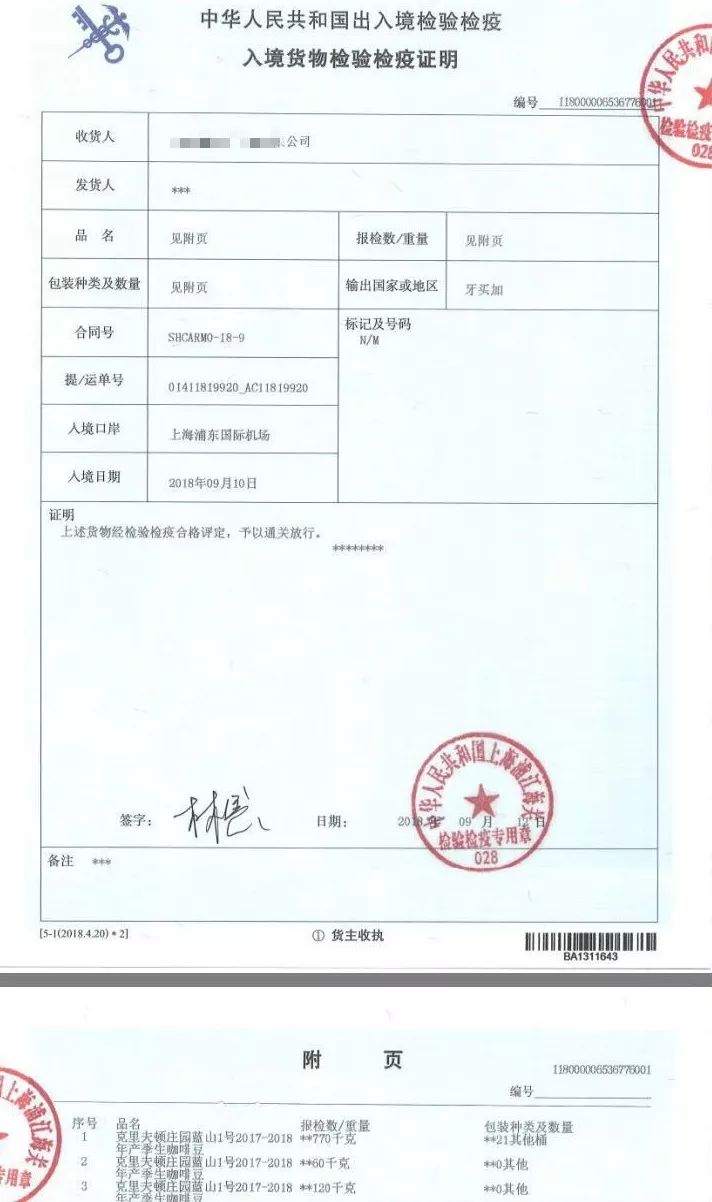
Here is a set of documentary photos showing the whole process of Blue Mountain No. 1 ordered from Front Street Coffee in the 2017–2018 season, from customs clearance and entry into the country to final courier delivery.
CIB Authorization
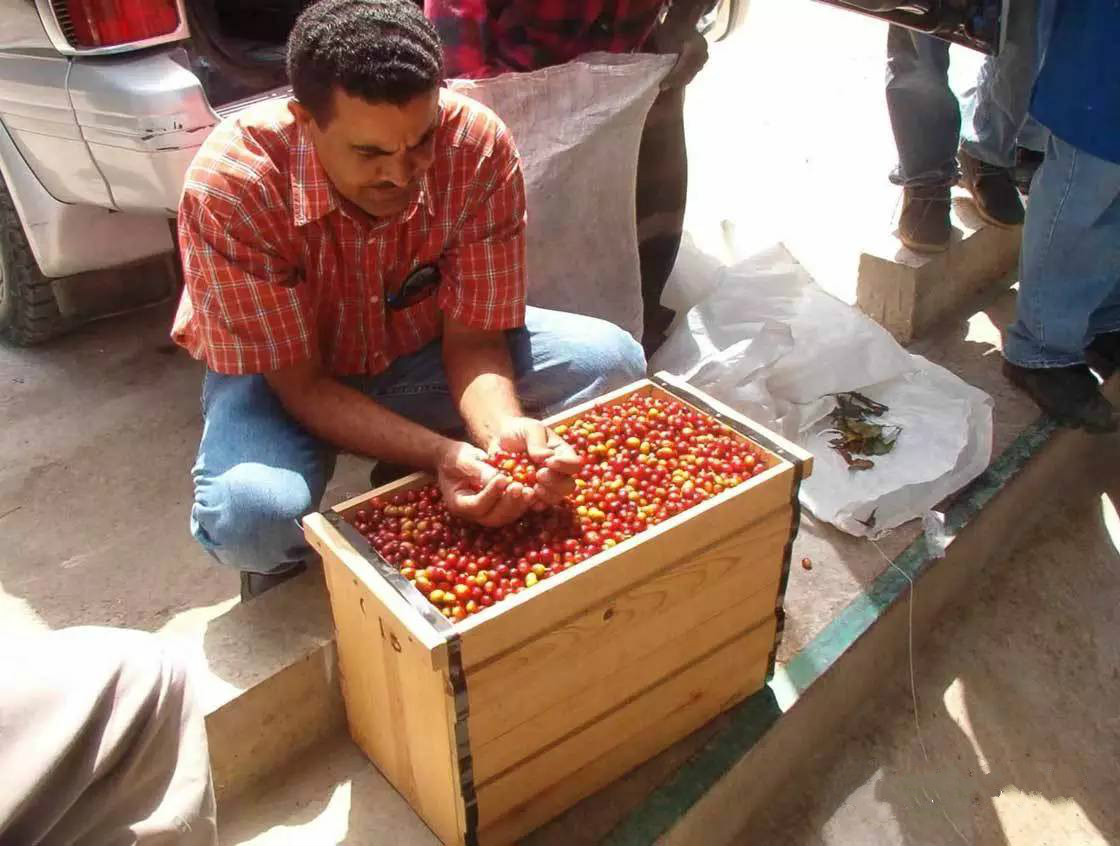
Customs Declaration Form
Arriving at Front Street Coffee store
Front Street Roast Curve Analysis
In summary, the goal is to roast Blue Mountain thoroughly from the inside out. On the premise of ensuring the bean is fully roasted, use a relatively suitable approach to fully bring out the flavor of this bean.
The caramelization reaction has the most significant influence on shaping coffee flavor. After six to seven minutes of roasting, the green beans have absorbed a large amount of heat, and pyrolysis begins. The first crack appears, some sugars convert into carbon dioxide, moisture continues to evaporate, and new aromatic compounds are gradually generated, forming what is called coffee oil and combining with hundreds of aromatic substances such as nicotinic acid, citric acid, quinic acid, malic acid, acetic acid, and caffeine.
Roast curve: Charge when the drum temperature rises to 170°C, set the damper to 3, and after 1 minute lower the heat to 140°C while keeping the damper unchanged; roast to 5 minutes 10 seconds at 153°C, when the bean surface turns yellow, the grassy smell completely dissipates, and the dehydration phase ends, then lower the heat to 115°C and adjust the damper to 4;
At 8 minutes 00 seconds, ugly wrinkles and dark blotches appear on the bean surface, and the toast-like smell clearly turns into coffee aroma. This can be seen as the prelude to first crack, and at this point you must listen carefully for the sound of the first crack point. First crack begins at 8 minutes 12 seconds; reduce the heat to 90°C, open the damper fully (adjust the heat with great care, and do not reduce it so much that the cracking sound cannot be heard), and drop the roast at 201.3°C.
Front Street Blue Mountain Coffee Cupping
Cupping characteristics: A perfect and delicate balance of acidity, body, and aroma. The acidity is bright and refined, the body is velvety smooth, and the aroma has a slight penetrating quality, accompanied by floral, spicy, and citric notes. On the palate there is a hint of cocoa in the aftertaste. The taste is very clean, complex, and extremely mild, with a chocolate-like sweetness and a very strong body. Overall the flavor is rich and mellow, with the coffee's sweetness, acidity, and bitterness perfectly matched. There is no bitterness at all, only a moderate and perfect acidity, and the finish is a lasting fruity note.
Dry aroma: roasted peanut, hazelnut, melon, chocolate-like
Wet aroma: rose-tea, caramel, honey, black-chocolate, almond skins, silky mouthfeel, brightness
Why did Japan have priority purchasing rights back then?
In 1950, the Jamaican government established the Jamaica Coffee Industry Board, responsible for setting coffee quality standards and supervising their enforcement in order to safeguard the quality of Jamaican coffee. The board issues special official seals for exported green coffee and roasted coffee. It was precisely with Japanese loans that production quality was improved that year, thereby stabilizing the market.
By 1981, Jamaica had cleared about another 1,500 hectares of land for coffee cultivation, and subsequently invested funds to develop another 6,000 hectares of coffee plantations. In fact, today's Blue Mountain region has only 6,000 hectares of planted area, a very small scale, so it is impossible for all coffee labeled "Blue Mountain" to come from there. The other 12,000 hectares are used to grow the other two categories of coffee: High Mountain Supreme and Jamaica Coffee.
According to export statistics from the Jamaica Coffee Board in 2013, of the limited quota of Blue Mountain coffee beans, 85% went to Japan, 5% to the United States, 5% to Europe, and 5% to other countries. But in the global distribution of authentic Jamaican Blue Mountain coffee consumption, according to statistics from the International Coffee Association, China accounted for 15% of consumption. This is because part of the Jamaican Blue Mountain coffee shares of Japan, Australia, and Europe were exported to Taiwan through directly operated branch companies.
How to identify real and fake Blue Mountain?
1. Appearance: Blue Mountain green beans are bluish-green, uniform in appearance, medium to slightly small in size, with slightly raised ends. After roasting, their volume expands noticeably and they look very plump.
2. Grinding: Authentic Blue Mountain coffee beans grow at high elevation, and their cell structure is relatively loose. When hand grinding, the feel is crisp and continuous, without resistance.
3. Aroma: The aroma is extremely rich and dense; so-called blended Blue Mountain coffee does not have this aroma.
4. Taste: Real Blue Mountain coffee has a balanced, rich taste, with no single flavor standing out excessively or being noticeably missing. This is also something other coffee beans find hard to match, and it is the most critical point in identification. Blue Mountain estate beans have a relatively more restrained aroma and a more intense taste.
Real Blue Mountain coffee and Blue Mountain flavor coffee are two different concepts; the latter is usually a product roasted from other bean varieties to approximate the taste of Blue Mountain. "Blue Mountain blend" beans are mixed, vary greatly in shape, and are relatively easy to identify. At the same time, do not readily believe in "premium Blue Mountain" selling for a few dozen yuan a pound or "Blue Mountain coffee" at a dozen or so yuan a cup.
Not everything labeled "Blue Mountain" is real Blue Mountain. I hope this content helps everyone make that distinction.
However, although Blue Mountain coffee beans are high in quality, they are best drunk fresh. Front Street recommends brewing with freshly roasted coffee beans, as this allows you to experience the coffee's rich flavor to the greatest extent. Coffee beans shipped by Front Street Coffee are all within 5 days of roasting, because Front Street knows very well that freshness has an enormous impact on flavor. Front Street's roasting philosophy is "Freshly Roasted Good Coffee," so that every customer who places an order receives the coffee in its freshest state. The resting period for coffee is about 4 to 7 days, so when customers receive it, it is exactly at its peak flavor.
Suggested Blue Mountain Coffee Brewing Method
Dripper: KONO dripper;
Dose: 15g coffee;
Water temperature: 88°C;
Grind size: coarse grind, 75% passing a Chinese standard No. 20 sieve;
Water-to-coffee ratio 1:15
Extraction time: about 1:55
Front Street uses a three-stage pour. First use 30g of water to bloom for 30 seconds. In the first stage, pour until 120g and then stop; use a vertical stream, a small flow, slowly circling. In the second stage, pour until 210g, with the stream and circling speed slightly faster, to reduce clogging of the dripper by coffee particles.
The taste is very clean, complex, and extremely mild, with a chocolate-like sweetness and a very strong body. The flavor is rich and mellow, with the coffee's sweetness, acidity, and bitterness perfectly matched. There is no bitterness at all, only a moderate and perfect acidity, and the finish is a lasting fruity note.
The above content is compiled by CoffeeHunters, a coffee news website.


