





How Does the Yirgacheffe Grading System Work?
Yirgacheffe is a specialty coffee region in Ethiopia known for citrus florals and bright acidity. Beans are graded under the ECX system, which uses two standards: defect rate and cupping score. Heirloom varieties and regional microclimates shape the cup, and the processing method, washed or natural, brings clear flavor differences. Washed lots tend to show cleaner citric acidity and jasmine aromas, while natural lots lean toward dried fruit and berry sweetness.
Coffee processing decides much of what ends up in the cup. Front Street Coffee's washed Kochere and natural Red Cherry beans from Yirgacheffe show that contrast, and the company shares V60 extraction parameters with a staged pouring schedule for brewing them. Researchers are also studying the microclimate and soil-water conditions around Yirgacheffe to identify cultivation rules for specialty coffee.
Yirgacheffe is Ethiopia's most iconic specialty coffee region, world-renowned for its citrus florals and bright acidity. This article systematically covers Yirgacheffe's regional origins, heirloom variety characteristics, the ECX grading system (including the dual standards of defect rate and cupping score), and the flavor differences between washed and natural processing methods. It also draws on Front Street Coffee's brewing experience to provide specific V60 extraction parameters and a staged pouring schedule, along with flavor descriptions of Front Street's washed Kochere and natural Red Cherry beans. Whether you're a newcomer to specialty coffee or a veteran looking for an everyday bean, you'll find practical buying and brewing guidance here.
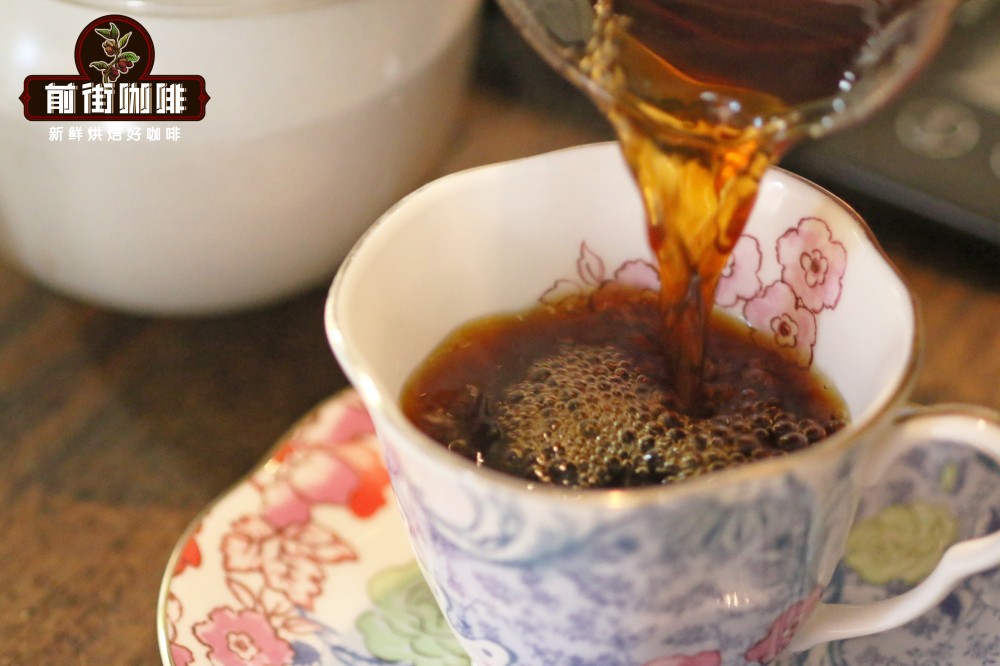
If you prefer coffee with acidity, Front Street Yirgacheffe is a choice well worth trying. Its bright citric acidity and jasmine-like aroma are often unforgettable once tasted. Worldwide, Yirgacheffe ranks among the most distinctive coffees, and it is a typical representative of African washed beans, long enjoying high praise in coffee circles. For this reason, Front Street washed Yirgacheffe has also become an everyday repurchase bean for many people.
Front Street Yirgacheffe's aroma layers are quite rich, and its mouthfeel is equally outstanding—hard to sum up in just a few words. Overall, Front Street Yirgacheffe's dry aroma carries an intense fruity character, with a substantial dried-fruit note and sweet aromas like strawberry, mango, and apricot jam. The wet aroma after pouring is like thick syrup, as if dense apricot nectar were wrapped in honest honey or chocolate. On the palate it isn't harsh, with moderate body; the acidity isn't sharp but rather lively and bright, overall like a cup of fruity black tea.
Front Street feels that "coffee enters the mouth, a hundred flowers bloom" is the perfect way to describe it, as if flowers blossom simultaneously on the taste buds and in the nasal cavity. Beyond the florals, its delicate body is like silk massaging the mouth, a truly wondrous sensation. At present, quite a few coffee chemistry researchers have begun analyzing the microclimate and soil-water conditions around Yirgacheffe, attempting to distill a set of cultivation rules for specialty coffee.
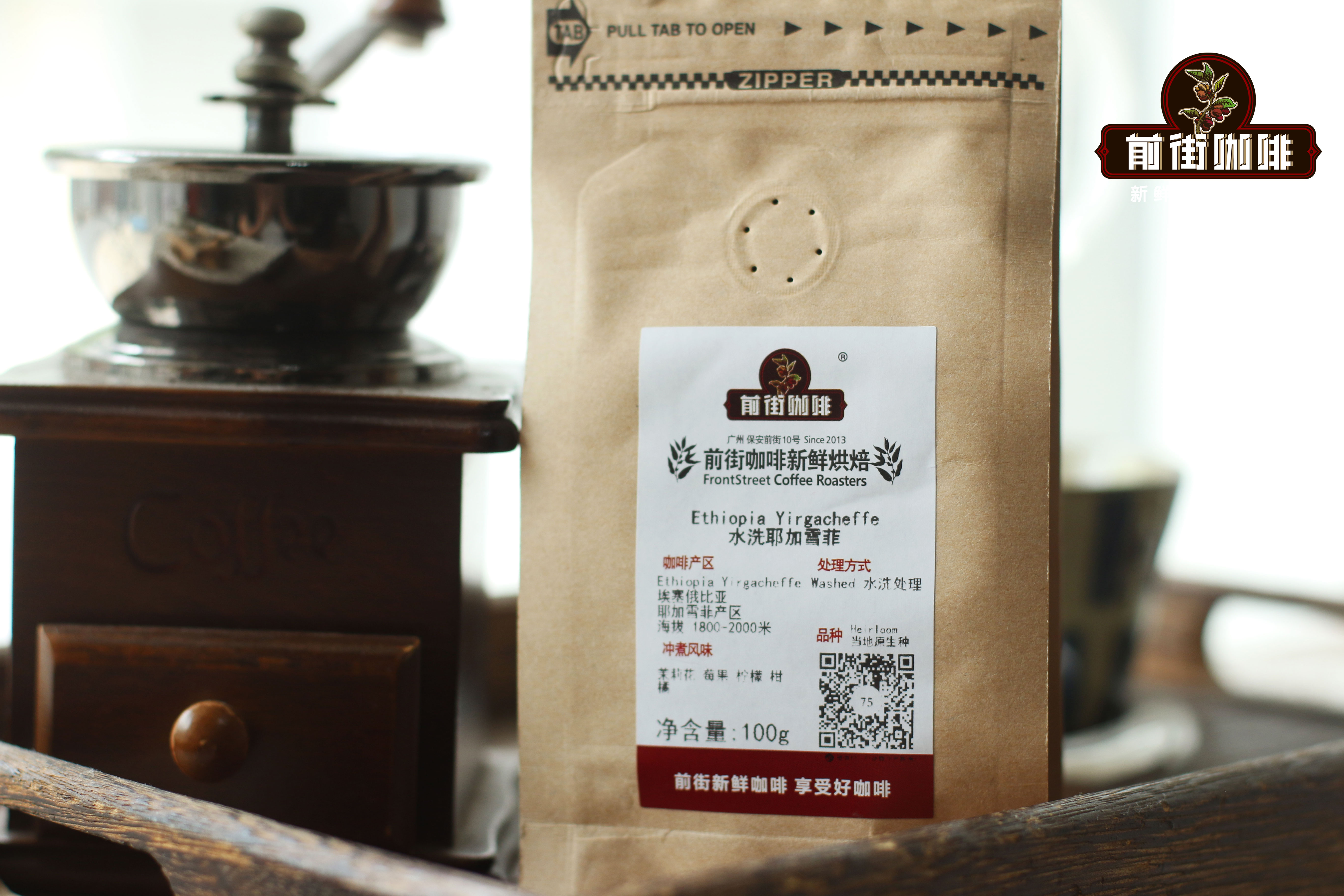
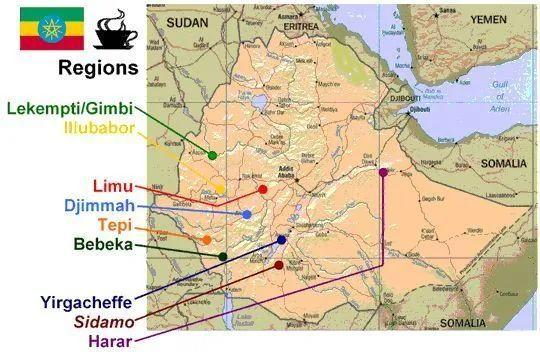
Most Ethiopian coffee beans are named after their region, and Yirgacheffe is a representative specialty coffee region of the country, at an altitude of roughly 1,800 to 2,000 meters, making it one of Ethiopia's highest coffee-growing regions. Front Street believes that the reason Front Street Yirgacheffe can present its unique interwoven citrus and floral flavors is inseparable from its special geographical environment. As the birthplace of coffee, Ethiopia possesses extremely rich coffee varieties; each region's microclimate differs, and coffee flavors vary accordingly—which is also why Front Street has selected over a dozen single-origin beans from the Ethiopian region alone.
Yirgacheffe Region
Yirgacheffe has always been one of Ethiopia's most important specialty coffee regions. It was originally part of the Sidamo region, later becoming independent because of its beans' unique flavor. You could say Yirgacheffe is not just a region's name but also a byword for a specific flavor. The region is high-altitude, about 2,000 meters, with more than 40 cooperatives, mainly managing coffee cultivation through family-run operations. But the production methods and flavors here are so outstanding that Ethiopian coffee farmers take pride in their coffee having Yirgacheffe flavor, and it eventually became independent from the Sidamo region, standing on its own as Africa's most famous region.
Front Street Coffee believes that every Yirgacheffe has its own unique flavor expression—for example, Front Street Yirgacheffe Red Cherry is dominated by berry notes.
Yirgacheffe Coffee Bean Varieties
Ethiopia can be called coffee's gene bank, with so many varieties that identification and classification are very difficult. In addition, out of protection for its natural coffee, the Ethiopian government is unwilling to disclose this variety information, so exported Ethiopian coffee beans are often collectively called "Heirloom" native varieties—and Yirgacheffe beans also belong to local heirloom varieties. In terms of bean shape, it is a small-seed type, fairly round in appearance, with a very small body, mostly between screen sizes 14 and 15.
Yirgacheffe Coffee Bean Grading
As Front Street has discussed before, coffee-producing countries grade differently—some by altitude, some by bean size, some by the proportion of defective beans. So what standard is used to grade Yirgacheffe coffee beans? Perhaps observant friends have noticed that Yirgacheffe is sometimes labeled G1—is that G1 the grade? That's right, it is the grade. Below, Front Street explains Yirgacheffe coffee grading in detail.
The ECX (Ethiopian Commodity Exchange, established in 2012) grading system for Ethiopian coffee beans includes two aspects.
The first aspect: grading by defect rate.
This system gives clear grading definitions for coffee bean defect rates. For both washed and natural beans, if export green beans contain no more than 3 defective beans per 300 grams, the grade is G1; if there are 4 to 12 defective beans per 300 grams, the grade is G2. Yirgacheffe beans are divided into G1, G2, G3, G4, etc. according to defects, and the higher the grade, the better the quality.
The second aspect: since the Ethiopian Commodity Exchange (ECX) began operating in 2009, flavor evaluation grading was also introduced. Following the SCA (Specialty Coffee Association of America) cupping method to evaluate G1 and G2 beans, a score of 85 or above is Q1 grade, while 80 to 84.75 points is Q2 grade.
Yirgacheffe Coffee Processing Methods
Speaking of washed Yirgacheffe, you might assume all coffee from the Yirgacheffe region is washed. In fact, Ethiopia traditionally used the ancient natural method, but after washed processing was introduced in 1972, over decades of development the use of washed processing has far exceeded natural. Front Street believes washed processing can reduce bean defects and produce a cleaner, more transparent flavor expression.
Natural processing is one of the oldest and most traditional methods. After the coffee fruit is picked, it is dried directly in the sun; this is more common in areas with abundant sunshine or scarce water resources—for example, nearly 70% of coffee fruit across all Ethiopian regions is naturally processed. Front Street believes that compared with washed coffee, natural coffee has lower acidity, higher sweetness, and a clearer tactile feel, but slightly inferior cleanliness, with more berry notes and greater complexity in flavor.
Front Street Brewing Suggestions
How should such an excellent coffee be brewed to show off its deliciousness? Front Street believes that the freshness of the coffee beans is a very key factor—only fresh beans can present rich flavors to the greatest extent. Coffee beans shipped by Front Street Coffee are all within 5 days of the roast date, because Front Street well knows the huge impact of freshness on flavor. Front Street's roasting motto is "freshly roasted good coffee," so that every customer who places an order receives the freshest beans when the coffee arrives. The coffee's resting period is about 4 to 7 days, so when customers receive it, it is exactly at its best.
Of course, some customers need Front Street to grind the coffee for them, and that's no problem either—but Front Street should remind you: once coffee beans are ground in advance, they no longer need resting, because during transport the pressure from carbon dioxide inside the package can also round out the flavor, so once you receive the ground coffee you can brew a cup right away. But ground coffee should be brewed as soon as possible, because after contact with air it oxidizes quickly and its flavor dissipates faster, so the quality won't be as good. Therefore Front Street recommends buying whole beans and grinding fresh for each brew, so you can better taste the coffee's flavor.
Parameters for brewing Front Street Yirgacheffe coffee:
V60 dripper, water temperature 90℃, water-to-coffee ratio 1:15, dose 15g, grind size (80% passing a Chinese No. 20 standard sieve)
Use staged extraction: first bloom with water at 2 times the coffee dose, i.e. 30 grams of water for a 30-second bloom. The purpose of the bloom is to let the coffee grounds release internal carbon dioxide, making the later stages of extraction more stable. Then pour in a small stream in circles until reaching 125 grams, pause, continue pouring until 225 grams and stop, and once all the water in the dripper has dripped through, remove the dripper. Start timing from the beginning of pouring; extraction time is 2 minutes 00 seconds. Finally, swirl the whole cup of coffee to mix, then pour into a cup and taste.
Front Street Washed Kochere coffee flavor: citrus, berries, tea-like, cream, slight nuts
Front Street Natural Red Cherry coffee flavor: berries, lemon, strawberry, fermented wine aroma
Professional coffee knowledge exchange. For more coffee bean information, please follow Coffee Workshop (WeChat public account: cafe_style).
For more specialty coffee beans, please add the private WeChat of Front Street Coffee: qjcoffeex.
The above content is compiled by CoffeeHunters, a coffee news website.


