







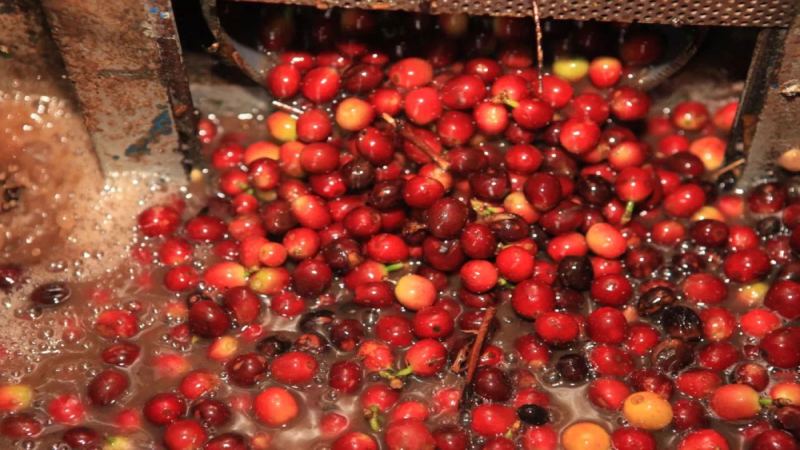

Why has Yunnan coffee become the raw material for instant coffee? The first coffee planted in Yunnan was the Typica variety. Later, in order to repay debts to the Soviet Union, Yunnan began to plant large quantities of Typica coffee beans, which were purchased by a unified department and then shipped to the Soviet Union. Later, because domestic coffee demand was not high, coffee farmers cut down their coffee trees one after another and planted crops with greater economic value.
But Yunnan is a treasure land for growing coffee. It is not only located between the Tropic of Cancer and the Tropic of Capricorn, but its altitude also meets the growth needs of coffee trees. So Nestle took a fancy to this treasure land and set up a coffee agriculture department in 1992 to specifically guide and research the improvement and cultivation of Yunnan coffee, introduce the high-yield and disease-resistant Catimor, and purchase coffee at prices based on the U.S. spot market.

In 1959, the Portuguese crossed the Brazilian Bourbon mutant Caturra with Timor, which has Robusta bloodlines, in East Timor, and unexpectedly succeeded in developing Catimor, which had strong disease resistance and productivity. Because leaf rust affected coffee-producing countries around the world, with the assistance of international organizations, producing countries vigorously promoted Catimor to resist leaf rust and increase productivity.
Catimor is not purely Arabica. It is a hybrid of Timor (a cross between Arabica and Robusta) and Caturra (a variety of Bourbon), so Catimor has 25% Robusta bloodlines, and its Robusta bloodlines also determine its flavor defects: the aroma is not rich enough, and the overall taste is heavily bitter.

At present, the coffee variety commonly grown in Yunnan is Catimor and its improved varieties. This is what people on the market often call Yunnan small-bean coffee. Now it seems that most of what is grown in Yunnan is Catimor. This variety is a hybrid of Caturra, a branch of the Bourbon line within the Arabica species, and the Robusta line. The reason for growing this variety is that Catimor has Robusta genes, so its disease resistance is stronger than that of a single old variety, and its yield is also better. Compared with delicate old varieties, which have poor disease resistance and low yields, farmers naturally prefer to grow Catimor, so Yunnan has now set off a wave of Catimor.This is also why when people mention Yunnan coffee, what comes to mind is that it is the raw material for instant coffee.

However, with the widespread popularity of specialty coffee culture and the growing demand for coffee among domestic consumers, Yunnan coffee has gained government attention in recent years, and everyone has also adopted more scientific practices for coffee tree cultivation and coffee bean processing. We can come across more and more Yunnan pour-over single-origin coffees. Here are two Yunnan small-bean coffees that are deeply loved by many people:

Front StreetYunnan small-bean coffee beans
Region: Baoshan, Yunnan, China
Altitude: 1200m
Variety: Catimor
Processing method: washed processing
Flavor: nutty notes, herbal, chocolate, caramel, with a light fruity acidity in the aftertaste.
Recommended reason: Can be used for pour-over and moka pot; at an affordable price, you can taste the typical Yunnan small-bean flavor.

Front Street 2013 Sun-Dried Typica Coffee Beans
Region: Lincang, Yunnan, China
Altitude: 1300m
Variety: Typica
Processing method: sun-dried processing
Flavor: berry-like acidity, nutty tone, brown sugar sweetness, with a tea-like aftertaste.
Recommended reason: Can be used for pour-over, cold brew, and American drip machines; high cost performance, with the authentic Yunnan small-bean Typica flavor.
The above content is compiled by CoffeeHunters, a coffee news website.

