





Why does channeling make espresso taste bitter?
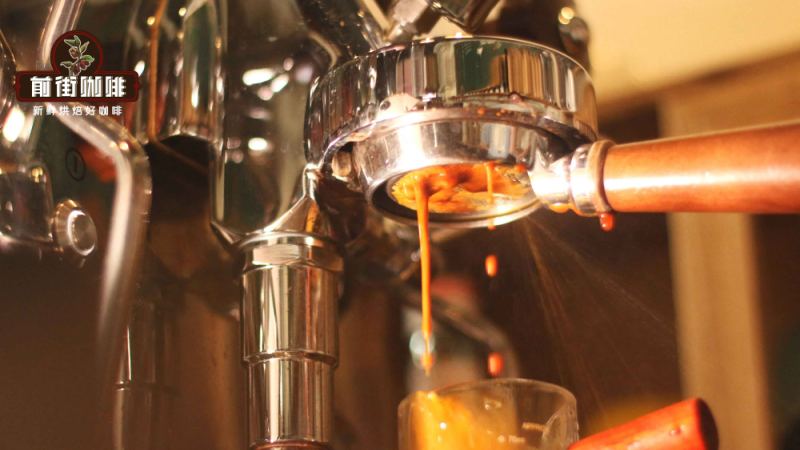
Channeling happens when high-pressure water punches small holes through the coffee puck, so most of the water shortcuts through those gaps instead of passing evenly through the grounds. The result is a flow rate that keeps speeding up, thin body, pale crema, and a cup that tastes both bland and sharply bitter. A bottomless portafilter makes the spurting easy to spot.
Look at the puck after the shot: a pitted, uneven surface with scattered holes confirms the damage. Common causes include uneven distribution, too small a dose, and a clogged dispersion screen. Fixes are distribution and tamping, adjusting the dose, cleaning the screen, and choosing beans suited to espresso. These steps reduce spraying and the harsh bitterness that comes with it.
When pulling espresso, a sudden increase in flow rate, lighter-colored crema, and a thin body often mean the puck has been pierced by the water flow—what is commonly known as channeling. This article starts with identifying the phenomenon, explains how to spot perforation using a bottomless portafilter, analyzes the main causes such as uneven distribution, insufficient dose, and a clogged dispersion screen, and offers specific solutions including distribution and tamping, adjusting the dose, cleaning the dispersion screen, and choosing suitable espresso beans, to help reduce spraying and bitterness and make espresso extraction more stable.
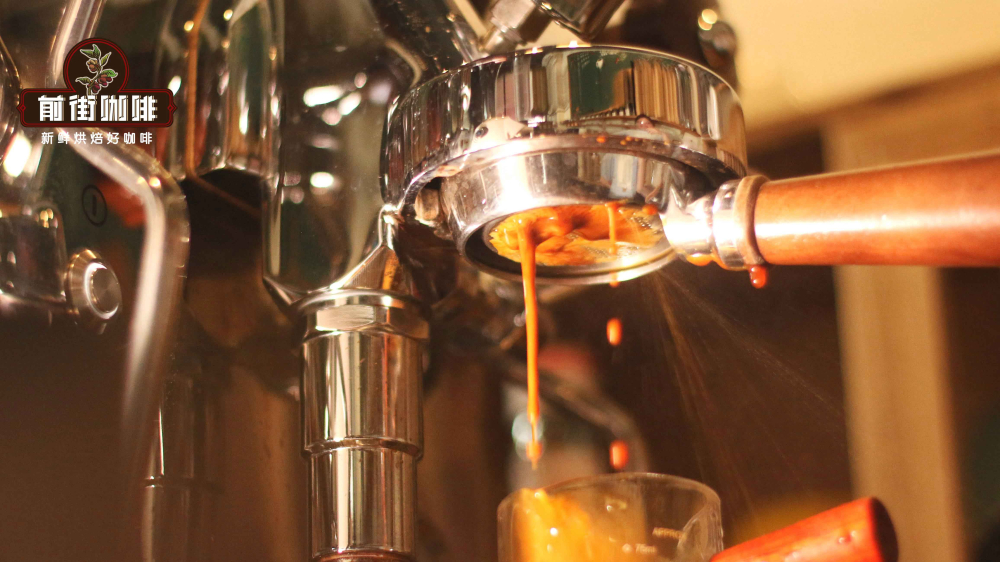
During espresso extraction, an uneven flow rate is a fairly common problem, and sometimes it gets faster and faster. If you swirl the cup a bit, you'll feel the coffee liquid is rather thin, and the crema on the surface isn't dark enough. When this happens, it usually means the puck has been punched with holes by the water flow.
What is meant by "perforation"?
After extraction is finished and you remove the portafilter, if you see the puck surface is pitted and uneven, with several small holes scattered across it, like this ⬇️
In more serious cases, it looks like this ⬇️
These holes are punched through by the high-pressure water during extraction. Once the holes form, the puck no longer offers consistent resistance to the water flow, and more water takes a shortcut through the holes, so the flow rate appears noticeably faster. The water flowing through the holes doesn't fully contact the coffee grounds, so extraction is naturally incomplete, resulting in a bland cup with lighter-colored crema. This phenomenon is generally called "channeling."
How do you detect perforation?
A bottomless portafilter exposes perforation most easily. First compare normal extraction with perforated extraction: during normal extraction, the coffee liquid flows at a roughly even rate, not fast one moment and slow the next, and the crema color transitions in an orderly way from dark to light.
Now look at extraction with perforation: the coffee liquid flows rather fast and keeps getting faster, even spurting twice, and the spurt points are exactly where the perforations are. You can see the flow rate at the holes is clearly higher than around them, and the crema color there is lighter than elsewhere.
Why does perforation occur?
The core causes can be grouped into three categories: uneven distribution, too small a dose, and overly concentrated water output.
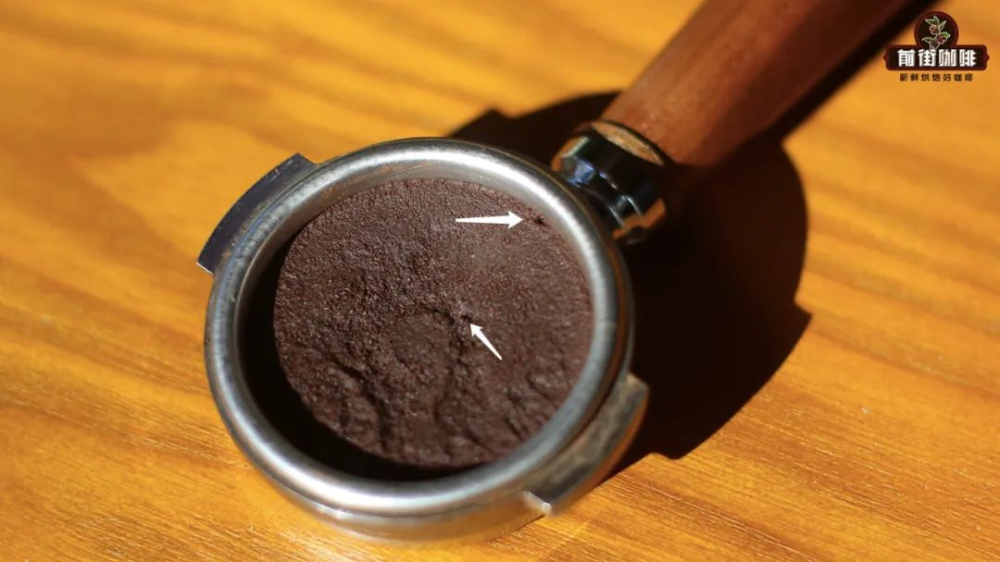
Inconsistent density inside the puck is a frequent cause of perforation. When the density of the coffee layer varies from place to place, water preferentially breaks through the areas with less resistance, and perforation follows.
To reduce this risk, you need to distribute and tamp before extraction. The purpose of distribution is to spread the coffee grounds roughly evenly in the basket, avoiding areas that are too loose or too dense; tamping compresses the evenly spread grounds into a firm puck so it doesn't fall apart the moment water hits it.
Many people know that making espresso requires distribution and tamping, but in practice they often do ineffective distribution—after distributing, it's still uneven, and perforation happens anyway.
The problem often lies in the dosing step: when catching grounds with the portafilter, you don't catch them well, or after catching them you try to level the grounds by tapping the portafilter, only to make them more compact the more you tap. A relatively easy way to achieve even distribution is to let the falling grounds pile up into a small mound that's high in the middle and low around the edges, then place the distribution tool vertically on the basket and rotate it a few turns. Once distribution is done properly, tamping just needs to ensure the surface is level.
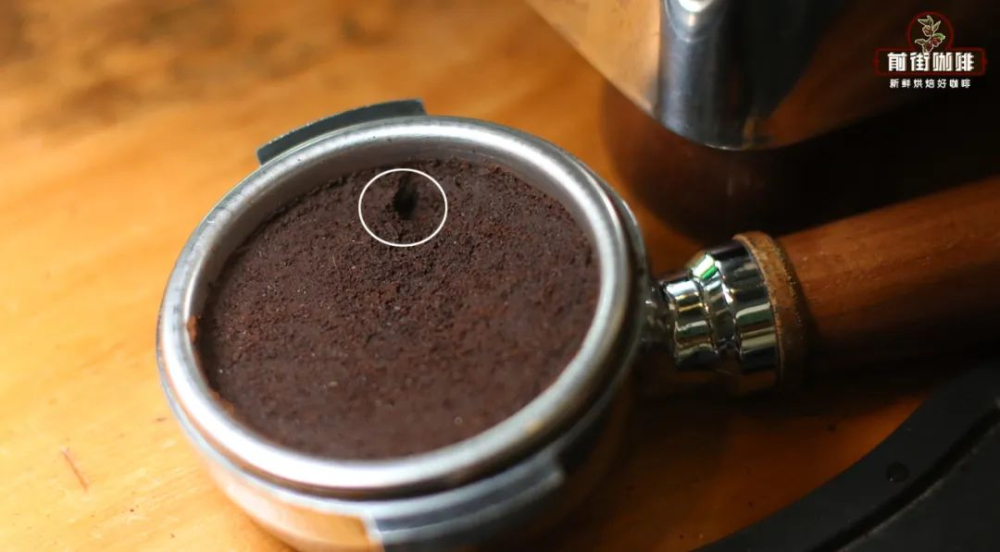
When the dose is too small, the distance between the dispersion screen and the puck increases, and during extraction the top layer of coffee grounds is easily churned up by the water flow, making surface resistance inconsistent and making perforation more likely. So some people avoid this problem by increasing the dose or switching to a smaller-capacity basket.
The job of the dispersion screen is to break a strong high-pressure column of water into an even flow. But once the dispersion screen is clogged by coffee residue sucked back up, the water distribution becomes unbalanced, and during extraction pressure on one side may become too high, punching straight through the coffee layer. This situation is also fairly easy to judge: during normal water output, the dispersion screen spreads the water into 4 to 5 streams; if something is wrong, the water merges into a single stream. At this point you need to remove the dispersion screen and clean it.
If all the above operational issues have been ruled out and channeling still occurs frequently during extraction, then the espresso beans themselves are likely unsuitable. The darker the roast, the more noticeably the beans expand and the looser their texture; compared with light-roasted beans, they absorb water more strongly and release flavor compounds more easily during extraction. Light-roasted beans, however, are harder in texture, and once tamped into a puck, hot water struggles to penetrate them, so it can only look for gaps, ultimately causing the coffee liquid to spurt.
For stable extraction, it's recommended to prioritize espresso blend beans of the same kind used in coffee shops. If you prefer a rich crema, you can try the medium-dark roasted Front Street. Commercial Blend: it uses the classic combination of Brazil and Colombia, with a small amount of Vietnamese Robusta added to further bring out a golden crema. The medium-dark roast delivers abundant crema and roasted aromas; as an Americano it's mellow and easy to drink, and as a latte it's rich and silky, leaving a lingering fragrance after you drink it.
The above content is compiled by CoffeeHunters, a coffee news website.


