







For more specialty coffee knowledge, please follow: Front Street Coffee (Frontsteet Coffee)
In daily life, many friends brew pour-over coffee without a thermometer, using an approximate water temperature to brew a coffee bean, and then because the taste is different every time, they start to question whether the coffee beans are not fresh or not tasty. How big a difference can water temperature make to the flavor expression of coffee? In this article, Front Street will discuss the effect of pour-over coffee water temperature on coffee extraction.
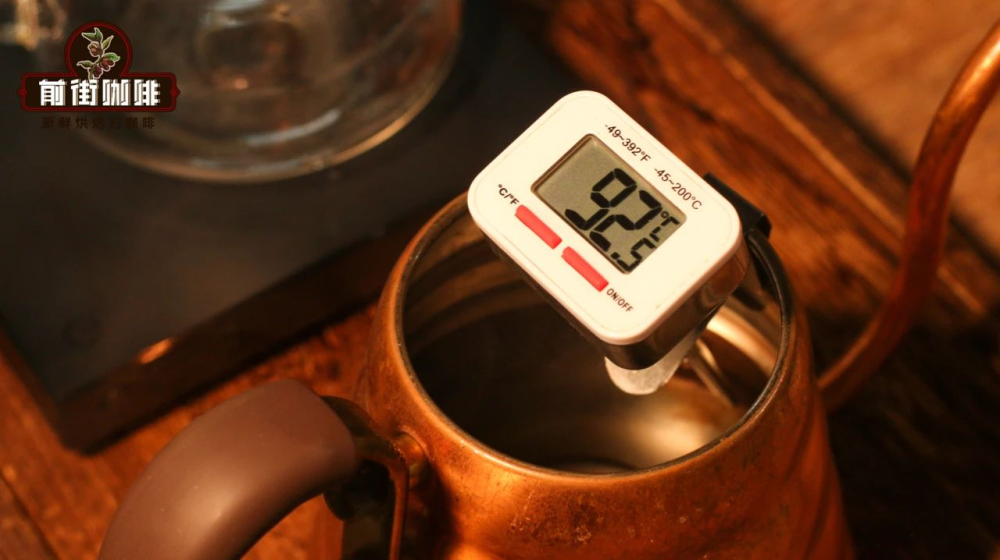
This time, Front Street used washed coffee beans from the Gotiti Cooperative in Yirgacheffe, Ethiopia, for experimental comparison.The generally recommended water temperature for pour-over coffee is 86-93°C, so this brewing was divided into 5 groups: 80°C, 86°C, 90°C, 93°C, and 96°C to brew this coffee bean.

Front Street's brewing parameters are as follows:
Dripper: Hario V60
Grind size: medium-fine grind (75% passing rate with a 0.85mm aperture sieve)
Dose: 15g
Coffee-to-water ratio: 1:15
Brewing water temperature:80°C, 86°C, 90°C, 93°C, 96°C

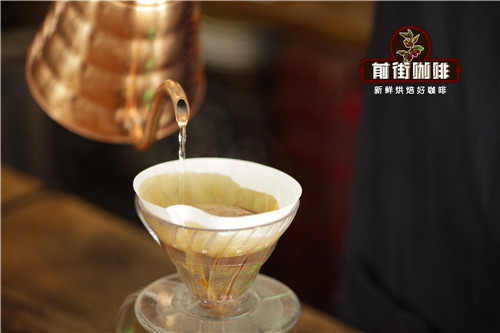
Front Street's staged extraction:This time, staged brewing was used. First, pour 30g of water for a 30s bloom; at this point the coffee expands into a “hamburger” shape. In the second stage, pour 125g of water in small circles from the center. The pouring height is 4cm, and the force is gentle to minimize the tumbling of the coffee bed as much as possible, with the water flow falling at 4g per second. When the water level drops to 1/2 of the coffee bed, begin the third stage of pouring. This stage is also poured gently in circles from the center outward until 225g is reached and the pouring ends. Extraction is finished when all the coffee liquid in the dripper has dripped through, with a time of 2'01". After extraction is complete, gently swirl it, and taste only after the coffee liquid is fully uniform.
Through 5 brews at different water temperatures, the results were respectively:
80°C: slightly sour and astringent, lemon peel, obvious tea-like note, with a tea sweetness as the main note.
86°C: kumquat acidity, with a slight sharp sourness.
90°C: bright citrus acidity, with obvious fruity sweetness.
93°C: bright citrus acidity, with a black tea note in the finish.
96°C: fruit tea, with a tea astringency, and concentrated flavor.

What effect does water temperature have on coffee extraction?
From the data of Front Street's brewing experiment, it is reflected that: the higher the water temperature, the more coffee substances are extracted and the higher the concentration; the lower the water temperature, the fewer coffee substances are extracted and the lower the concentration. From the perspective of flavor, when other parameters are fixed (light-roasted coffee), the lower the water temperature, the more the extracted coffee tends toward acidity, and the higher the water temperature, the more the extracted coffee tends toward bitterness and sweetness. Coffee is not better the higher the concentration, nor is it better the more coffee substances are extracted, so an appropriate water temperature can avoid over-extraction during brewing that causes coffee bitterness and astringency, and can also reduce the situation where under-extraction makes the coffee taste weak.
Why do different water temperatures produce different coffee flavor expressions?
During pour-over brewing, water and coffee undergo some complex chemical reactions, producing different reactions at different stages, and water temperature directly affects the extraction rate of different components in coffee during brewing, extracting the quinic acid, amino acids, tannic acid, caffeine, oils, and other substances contained in coffee.
Two-thirds of coffee beans are composed of lignocellulose, and the other one-third consists of some soluble aroma molecules, which, upon contact with water, are dissolved out in order according to molecular size. The first small-molecule substances to be dissolved out include acidity and aroma, then medium-molecule sweetness, and finally large-molecule bitter and roasted notes. This is how coffee's different layers of taste come about.
Water temperature is the key to accelerating the release of aroma molecules. Too high a temperature will cause aroma molecules to be released too quickly. If extraction is carried out within the same extraction time, the aroma molecules will have already been completely released before extraction is finished, so the remaining extraction time will release the taste of lignocellulose, making the coffee show woody notes, woody astringency, and so on; if the temperature is too low, the aroma molecules will be released too slowly,and if extraction is carried out within the same extraction time, the aroma molecules will not yet have been completely released after extraction is finished, so the resulting coffee will only have sourness and sweetness, lacking a mellow flavor, and the overall cup will appear thin.

So what water temperature is suitable for daily brewing?
Front Street Coffee recommends that the water temperature for pour-over coffee is generally between 86 and 93 degrees Celsius,Coffee beans with a lighter roast degree (such as the washed Yirgacheffe coffee beans just brewed by Front Street) use between 90 and 93 degrees Celsius, while coffee beans with a darker roast degree (such as Front Street's PWN Golden Mandheling coffee beans) use a lower water temperature between 86 and 88 degrees Celsius.
For professional coffee knowledge exchange and more coffee bean information, please follow Coffee Workshop (WeChat public account cafe_style)
The above content is compiled by CoffeeHunters, a coffee news website.


