









Making espresso-based coffee is an essential skill for every barista, and almost every café serves espresso-based drinks. What we commonly call espresso-based coffee is a series of coffee beverages made with espresso as the base. Today, let's make the easiest milk coffee among espresso drinks—iced latte.
Iced latte coffee seems like a very simple process, [put ice, pour milk, pour coffee] and it's done. But this seemingly simple operation requires a lot of thoughtful understanding to make a delicious iced latte.

First point: Choose suitable ingredients
Why is iced latte so simple that it's basically a must-have on every coffee bean menu, yet every shop's iced latte doesn't taste exactly the same? One of the main reasons is that the milk and coffee beans used are different. The flavor of coffee beans can very directly control the taste direction of iced latte coffee. Most espresso blend coffee beans will make iced latte show rich nutty, chocolate, and strong coffee flavors, while a few coffee beans bring out the sweetness and richness of the milk in the iced latte.

The choice of milk is also very important. Just for whole fresh milk alone, there are more than 10 common varieties on the market. Among these milks, some have a strong milk flavor, some have a thick mouthfeel, and some are light, like water. The standard for choosing milk is not to blindly pursue thick, obvious milk flavor, but to choose one that pairs well with coffee. A strong milk flavor will mask part of the coffee's taste, while milk with an obvious watery feel will also make the latte watery.

Second point: Reasonable milk-to-coffee ratio
Choose good coffee beans and good milk, and you can make a delicious iced latte, right? The premise is a reasonable ratio combination. Front Street Coffee's iced latte uses Sunflower · Warm Sun blend coffee beans and Vitasoy fresh milk. The ratio of espresso to milk is 1:6, that is, 40 grams of espresso liquid, corresponding to adding 240 grams of iced milk and 75 grams of ice cubes, and finally served in a transparent glass cup with a capacity of about 300ml.
This ratio is for everyone's reference, and is not the golden ratio for latte coffee. Front Street Coffee uses the above materials and obtained these parameters through multiple ratio adjustments, mainly based on real tasting feedback. So when making iced latte coffee, you can also appropriately adjust the ratio. More milk will mask the coffee flavor, less milk will make it bitter, and more ice will make it weaker.

Third point: Operational details
Just as the [put ice, pour milk, pour coffee] method for iced latte coffee is simple and clear, there are actually still some small details to note. The most important among them is the extraction of espresso. Whether a latte coffee is delicious or not depends on whether the espresso extraction meets the standard. Common espresso extraction problems such as channeling and incorrect extraction time will naturally also affect the taste of the iced latte.

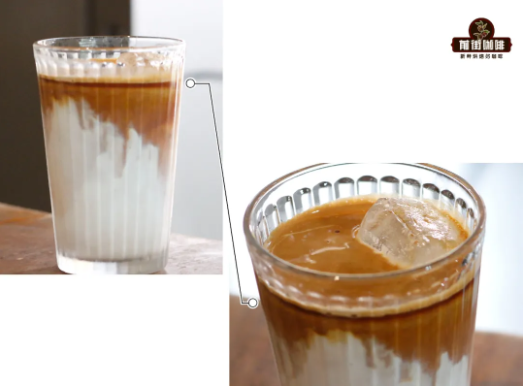
The process of making an iced latte also needs to be fast. Fast here means that the time the ice and milk spend in the cup should be as short as possible, and the freshly extracted espresso should be poured into the cup immediately. This is also why a freshly made iced latte coffee shows a gradient layer formed by milk and coffee. If the ice soaks in the milk for too long, the ice cubes will melt, a water layer will appear on top, and when drinking, the whole cup of coffee will become weaker. Espresso is even more sensitive. Freshly extracted espresso has very rich crema, but after 30 seconds, the crema noticeably decreases. Espresso without crema also finds it harder to float on the surface.
The above content is compiled by CoffeeHunters, a coffee news website.


