







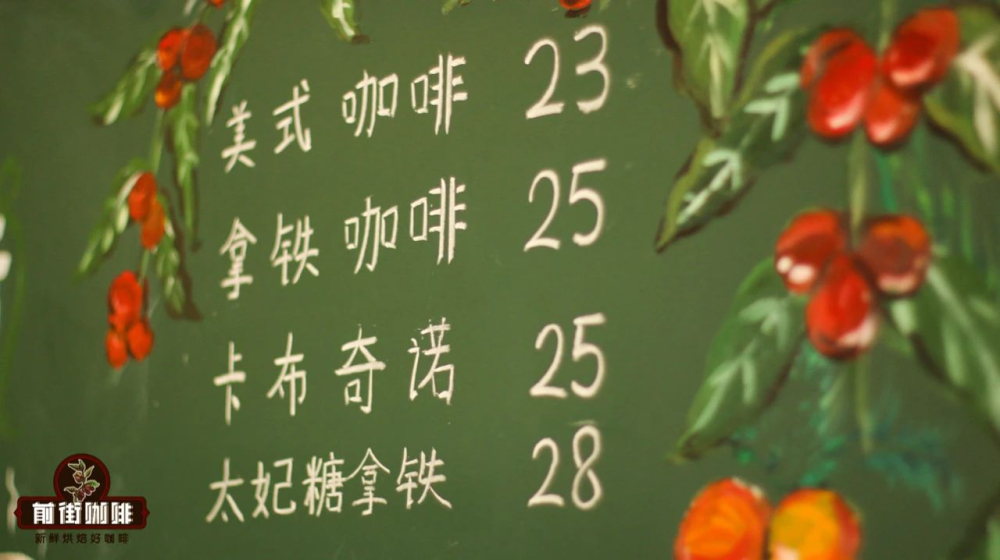
Espresso is a must-have beverage in every café. Many Chinese people's first impression of espresso is that it's bitterly awful. In fact, espresso drinks aren't limited to just the bitter espresso. If you want to enjoy an espresso drink that isn't bitter and suits your taste, the first thing you need to understand is the types of espresso drinks. Front Street Coffee is here to introduce the major types of espresso drinks commonly found in cafés, so everyone can gain a better understanding of espresso.
When it comes to espresso drinks, espresso is a type you absolutely must know. Why do we say that? Because other types of espresso drinks are also derived from espresso.

Authentic espresso is made using nearly boiling high-pressure hot water—"92-94°C, 9 bars of atmospheric pressure, 20-30 seconds of extraction time"—passing through finely ground, evenly tamped coffee grounds to produce about 30ml of beverage. On the surface, it carries a thick, dense layer of coffee oil foam called Crema. The color of the crema tends toward golden yellow and brown, and nowadays it can vary in color depending on the roast level. Traditional Italians place great importance on espresso culture and quality. To this end, the Italian National Coffee Institute provides official certification for espresso extraction parameters, making the brewing process data-transparent, which helps preserve the traditional flavors of espresso and allows for more complete transmission of this heritage.
The "es" in espresso actually corresponds to the English "ex," meaning fast and convenient. The coffee beans used for espresso are called House Blend, which is what we commonly hear as blended/formula coffee. As the name suggests, it's coffee beans blended from multiple origins. Using blended coffee beans helps balance flavors and stabilize the taste. To ensure the quality of the final brew, before making espresso, a professional grinder is usually used to grind the coffee beans to a fine state so that espresso can complete extraction in a short time.

Because espresso has a very intense flavor, many people add sugar or milk to balance the bitterness, which sparked the trend of using espresso as a base. Fancy espresso drinks are combined with syrups, cream, spices, and various other flavorings, creating diverse and layered coffee flavors—such as Con Panna, Macchiato, Caramel Macchiato, Cappuccino, Latte, Mocha, Caffè Americano… all members of the great espresso family!
Espresso is a foundational element of many coffee items. Now let's take a look at what common espresso drink types there are!
Espresso
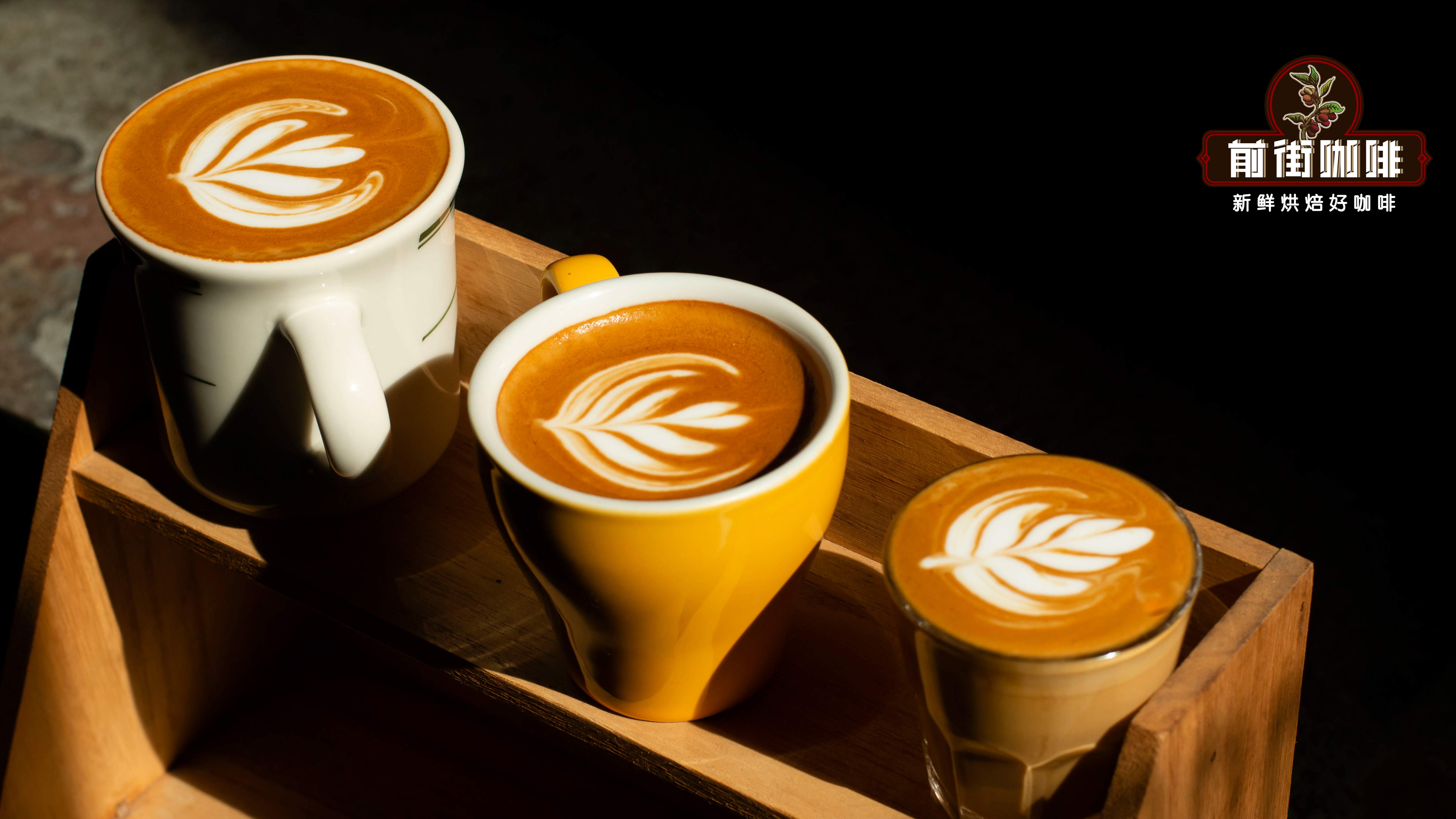
The most commonly seen type of espresso drink is espresso itself. Espresso uses dark-roasted coffee beans, and the coffee liquid is instantly extracted through steam pressure. The coffee has a strong taste and powerful bitterness, with the charred aroma of dark roasting. It can be said to be the spiritual symbol of the coffee world, and other espresso drink types are also derived from espresso. It can be said that if the espresso extraction isn't good, the other espresso drinks won't taste good either.
Espresso is a fast, concentrated coffee. Under the action of high steam pressure (around 9 atmospheres), when hot water quickly passes through the coffee grounds, the essence of the coffee is fully extracted, completing a cup of rich, aromatic, full-bodied coffee with a caramel note amid the bitterness.

Front Street Coffee generally uses a double shot of espresso (20g of coffee grounds) as the base, producing about 40g of espresso, with a very fine and rich layer of crema on the surface, also called "Crema."
Americano
The common Americano in cafés refers to a type of espresso drink made by diluting espresso with a large amount of hot water. It's said that during World War II, American soldiers who came to Italy couldn't get used to the strong taste of espresso, so they added a large amount of hot water to dilute it. It later became widely popular as another way of drinking espresso.

Front Street Coffee's hot Americano ratio is 40g of espresso mixed with 180ml of hot water, yielding a 220ml cup of Americano. The ratio of espresso to water is 1:4.5.
Caffe Latte
In Italian, latte means milk, while outside Europe it refers to a type of espresso drink with added milk and milk foam. The common latte is made with 1/5 espresso, 2/5 hot milk, and 2/5 milk foam. This type of espresso drink has a relatively rich flavor and can be further flavored with vanilla syrup, cinnamon, or caramel. Different regions also have different ratio adjustments. Front Street uses a double shot of 40g espresso paired with 260g of milk and milk foam when making lattes, with a milk foam thickness of 1cm. Of course, lattes can be made with exquisite latte art patterns. Under the perfect fusion of milk and coffee, the sweetness of the milk is highlighted while also expressing the mellow charm of the coffee.
Cappuccino
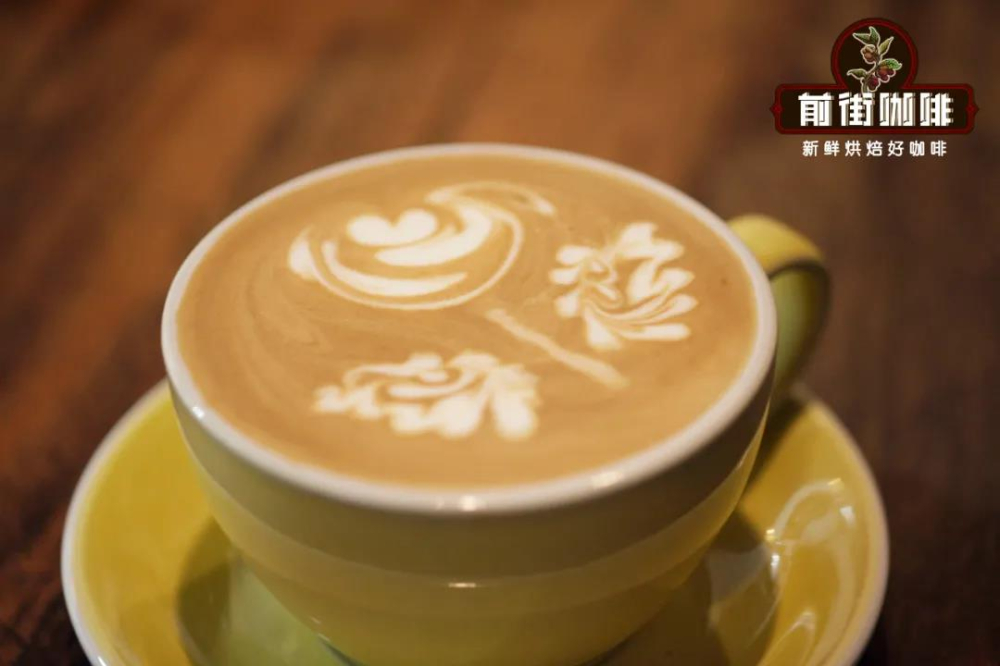
Also a type of espresso drink made from espresso, milk foam, and hot milk, cappuccino's ratios are 1/3 espresso, 1/3 milk, and 1/3 milk foam. The coffee proportion is heavier and the taste is stronger. The blended color resembles the robes of Italian Franciscan monks, hence the name from the Italian for Franciscan monk.

Front Street Coffee chooses to use a 180ml tulip cup when making cappuccino. Add one freshly extracted shot of espresso into the cup, then add milk that has been steamed with dense, thick milk foam.
Mocha
Mocha originally referred to a type of coffee bean with a chocolate aroma, and later came to broadly refer to all espresso drink types with added chocolate. The common ratio is 2/5 espresso, 2/5 hot chocolate, and 1/5 hot milk. You can taste both the aroma of coffee and the rich smoothness of chocolate, with a relatively smooth mouthfeel. Friends who love chocolate drinks can give this espresso drink a try!

Front Street Coffee's mocha recipe is 40g espresso + 20g chocolate sauce + 260g hot milk.
Macchiato
Macchiato is an Italian word meaning "marked." Macchiato coffee originated in 1980s Italy, when some customers had the habit of adding a small amount of milk to their espresso, but the milk would quickly disappear into the crema. So baristas wanted to distinguish a plain espresso from an espresso containing a small amount of milk, and used milk foam to "mark" a white dot on top of the crema.

Later, people discovered that in the gradual fusion of milk foam and espresso, one could taste the rich fragrance and mellowness of the espresso while also experiencing the dense sweetness of the milk, interweaving and blending in the mouth—wonderfully indescribable. Thus the traditional macchiato was born.
Front Street Coffee macchiato recipe: 40g espresso + 1 spoon of fine milk foam.
Caramel Macchiato
This is Starbucks' star espresso drink (having nothing to do with macchiato). A medium 355ml cup contains 1 shot (about 30ml) of espresso, with the other 300-plus milliliters being milk with milk foam, vanilla syrup, and caramel. The taste is sweet and fragrant.
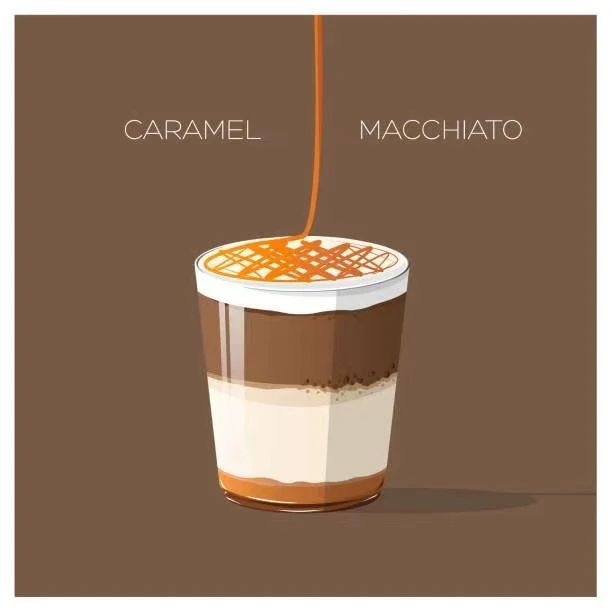
Caramel Macchiato: When making it, a large amount of milk and milk foam is used, not much different from a wet cappuccino or a thicker latte. Vanilla syrup and smooth hot fresh milk, topped with soft, fine milk foam, blended with mellow espresso, plus smooth caramel sauce—the sweet and mellow Caramel Macchiato becomes a great choice for coffee lovers to enjoy espresso.
Dirty Coffee
Many people wonder what the difference is between Dirty Coffee and iced latte. Indeed, from ingredients to recipe to appearance, the two have far too many similarities. But if you observe carefully, you'll find that Dirty is essentially a more refined iced latte. Its biggest difference lies in the choice of vessel and the attention to detail in execution.

The vessel chosen for Dirty Coffee is often a glass cup that can showcase the beautiful liquid, and no ice is added. The emphasis is on the espresso liquid flowing into the pure white milk, slowly penetrating, slowly blending, forming a beautiful layered effect. As time passes, the pure white milk is gradually "polluted" by the rich espresso. Looking through the glass, the drink appears dirty. Besides the visual dirtiness, it also contains the collision between cold milk and hot espresso, allowing one to feel the change from hot to cold in a single cup of coffee.
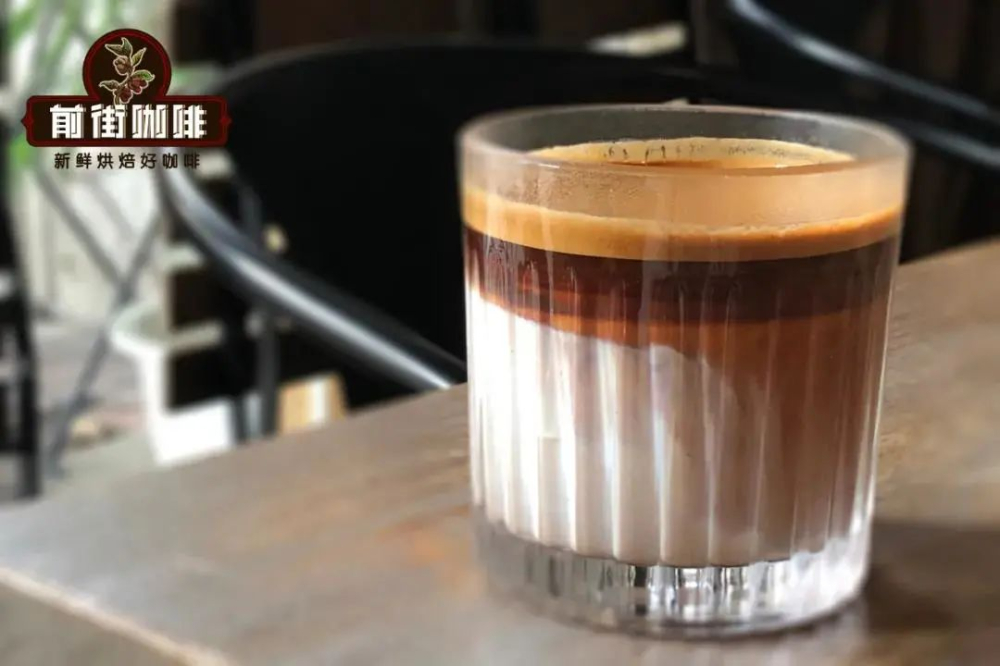
Front Street Coffee's Dirty recipe ratio is 150g of milk and 40g of espresso. First, take out a pre-chilled glass cup, making sure there's no water in it, and pour in cold milk. Then lock on the tamped portafilter and place the glass with cold milk below the spout (for a bottomless portafilter, place it directly below the extraction outlet). The spout shouldn't be too far from the liquid surface; if too far, the coffee's own gravity will create stronger penetration and tend to "blend in." A distance of about 1cm is recommended. A proper espresso will flow evenly and slowly onto the milk surface, "floating" on the surface and slowly sinking, creating that dirty effect.
Drinking Dirty requires no stirring, and you should drink it quickly. You'll find that the hot espresso on top hasn't been cooled by the ice yet, and the milk below hasn't been "polluted" yet. That transformation from a rich, chocolate-flavored hot coffee to a milky, icy, light coffee is simply wonderful.
For professional coffee knowledge exchange and more coffee bean information, please follow Coffee Workshop (WeChat public account: cafe_style)
For more specialty coffee beans, please add the private WeChat of Front Street Coffee: qjcoffeex
Espresso is a must-have beverage in every café. Many Chinese people's first impression of espresso is that it's bitterly awful. In fact, espresso drinks aren't limited to just the bitter espresso. If you want to enjoy an espresso drink that isn't bitter and suits your taste, the first thing you need to understand is the types of espresso drinks. Front Street Coffee is here to introduce the major types of espresso drinks commonly found in cafés, so everyone can gain a better understanding of espresso.
When it comes to espresso drinks, espresso is a type you absolutely must know. Why do we say that? Because other types of espresso drinks are also derived from espresso.
Authentic espresso is made using nearly boiling high-pressure hot water—"92-94°C, 9 bars of atmospheric pressure, 20-30 seconds of extraction time"—passing through finely ground, evenly tamped coffee grounds to produce about 30ml of beverage. On the surface, it carries a thick, dense layer of coffee oil foam called Crema. The color of the crema tends toward golden yellow and brown, and nowadays it can vary in color depending on the roast level. Traditional Italians place great importance on espresso culture and quality. To this end, the Italian National Coffee Institute provides official certification for espresso extraction parameters, making the brewing process data-transparent, which helps preserve the traditional flavors of espresso and allows for more complete transmission of this heritage.
The "es" in espresso actually corresponds to the English "ex," meaning fast and convenient. The coffee beans used for espresso are called House Blend, which is what we commonly hear as blended/formula coffee. As the name suggests, it's coffee beans blended from multiple origins. Using blended coffee beans helps balance flavors and stabilize the taste. To ensure the quality of the final brew, before making espresso, a professional grinder is usually used to grind the coffee beans to a fine state so that espresso can complete extraction in a short time.
Because espresso has a very intense flavor, many people add sugar or milk to balance the bitterness, which sparked the trend of using espresso as a base. Fancy espresso drinks are combined with syrups, cream, spices, and various other flavorings, creating diverse and layered coffee flavors—such as Con Panna, Macchiato, Caramel Macchiato, Cappuccino, Latte, Mocha, Caffè Americano… all members of the great espresso family!
Espresso is a foundational element of many coffee items. Now let's take a look at what common espresso drink types there are!
Espresso
The most commonly seen type of espresso drink is espresso itself. Espresso uses dark-roasted coffee beans, and the coffee liquid is instantly extracted through steam pressure. The coffee has a strong taste and powerful bitterness, with the charred aroma of dark roasting. It can be said to be the spiritual symbol of the coffee world, and other espresso drink types are also derived from espresso. It can be said that if the espresso extraction isn't good, the other espresso drinks won't taste good either.
Espresso is a fast, concentrated coffee. Under the action of high steam pressure (around 9 atmospheres), when hot water quickly passes through the coffee grounds, the essence of the coffee is fully extracted, completing a cup of rich, aromatic, full-bodied coffee with a caramel note amid the bitterness.
Front Street Coffee generally uses a double shot of espresso (20g of coffee grounds) as the base, producing about 40g of espresso, with a very fine and rich layer of crema on the surface, also called "Crema."
Americano
The common Americano in cafés refers to a type of espresso drink made by diluting espresso with a large amount of hot water. It's said that during World War II, American soldiers who came to Italy couldn't get used to the strong taste of espresso, so they added a large amount of hot water to dilute it. It later became widely popular as another way of drinking espresso.
Front Street Coffee's hot Americano ratio is 40g of espresso mixed with 180ml of hot water, yielding a 220ml cup of Americano. The ratio of espresso to water is 1:4.5.
Caffe Latte
In Italian, latte means milk, while outside Europe it refers to a type of espresso drink with added milk and milk foam. The common latte is made with 1/5 espresso, 2/5 hot milk, and 2/5 milk foam. This type of espresso drink has a relatively rich flavor and can be further flavored with vanilla syrup, cinnamon, or caramel. Different regions also have different ratio adjustments. Front Street uses a double shot of 40g espresso paired with 260g of milk and milk foam when making lattes, with a milk foam thickness of 1cm. Of course, lattes can be made with exquisite latte art patterns. Under the perfect fusion of milk and coffee, the sweetness of the milk is highlighted while also expressing the mellow charm of the coffee.
Cappuccino
Also a type of espresso drink made from espresso, milk foam, and hot milk, cappuccino's ratios are 1/3 espresso, 1/3 milk, and 1/3 milk foam. The coffee proportion is heavier and the taste is stronger. The blended color resembles the robes of Italian Franciscan monks, hence the name from the Italian for Franciscan monk.
Front Street Coffee chooses to use a 180ml tulip cup when making cappuccino. Add one freshly extracted shot of espresso into the cup, then add milk that has been steamed with dense, thick milk foam.
Mocha
Mocha originally referred to a type of coffee bean with a chocolate aroma, and later came to broadly refer to all espresso drink types with added chocolate. The common ratio is 2/5 espresso, 2/5 hot chocolate, and 1/5 hot milk. You can taste both the aroma of coffee and the rich smoothness of chocolate, with a relatively smooth mouthfeel. Friends who love chocolate drinks can give this espresso drink a try!
Front Street Coffee's mocha recipe is 40g espresso + 20g chocolate sauce + 260g hot milk.
Macchiato
Macchiato is an Italian word meaning "marked." Macchiato coffee originated in 1980s Italy, when some customers had the habit of adding a small amount of milk to their espresso, but the milk would quickly disappear into the crema. So baristas wanted to distinguish a plain espresso from an espresso containing a small amount of milk, and used milk foam to "mark" a white dot on top of the crema.
Later, people discovered that in the gradual fusion of milk foam and espresso, one could taste the rich fragrance and mellowness of the espresso while also experiencing the dense sweetness of the milk, interweaving and blending in the mouth—wonderfully indescribable. Thus the traditional macchiato was born.
Front Street Coffee macchiato recipe: 40g espresso + 1 spoon of fine milk foam.
Caramel Macchiato
This is Starbucks' star espresso drink (having nothing to do with macchiato). A medium 355ml cup contains 1 shot (about 30ml) of espresso, with the other 300-plus milliliters being milk with milk foam, vanilla syrup, and caramel. The taste is sweet and fragrant.
Caramel Macchiato: When making it, a large amount of milk and milk foam is used, not much different from a wet cappuccino or a thicker latte. Vanilla syrup and smooth hot fresh milk, topped with soft, fine milk foam, blended with mellow espresso, plus smooth caramel sauce—the sweet and mellow Caramel Macchiato becomes a great choice for coffee lovers to enjoy espresso.
Dirty Coffee
Many people wonder what the difference is between Dirty Coffee and iced latte. Indeed, from ingredients to recipe to appearance, the two have far too many similarities. But if you observe carefully, you'll find that Dirty is essentially a more refined iced latte. Its biggest difference lies in the choice of vessel and the attention to detail in execution.
The vessel chosen for Dirty Coffee is often a glass cup that can showcase the beautiful liquid, and no ice is added. The emphasis is on the espresso liquid flowing into the pure white milk, slowly penetrating, slowly blending, forming a beautiful layered effect. As time passes, the pure white milk is gradually "polluted" by the rich espresso. Looking through the glass, the drink appears dirty. Besides the visual dirtiness, it also contains the collision between cold milk and hot espresso, allowing one to feel the change from hot to cold in a single cup of coffee.
Front Street Coffee's Dirty recipe ratio is 150g of milk and 40g of espresso. First, take out a pre-chilled glass cup, making sure there's no water in it, and pour in cold milk. Then lock on the tamped portafilter and place the glass with cold milk below the spout (for a bottomless portafilter, place it directly below the extraction outlet). The spout shouldn't be too far from the liquid surface; if too far, the coffee's own gravity will create stronger penetration and tend to "blend in." A distance of about 1cm is recommended. A proper espresso will flow evenly and slowly onto the milk surface, "floating" on the surface and slowly sinking, creating that dirty effect.
Drinking Dirty requires no stirring, and you should drink it quickly. You'll find that the hot espresso on top hasn't been cooled by the ice yet, and the milk below hasn't been "polluted" yet. That transformation from a rich, chocolate-flavored hot coffee to a milky, icy, light coffee is simply wonderful.
For professional coffee knowledge exchange and more coffee bean information, please follow Coffee Workshop (WeChat public account: cafe_style)
For more specialty coffee beans, please add the private WeChat of Front Street Coffee: qjcoffeex
The above content is compiled by CoffeeHunters, a coffee news website.


