When we talk about Dirty coffee, it's simply putting milk in a glass, placing it under the espresso machine's group head, and letting the espresso slowly flow into the glass, so the coffee floats on top of the milk, forming a beautiful layer. Over time, the coffee layer gradually seeps into the white milk, creating that "dirty" look.

Reading others' descriptions of Dirty coffee, it seems like anyone with hands can make it. But in reality: "Why doesn't mine have layers?", "My coffee layer sank to the bottom," "It turned completely milk-tea colored."What's the difference between Dirty and iced latte?Dirty and iced latte look very similar—both are layered right after being made. But the drinking experience is completely different. Iced latte usually has ice cubes and more milk, and needs to be stirred before drinking. Dirty, on the other hand, uses a smaller cup and is typically drunk in its layered state: the first sip is rich coffee flavor; the second sip is the aroma of coffee and milk blending; the third sip is pure creamy milk—an immersive experience.How do you make a Dirty coffee with distinct layers?The method for making Dirty coffee is no secret anymore—the process is basically identical every time, so Front Street Coffee won't go into detail here. Instead, let's share the key details Front Street Coffee focuses on when making Dirty coffee. To sum it up as a mantra:"Extreme cold against extreme heat, matched concentrations on both sides, impact force minimized." ○ Dirty coffee has no ice, so to keep it cold, you have to rely on other things—the cup and the milk are the best options. At Front Street Coffee, the cups and milk used for Dirty coffee are usually stored in the fridge and taken out when needed. Sufficiently low temperature makes the coffee more stable and prevents the Dirty coffee from turning into room-temperature coffee by the time it reaches the customer.

○ Both the milk and the coffee need to have relatively high concentrations, and not too different from each other. When two high-concentration solutions of similar density merge, they permeate each other more slowly—that is, a stable layer forms. But when the bottom solution's concentration is noticeably lower than the top solution's, the top solution quickly seeps into the bottom—that's the "sinking" phenomenon. And when the bottom solution's concentration is noticeably higher than the top's, the layered structure becomes very firm—you can see this with Ice Breaker Dirty coffee.In other words, when the milk is too thin, it can't support the weight of the coffee, so the coffee sinks and there's no layering. But when the milk is too thick, the coffee can't seep in, so the layers stay too firm and there's no "dirty" effect. This is assuming the espresso is in a normal state.
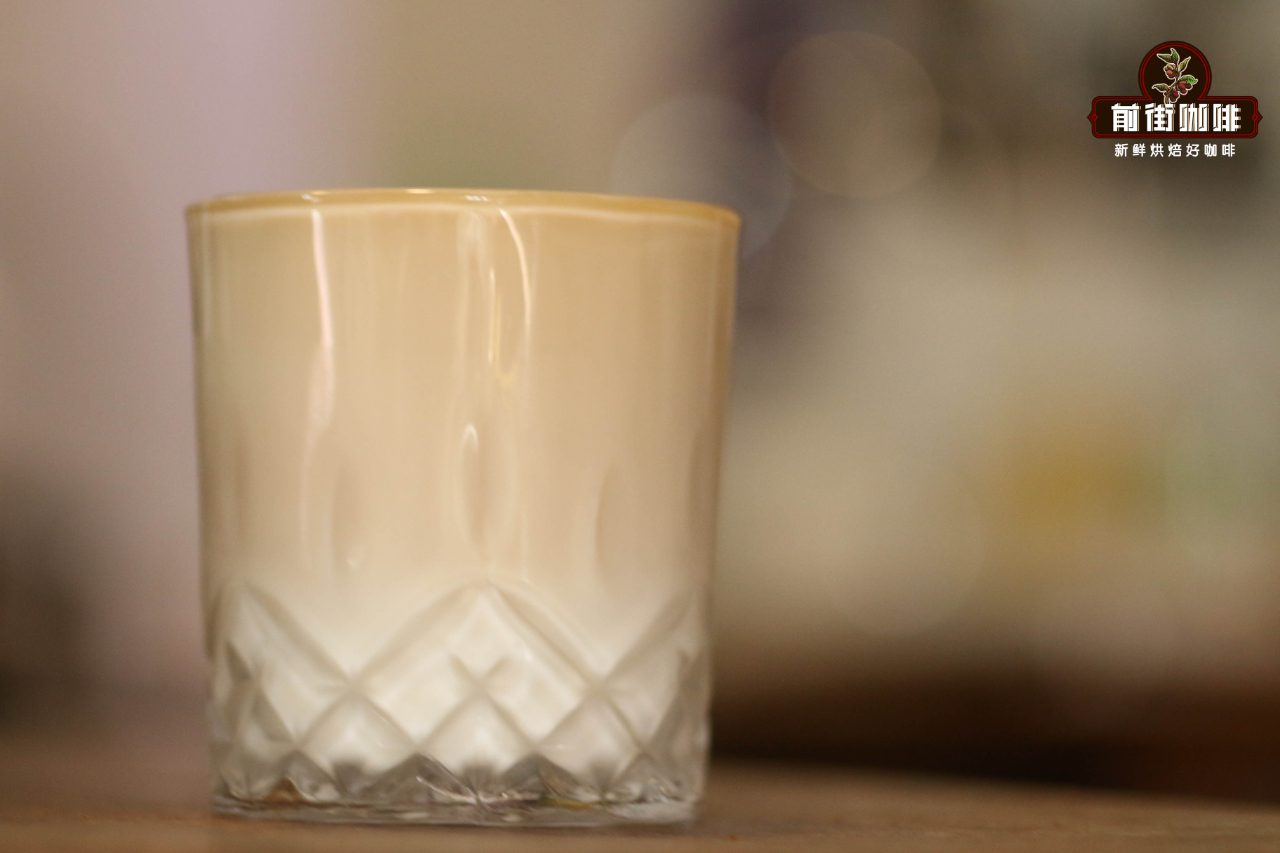
And when the milk is at normal concentration but the coffee is too thin, they also tend to permeate each other easily—put simply, the overall concentration is low, the difference between the two is too large, and the coffee's mass is too great (high water content). Espresso with rich crema floats on the surface more easily, because its weight is less than its volume—that is, its mass is small.

The fresh milk used at Front Street Coffee has a concentration of about 10.66%, while the espresso has a concentration of about 9.88%. The two concentrations are close, with the coffee slightly lower than the milk, forming a perfect "layer" right after being made, and within 2 minutes it also achieves the downward "dirty" state.○ The last thing is to reduce impact force—whether it's the coffee flowing into the milk or the milk being poured into the cup. When choosing a cup, pick an appropriate size. For example, if Front Street Coffee is making a 220ml coffee, choose a cup of 220-240ml.When pouring the milk, try not to use too much force—excessive impact easily creates bubbles on the milk's surface. And when receiving the coffee, the shorter the distance, the better—let the coffee slowly flow into the cup and float on top of the milk. If you raise that distance, gravity's acceleration will definitely make the layering worse.

The whole approach emphasizes one word: "gentle"!And a tiny bit of physics knowledge.
The above content is compiled by CoffeeHunters, a coffee news website.