






Is iced americano bitter depending on how much ice you add?
Ice in an iced americano does more than chill the drink. It locks in aroma, holds a low temperature, and controls concentration. Because most iced coffee is brewed hot and then cooled, the ice amount decides how diluted the final cup becomes. Too little ice leaves it warm and weak; too much melts fast and flattens the flavor.
Solid ice melts more slowly than hollow ice, and refrozen ice holds its shape longer, so it waters the drink down less. Iced americano, iced latte, iced pour-over, and cold brew each take different ratios. Using good beans, sensible extraction, and the right ice proportion is what keeps an iced americano from turning bitter or thin.
When drinking iced coffee, have you ever struggled with how much ice to add and how to add it properly? In fact, ice in iced coffee is far more than just about cooling—it also plays multiple roles such as locking in aroma, maintaining low temperature, and balancing concentration. This article starts from the principles of how ice works, breaks down in detail the differences between solid ice and hollow ice, the advantages of refrozen ice, and for different categories such as iced Americano, iced latte, iced pour-over, and cold brew/ice drip, provides specific ice ratios and Front Street brand recommendations, helping you make a cup of iced coffee at home that isn't watered down and has ample aroma.
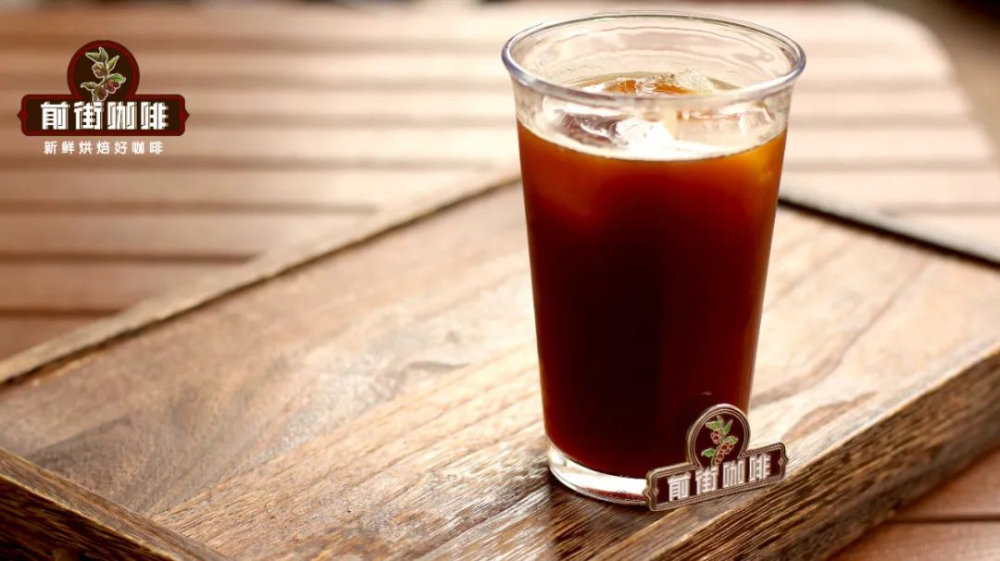
Everyone has surely had iced coffee. Generally speaking, as long as the coffee beans are of good quality, the extraction parameters are set reasonably, the concentration is properly controlled, and ice is added in a certain ratio, the final product can usually present a satisfying icy flavor. However, Front Street still often hears friends ask: How should ice be added? How much is appropriate? Should ice be added first or last?
Today Front Street will continue to talk with everyone about the tricks of using ice in coffee.
The core functions of ice
Ice itself has no color and no taste, and seems merely an accompaniment to the drink, but in iced coffee that pursues a low-temperature stimulating mouthfeel, its position is quite crucial. Used properly, it can take coffee to the next level; used incorrectly, a good cup of coffee may instantly turn into "ashtray water."
Nowadays, more and more players are entering the field, and almost all common coffees on the market have iced versions, with methods varying widely and parameters so numerous they make one dizzy. But in the end, the underlying logic remains unchanged. As long as you understand the principles, adding ice is not difficult at all.
1. Rapid cooling
Looking at coffee shop menus, you can find that except for cold brew and ice drip, the vast majority of iced coffees are extracted by bringing hot water into contact with coffee grounds, so they are most aromatic when just made, but also hottest. If you want to turn it into a cold drink immediately, adding ice directly is the quickest and easiest way to do it.
But there is a common sense point: ice cools by absorbing heat and melting. To avoid the coffee not yet cooled thoroughly while the ice has all melted into water, we must leave a certain "margin" in concentration for the ice to do its job. In other words, before cooling, the coffee must be strong enough and flavorful enough to withstand dilution by ice.
2. Locking in coffee aroma
If you think a cup of coffee is too bitter, you can add sugar and milk to weaken the bitterness, but the amount must be controlled well, otherwise the coffee will be diluted or become too sweet and cloying. Adding ice can not only suppress bitterness, but also lock in the coffee's aroma through rapid cooling.
3. Maintaining a low-temperature state
Research shows that human taste has perceptual characteristics related to temperature, and the intensity of flavors changes with temperature. When drinking iced coffee, the tongue's sensitivity to bitterness decreases, because low temperature neutralizes and reduces bitterness, making the coffee easier to drink, while the brief numbing of the tongue also reduces the perception of bitterness.
However, when iced coffee gradually warms back up, moving from cold toward room temperature, the taste buds' perception of bitterness increases, and the coffee begins to taste bitter, even astringent. So if you want a better drinking experience, maintaining a low-temperature state is very important.
Based on the above three points, when deciding the amount of ice, the key is whether it can make hot coffee cool quickly, maintain a low-temperature state, and at the same time not melt too fast and make the coffee bland. In other words, making a good cup of iced coffee requires considering not only how much ice, but also the quality of the ice.
What are the tricks of ice?
Ice on the market is roughly divided into solid ice and hollow ice, and if classified by shape, there are square, spherical, crescent, snowflake, and so on. Many milk tea shops prefer square and crescent shapes. Square ice is mostly hollow, not large in particle size, and melts relatively quickly; crescent ice is solid, high in hardness, and melts more slowly in water.

Ice-making molds used at home are usually mainly spherical and square, and because they are statically frozen, they are all solid ice. Under the same shape, the larger the volume, the slower it melts, but the longer the freezing time. In addition, ice that has been refrozen is harder, and after being put into coffee, it cools better than newly frozen ice just removed from the mold. (Front Street conducted comparative experiments and found little difference between coffee made with ice added first and ice added later, so this is not discussed separately here.)
For friends who like to drink iced coffee at home, Front Street suggests choosing larger-sized ice trays when buying them, or using a single large spherical mold, so the ice freezes more solidly. If the ice tray you have is on the small side, you can unmold the ice in advance and store it in a clean container, which can keep the ice harder.
How should ice be added to different coffees?
After understanding the purpose of using ice and grasping the factors affecting ice quality, you can then combine that with actual conditions to find the corresponding amount of ice to add. For iced coffee that starts hot and then becomes cold, Front Street's approach is: ensure both aroma and concentration, and also maintain low temperature for a long time, so the proportion of ice should be large, and refrozen large ice cubes should be preferred;
Prioritize espresso blends, with Front Street Classic Blend and Front Street Dark Cocoa Blend as top choices, suitable for beginners to make.
Iced Americano: 40g espresso + 120ml water + 100g large ice cubes; the ice is 2.5 times the coffee liquid;
Iced Latte: 40g espresso + 180ml low-temperature fresh milk + 80g large ice cubes; the ice is 2 times the coffee liquid;
For pour-over coffee, prioritize single-origin beans, with the most cost-effective everyday beans as top choices, such as the floral and lemony Front Street Yirgacheffe and the herbal and woody Front Street Mandheling;
Iced Pour-over: 15g coffee grounds / 150ml hot water / 75g ice cubes; the ice is 5 times the coffee grounds;
Considering that coffee liquid extracted at low temperature is already cold and needs no extra cooling, but because Front Street habitually uses a slightly higher concentration ratio, a small amount of ice is needed to slightly dilute the coffee liquid:

For cold brew and ice drip, prioritize medium-roast flavor-oriented coffee beans, with Front Street Sidra, Front Street Mozart, and Front Street Strawberry Candy recommended.
Cold Brew, Ice Drip: 180ml coffee liquid + 30g large ice cubes; the coffee liquid is 6 times the ice.
The above content is compiled by CoffeeHunters, a coffee news website.


