





How does the roast curve shape Mandheling and Yirgacheffe coffee flavor?
Roast level is a flavor decision, not a formula. Green beans supply roughly sixty percent of the cup's character, roasting about thirty percent, and brewing the last ten percent. Light roasts keep acidity and origin notes, medium roasts balance sweetness and body, and dark roasts push smoke, cocoa, and bitterness forward, so the same bean tastes different at each level.
Bean type guides the choice. Mandheling, Yirgacheffe, and Geisha each respond differently, and some origins resist browning, so roasters stop before burnt notes appear even if the surface color stays light. Roast names such as Cinnamon, City, Vienna, and French come from a standard color chart, but real batches often fall outside those labels.
About sixty percent of a cup of coffee's flavor profile depends on the green beans themselves, thirty percent comes from roasting, and the remaining ten percent is attributable to the brewing stage. For a roaster, choosing how dark to roast is never a matter of applying a formula, but rather a judgment based on an understanding of the bean variety, origin, and flavor. This article begins with how to distinguish degrees of roast, sorts out the flavor directions of light, medium, and dark roasts, and then, combining the characteristics of specific beans such as Mandheling, Yirgacheffe, and Geisha, explains the historical evolution and physical constraints behind roasting decisions. At the same time, the roasting approach that Front Street Coffee commonly uses for specialty beans will also be presented, to help readers understand why the same bean takes on a different face when the roast level is changed.
The flavor that coffee ultimately presents can be roughly broken into three parts: the green beans themselves contribute about sixty percent, the roasting stage accounts for thirty percent, and brewing only ten percent. It's clear that there are quite a few variables influencing the direction of flavor. So, from a roaster's standpoint, what exactly is used to judge how dark a bean should be roasted? Today Front Street will explain how a roasting style gets decided.
First, two points need to be clarified. One, how dark a coffee bean should be roasted depends on each roaster's personal understanding of that bean; it doesn't necessarily have an absolute right or wrong, and is essentially a choice of flavor orientation—there is no hard-and-fast standard that applies universally. Two, the degree of roast itself has no absolutely precise ruler.
The conventional approach is to classify roast level by referring to the color of the coffee beans, that is, comparing them against a standard color chart; the terms often seen in textbooks, such as Cinnamon, City, Vienna, French, and Dark French, come from this system. But this set of standards is only the internationally common terminology, and exceptions often arise in actual roasting—and such exceptions are not rare. For example, beans from certain origins are naturally resistant to browning; if you keep roasting, burnt-bitter notes will emerge, so roasting can only stop there—although the bean surface color is still light, the flavor has already taken shape. Other origins, because of a higher caramel content after roasting, will look darker on the bean body. In these situations, the color value can only serve as a reference.
Some people also use drop temperature as the basis for judging roast level, but differences exist among roasters of different brands and different technical approaches, and the drop temperatures of various models vary considerably when compared, which is why figures like 230 to 240 degrees often appear in Japanese roasting curves.
The essence of roasting is to transform the chemical and physical properties of green coffee beans into roasted coffee products. The entire process lasts ten to fifteen minutes, and the temperature can climb to over two hundred degrees Celsius; during this time it undergoes multiple rounds of chemical change, with first crack and second crack occurring in succession, producing sounds like popcorn bursting, while moisture is continuously lost, the green beans expand accordingly, and the color, mouthfeel, aroma, and density all change. As roasting progresses, chlorogenic acid gradually decomposes, releasing the familiar and pleasant fruit acids, such as acetic acid, citric acid, and malic acid, which is also found in wine. When roasting is just right, these wonderful acids are presented in moderation, and the coffee's distinctive flavor is formed as a result.
Theoretically, any point in time after first crack can be chosen for dropping. But for the sake of reliability, one generally does not drop the beans immediately after first crack; instead, it's necessary to develop for another two or three degrees to let the aroma unfold more fully. In other words, from two degrees Celsius after first crack to a little after second crack, a total range of no more than 10 degrees Celsius, we roughly simplify into three styles: light roast, medium roast, and dark roast. From this it can be seen that their drop temperatures actually differ very little—sometimes by only two or three degrees—yet their appearance is already worlds apart. Therefore we describe a bean's roast level by combining color, shape, and taste.
From a roasting perspective:
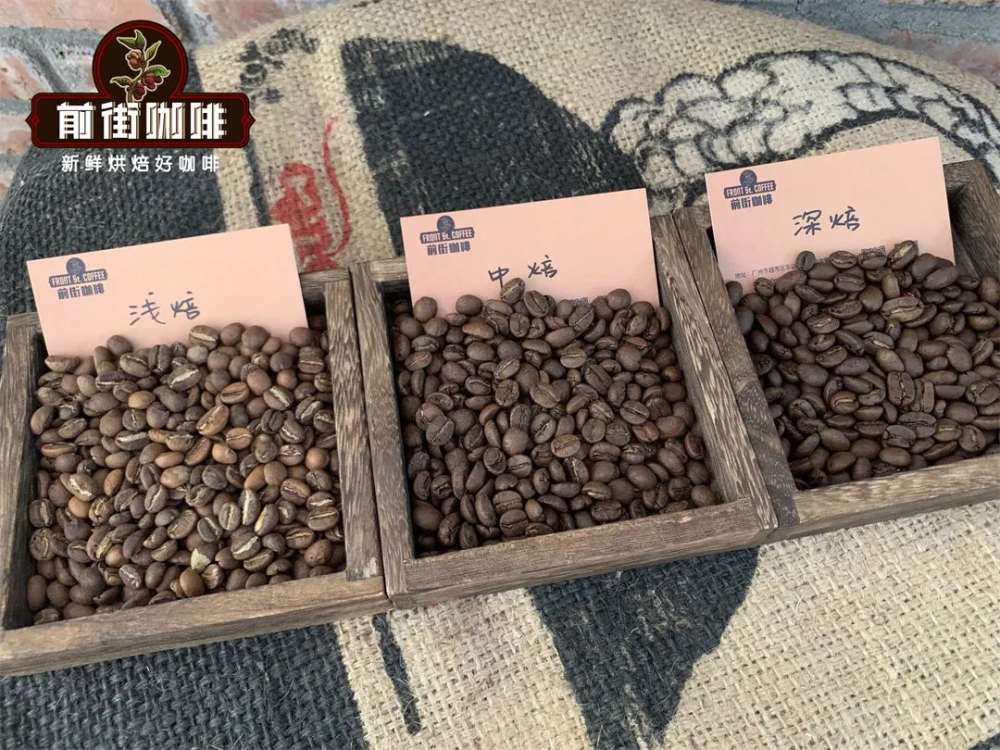
As Front Street mentioned in its newcomer assessment, light roast refers to coffee beans going through the middle of first crack to just the end of first crack. At this point enzymatic action and the Maillard reaction are still in their early stages, and the coffee beans' organic acids have not yet been completely broken down, so the acidity is especially prominent, while bitterness is so light it's almost imperceptible—very suitable for friends who prefer acidic coffee.
Medium roast usually refers to the period from the end of first crack to before second crack. At this stage caramelization and the Maillard reaction advance further; although acidity and aroma are still retained, they are noticeably weaker than in a light roast. At this point acidity and bitterness are relatively balanced, while a clean sweetness stands out even more, the entry is smooth, and the main tone shifts toward flavors like caramel and chocolate. This type of roast level often allows specialty coffee to release its best qualities, and it is also the roast level that Front Street Coffee most commonly uses.
Dark roast usually refers to beans after second crack, when the caramelization reaction is nearing its end and the Maillard reaction dominates, generating aromas such as resinous notes, spicy notes, and carbonized notes.
So, how are these different roast levels decided?
The first basis is history. In earlier years, consumers did not pursue coffee flavor very highly and valued its function more. During that long period, coffee's roast level was remarkably uniform—dark. Therefore the styles of the major production regions formed over hundreds of years were mainly full-bodied, such as Mandheling, Brazil, Colombia, or Blue Mountain. By comparison, Blue Mountain is full-bodied yet not markedly burnt-bitter, and perhaps this is precisely an important reason it firmly held the throne as the king of coffee in the old era. This roasting habit had a profound influence, and even today some consumers still ask for sugar and milk when ordering coffee, which stems from this.
So in terms of roasting choices, for beans from these classic origins, we try as much as possible to restore the style of that era and maintain the classic full-bodied mouthfeel.
Take Mandheling as an example. Its unique "heavy taste" drinks with a sense of hearty satisfaction, like galloping through the martial world, and not a few men like it; nowadays many women have also fallen in love with it. Indonesia is the world's largest archipelagic country, known as the country of a thousand islands. Indonesia's relatively high altitude, volcanic ash soil, and climatic characteristics are all excellent conditions suitable for the growth of Arabica coffee trees. Sumatra has long been known as the Spice Island; the coffee trees in the mountains keep company with wildlife, cloves, nutmeg, and pepper; coupled with the unique three-stage drying method (wet-hulling), this creates Mandheling's distinctive flavor: pronounced herbal notes, forest-like agarwood, moderate acidity, a rich mellowness carrying life's bittersweetness, and a strong sweet aftertaste.
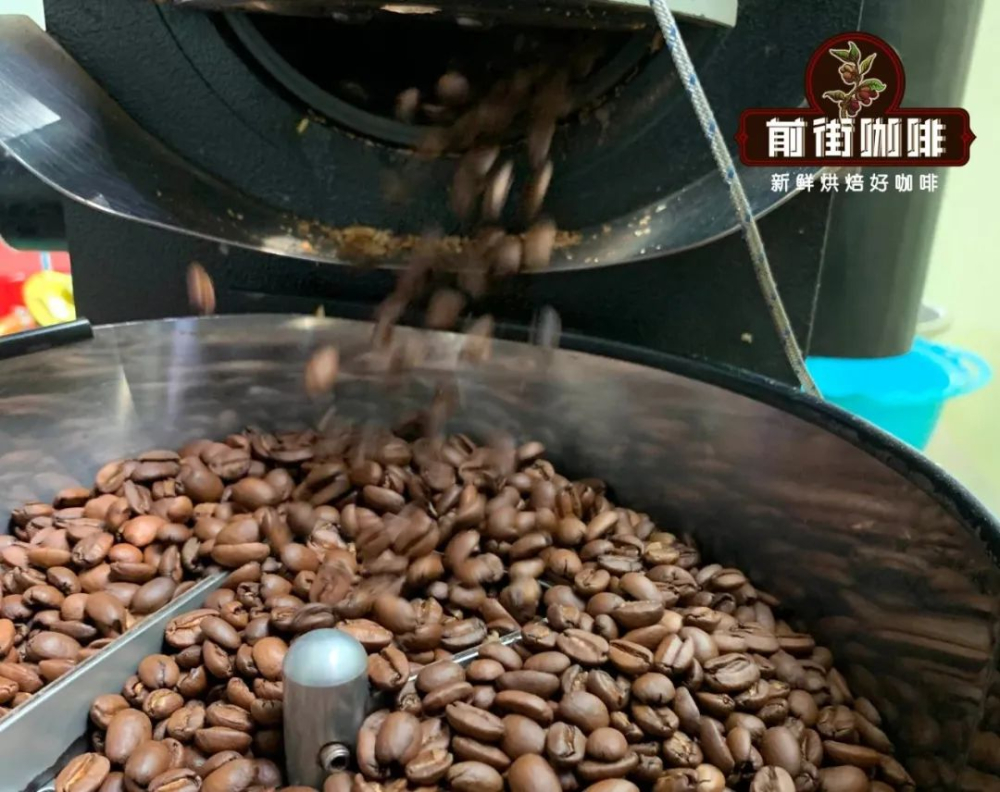
Mandheling coffee beans are rather large in size and relatively hard in texture. To highlight its famous full body, low acidity, and native herbal notes, Front Street uses a dark roast. If Mandheling were switched to a light or medium roast, the taste would probably fail to reach the full-bodied richness everyone likes, and the acidity would instead become noticeably prominent, so it would no longer be the Mandheling everyone knows. Of course, if someone prefers an acidic Mandheling, they can also try a medium roast. Then again, can a Mandheling without Mandheling flavor still be called Mandheling?
The second basis is the bean's appearance and characteristics. For example, Yirgacheffe chooses a light roast. It's not that this origin naturally exhibits good acidity; on the contrary, it is precisely the extremely light roast that brings about its acidic expression.
Yirgacheffe comes from Ethiopia. In order to sell most of their coffee beans, local coffee farmers do not grade their products by size the way the traditional countries mentioned earlier—Brazil, Mandheling, Colombia—do. Ethiopian coffee beans come in large and small sizes; only defective beans that would bring undesirable flavors are removed. As for the variation in size, the variety name Heirloom (native heirloom variety) is usually used to label the green bean variety.
Front Street often mentions in its articles that Ethiopian beans vary in size, and during roasting one must both roast the large beans through and avoid scorching the small ones; the more reliable approach is to drop them as soon as possible. Some people ask, can't a highly skilled roaster roast them evenly? The woody structure of the coffee bean itself determines that it conducts heat very slowly; if large beans and small beans differ too much, this thermal conductivity simply cannot achieve even transfer. Although one can lower the heat after dehydration and slowly lengthen the roasting time, using the boiled-frog method to pull the bean color to something that looks even, the aroma characteristics will inevitably become bland and tasteless because of the overly long roast. This too is a trade-off. For the floral and fruity acidity of Ethiopian beans, Front Street, like most roasters, chooses a light roast.
Take Geisha as another example. Its floral and fruity notes differ from most varieties, and many commentators hold that it should be classified as a medium-light roast for this characteristic. Geisha has one trait: its elongated shape makes its volume larger than some varieties, especially compared with Ethiopian beans that have already been unanimously recognized as light-roast—often it takes two or three small Ethiopian beans combined to match a single Geisha bean. Whether you like it or not, its roasting requires a longer time. And from the other side of roasting principles, roasting through as much as possible without causing burnt bitterness will bring richer aromatic characteristics and more flavor variation, which is exactly what roasting pursues.
Whether they are people who roast or people who drink coffee, everyone has their own understanding and views about coffee; sometimes there is no completely standard answer—just different choices.
The above content is compiled by CoffeeHunters, a coffee news website.


