





How Does Geisha Coffee Differ From Huakui Beans?
Huakui coffee comes from Ethiopia's Guji Hambela area and was named by a green bean trader after a natural coffee from the Buku Abel estate won the 2017 Ethiopian green bean competition. Huakui is not a Geisha: the two differ in variety classification and place of origin, even though both draw attention in brewing competitions.
Ethiopian coffees are usually named after their region, such as Yirgacheffe, which is why the Guji name raises questions. Huakui is labeled a local heirloom variety because Ethiopian farms use mixed planting and the government does not disclose native tree resources. Its cup leans toward passion fruit, strawberry, mango, jackfruit and citrus rather than a strong floral note.
Why is Huakui coffee not called Guji? Where does its name come from, and what connection does it have to the world-famous Geisha coffee? This article will take you through the story of Huakui's naming, starting from its victory in the 2017 Ethiopia green bean competition, and sort out its essential differences from Geisha in terms of variety classification and place of origin. At the same time, we will go deep into the Guji Hambela region to analyze the details of Huakui's natural processing method, the logic of its batch evolution, as well as the flavor comparison between Huakui and various Geisha coffees recommended by Front Street Coffee, along with brewing suggestions, providing coffee lovers with a complete knowledge reference.
Coffee enthusiasts may have noticed that Ethiopian coffees are mostly named after their regions, such as beans from the Yirgacheffe region being called Yirgacheffe Red Cherry or Yirgacheffe Kochere. So what about Huakui? It clearly comes from Ethiopia's Guji region, so why isn't it called Guji by convention? Could Huakui be something special?
How exactly did the name Huakui coffee come about?
Front Street believes: Huakui coffee , judging from the name alone, seems like it should be a bean with a rich floral aroma, but that is not the case. Huakui's floral note is not particularly prominent; instead, its fruit profile is more distinct, such as passion fruit, strawberry, mango, jackfruit, and citrus. According to Front Street: Huakui coffee beans were originally called Hambela, and the name Huakui was given by a domestic green bean trader. In February 2017, a natural coffee from the Buku Abel estate in Hambela won the Ethiopian green bean competition. It broke Geisha's dominant position in brewing competitions and became the only coffee currently able to rival it.
We know that Huakui coffee originates from Ethiopia, and Ethiopia is the birthplace of coffee. The local coffee varieties are extremely diverse, and every farmer uses mixed planting, so there is simply no ability to identify varieties; on the other hand, the Ethiopian government, in order to protect native coffee tree resources, is also unwilling to disclose them publicly. Therefore, many Ethiopian coffees are labeled as local heirloom varieties in the variety column, and Huakui's variety is precisely a local heirloom.
What kind of coffee is Geisha coffee?
The naming of coffee often carries multiple meanings. Geisha coffee is also called Gesha coffee . This name comes from Ethiopia's Geisha Mountain, and its pronunciation is the same as that of the famous Japanese geisha, hence the name.
Geisha coffee beans actually originated in southwestern Ethiopia, Africa. In 1963, Don Pachi Serracin introduced the Geisha coffee tree variety from Costa Rica to Panama. Due to low yield, which directly affected harvest volume, coffee farmers were not very willing to plant it. It was not until Daniel Peterson, the owner of Panama La Esmeralda, accidentally discovered that the beans produced by those previously overlooked Geisha coffee trees at the highest point of his estate actually carried the citrus and floral notes unique to African beans, so he separated them out and entered them in the 2004 Best of Panama green bean competition, and they became an instant sensation. Geisha beans have been unstoppable ever since, winning the Panama coffee cupping competition championship for many consecutive years. In the eyes of today's global specialty coffee lovers, Geisha coffee beans are undoubtedly the supreme treasure.
The difference between Huakui coffee and Geisha coffee
Huakui coffee and Geisha coffee both come from Ethiopia. What is the difference between them? Front Street tells everyone: Huakui is actually the name of an Ethiopian natural heirloom coffee, while Geisha is a clearly defined coffee variety. Gesha can be grown all over the world, while Huakui can only be called "Huakui" when it is produced and processed as natural coffee in Buku Abel, Hambela, in the Guji region. This is the most fundamental difference.
(Left is Hambela Huakui, right is Panama Geisha)
Huakui Coffee - Guji Hambela Region
This Huakui bean comes from Hambella, located in Guji, Ethiopia's largest coffee-producing region, and administratively part of Oromia State. Hambela's western side faces Yirgacheffe Kochere across the mountains. The two regions are separated by a highland 3,200 meters above sea level and about 30 kilometers wide. To the southeast and north, it borders Guji's Shakiso, Uraga, and Kercha sub-regions respectively, making it one of the highest-altitude coffee sub-regions in Ethiopia.
I believe that through Front Street's introduction above, everyone should understand that what we call "Huakui coffee" is a traditional natural G1 coffee bean from the Hambela region, and the "Buku Abel" processing station is its more detailed traceability information, located in Dimtu town. After "Huakui" became famous overnight, in order to meet surging market demand, DW Company added up to 5 independent coffee green bean drying and processing stations in Hambella Wamena Wereda, all located within the core production area of Dimtu town. In addition to the original Buku Abel, four other small villages—Buku Saysay, Haro Soresa, Tirtiro Goye, and Seke Bokosa—also joined the production of natural coffee beans. It is reported that at this point, the annual production of "Huakui" under DW Company had already reached tens of millions of tons.
Since the 2018 production season, Huakui (natural G1 coffee beans) from the same growing origin and the same processing station has already shown some changes in taste. Through cupping at the time, Front Street found that although the 2018 and 2019 Huakui also had flavors similar to the 2017 Huakui, they were inferior to the "first-generation Huakui" in terms of body, finish, and other mouthfeel aspects.
Therefore, in order to continue selling this natural coffee from Hambela while making some distinction from the original version, the domestic green bean trading company, counting from after 2017, created an X.0 suffix for each subsequent year's batch. For example, the 2018 batch was called "Huakui 2.0," the 2019 production was called "Huakui 3.0 and 3.1"... last year's release was "Huakui 7.0," and so on. In this way, we can identify which year's batch the Huakui we bought belongs to through this suffix.
Huakui Coffee Bean Natural Processing Method
Huakui coffee's berry, strawberry, lemon-citrus, and fermented wine notes are inseparable from its processing method. Front Street's Huakui coffee uses the oldest natural processing method—the sun-dried method. During the annual coffee harvest and processing season (December-January), the coffee cherries picked by farmers must reach a sugar content of 30 or above before sun-drying can begin. During the first two days of sun-drying, the humidity of the coffee cherries must be maintained so that the fruit sugars fully undergo fermentation reactions. At the same time, the high-altitude geographical location allows the processing plant's nighttime temperature to drop to around 12 degrees Celsius, without over-fermentation due to excessively high temperatures. When the midday temperature is relatively high, shading is carried out in time to prevent the coffee cherries from sunburn. At night, thick plastic sheeting is used to wrap them in case of sudden rainfall.
In this way, the coffee cherries ferment and dehydrate at a relatively low temperature. After more than half a month of sun-drying, when the moisture content of the green coffee beans drops to around 13%, they can be packed into jute bags and stored in a warehouse at 12-22 degrees Celsius and 45-55% humidity for about 50 days of green bean resting and further dehydration. When the green bean moisture content reaches about 11%, they are transported to the processing plant for hulling, screening, and sale. Front Street believes that selecting coffee cherries with high sugar content for sun-drying in this way will further give Huakui coffee beans higher sweetness, and the expression of juicy texture will also be richer.
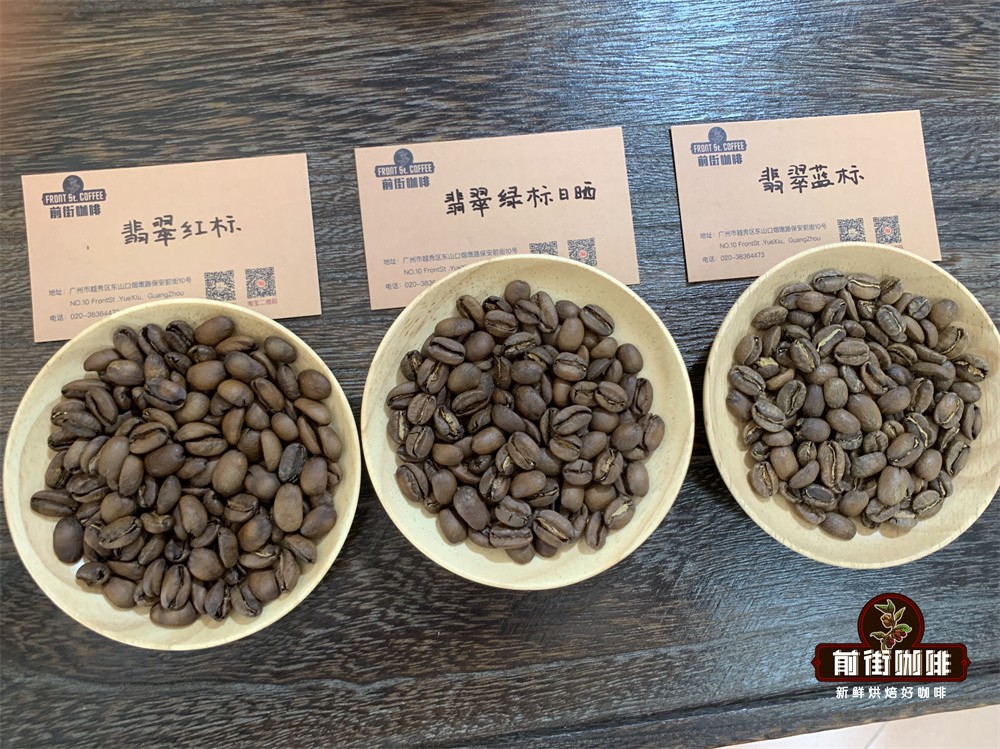
Next, let's take a look at how these two coffees of different varieties differ in flavor:
For coffee brewing, Front Street always recommends that freshly roasted coffee beans better bring out the coffee's flavor. Therefore, the coffee beans sold by Front Street are all within 5 days of roasting. Front Street's roasting philosophy is "freshly roasted good coffee," so that every customer who places an order receives the freshest coffee when it arrives. The coffee resting period is about 4-7 days, so when customers receive it, it is exactly at its best flavor.
Of course, some customers need Front Street to help grind the coffee, and that is no problem either. But Front Street reminds everyone that if coffee beans are ground in advance, they need to be brewed promptly. If they have already been ground into coffee powder, there is no need to rest the beans, because during transportation the pressure from carbon dioxide inside the packaging can also make the coffee flavor rounder, so once you receive the coffee powder you can immediately brew a cup and drink it. However, coffee powder oxidizes relatively quickly after contact with air, which means the coffee's flavor will dissipate fairly quickly and the coffee will not taste as good. Therefore, Front Street recommends buying whole beans and grinding fresh before brewing, so that you can better taste the coffee's flavor.
For these two coffee beans, Front Street recommends:
Filter: Hario V60, water temperature: 90°C, dose: 15g, coffee-to-water ratio: 1:15, grind size: medium-fine (80% passing through a Chinese standard No. 20 sieve)
Use segmented extraction. Bloom with twice the amount of water as the coffee dose, that is, 30g of water for 30 seconds. The reason the blooming process is needed is to allow the coffee grounds to release internal carbon dioxide gas, thereby making the later stages of extraction more stable. Pour in a small stream in circles until 125g, then pause, continue pouring until 225g and stop. After the water in the dripper has dripped through, remove the dripper. Start timing from the beginning of pouring; the extraction time is 2'00". Next, pick up the whole cup of coffee and swirl it to mix evenly, then pour it into a cup for tasting.
Front Street natural Huakui coffee flavor : light fermented wine aroma, more pronounced caramel, a much richer and more complex mouthfeel, honey sweetness, cocoa notes with some spice, thick body and a long finish.
[ Natural Red Label ] Has bright rose and citrus aromas, brown rice, berries, apricot, mixed fruits, honey, a thick juicy texture, rich flavor layers, and obvious sweetness.
[Washed Green Label ] On the palate, rich jasmine aroma, high sweetness, citrus, berries, juicy texture, cream, green tea, orange peel, cantaloupe; the overall flavor layers are rich, with a lasting finish of floral and citrus notes.
[Washed Blue Label ] On the palate, soft acidity of lemon and grapefruit; as it cools slightly, oolong tea, honey, and sugarcane sweetness return. The mouthfeel is relatively clean and bright.
[ Natural Blue Label ] Smells of fermented aroma and fruity sweetness; tastes of melon and tropical fruit sweetness, with a juice-like mouthfeel, and the overall sweetness is very high.
FrontStreet Coffee has nearly fifty single-origin coffee beans with different flavors, fully able to satisfy everyone's exploration and pursuit of coffee. You are welcome to come to FrontStreet Coffee and discuss with our FrontStreet Coffee baristas!
For professional coffee knowledge exchange and more coffee bean information, please follow Coffee Workshop (WeChat public account: cafe_style)
For more specialty coffee beans, please add the private WeChat of FrontStreet Coffee. WeChat ID: qjcoffeex
The above content is compiled by CoffeeHunters, a coffee news website.


