







Hawaiian Kona coffee is famous for its rich maltose sweetness and full, balanced flavor, making it a specialty representative in the hearts of coffee lovers. However, this growing region has faced the threat of leaf rust in recent years, along with historical pest outbreaks and reduced rainfall, drawing close attention to its yield and price. In this article, Front Street Coffee will guide you through the planting story of the Kona region, the characteristics of the Typica variety, the washed processing method, and share Front Street's roasting and pour-over extraction parameters, fully presenting the flavor profile of Kona coffee from seed to cup.
Hawaii is not just about blue seas, blue skies, and beaches! FrontStreet Coffee will tell you without hesitation: there is also Hawaiian Kona coffee beans! Kona coffee's rich maltose sweetness and full-bodied flavor have deeply captured the hearts of FrontStreet baristas and many coffee lovers. Today, Front Street will talk about the coffee beans on this island.
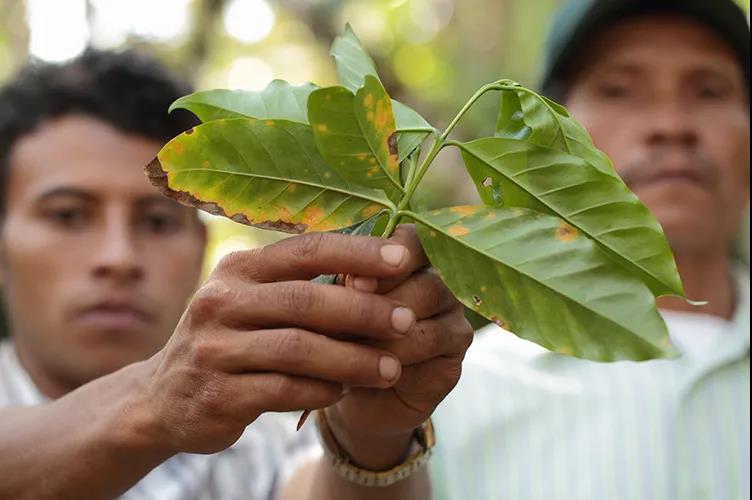
First, let's look at an important recent news item about the Kona growing region! According to foreign media reports, traces of leaf rust were first discovered in Hawaii in October 2020. The Hawaii Department of Agriculture (HDOA) notified Governor David Ige's office of this disturbing discovery about two weeks ago. And about a month earlier, a coffee farm in the Haiku area of Maui had already submitted a report to HDOA showing suspected symptoms of leaf rust.
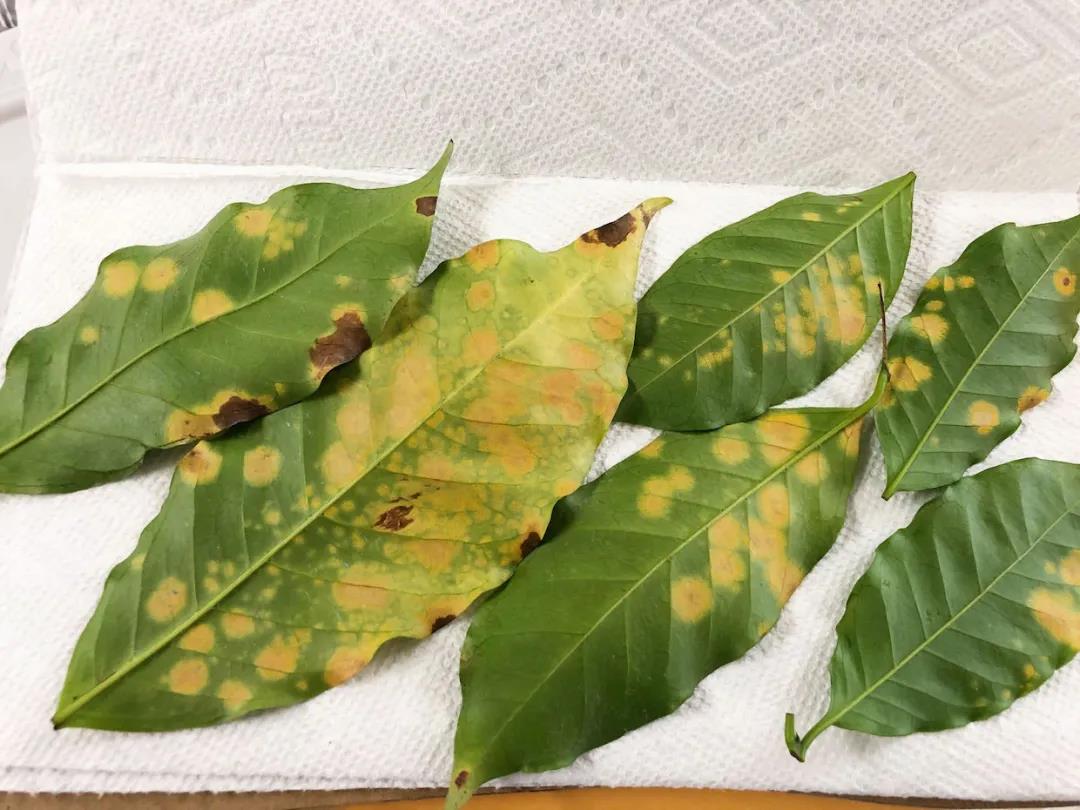
It is currently unclear how leaf rust was introduced to Maui, Hawaii, and how long it has been present cannot be determined. Two weeks later, the USDA National Identification Service confirmed that coffee leaf rust had also appeared on Hawaii Island—in samples collected by a coffee farmer in the Holualoa area south of Kailua-Kona, the leaf rust fungus, officially named Hemileia Vastatrix, was indeed detected. The gradual spread of leaf rust in Hawaii poses a serious threat to the local coffee industry, because this disease spreads rapidly and can destroy coffee crops in large numbers. Coffee leaf rust is a highly contagious plant disease that can destroy coffee crops. The symptoms mainly occur on leaves, and fruits and branches are rarely affected. After leaves are infected by the rust fungus, small light yellow water-soaked spots first appear on the underside of the leaves, surrounded by a light green halo. When the spots expand to 5–8 mm, orange-yellow powdery spore masses grow from the stomata in the diseased area, and the spots gradually enlarge. Several spots may merge into irregular large lesions. After that, the center of the lesion dries and turns brown, and brown spots can be seen on both sides of the leaf. Finally, the leaves gradually fall off, and the coffee plant can die within a few years.
Hawaii's economy mainly relies on tourism, the defense industry, and agriculture. Among these, agriculture is the backbone of the local economy, mainly producing sugarcane, pineapple, bananas, and coffee. Sugarcane annual output reaches as high as 1 million tons and occupies the main portion, but coffee should not be overlooked either. According to data from the Hawaii Department of Agriculture, Hawaii has about 7,200 acres of coffee planting area, with annual output reaching 5.7 million pounds of green beans, and the coffee output value in 2019 was 54.3 million US dollars. The Kona region where leaf rust was discovered this time is precisely Hawaii's main coffee-growing region. The coffee beans used in Kona coffee produced in Hawaii grow on volcanic terrain, and there is also high-density artificial cultivation and agricultural management, so every bean can be said to be pampered, and its price is naturally high, second only to Blue Mountain. Hawaiian Kona beans are relatively uniform in shape on average and have strong acidity and sweetness. Therefore, the appearance of leaf rust this time has made the Hawaii government attach great importance to it and begin taking measures for defense. Hawaii's coffee-growing regions suffer from pest damage In addition to the leaf rust discovered this year that may affect Kona coffee production, in fact, a pest outbreak already occurred in Hawaii's growing regions several years ago. The sudden surge in Kona coffee's value was also due to the pest outbreak in 2010. In 2010, Hawaii's growing regions were severely invaded by fruit pests. The island's specialty coffee regions, Kona and Ka'u, were the hardest hit, and coffee production on the island plummeted by 50 percent. Later, through the control of pesticides and biological beetles, Kona coffee had recovered more than 40 percent of its production by 2015. Although the disaster was brought under control, rainfall on the island has decreased in recent years, also affecting the Kona region. Because coffee bean production has been declining day by day while market demand is large, the price in recent years has been approaching that of Blue Mountain coffee.
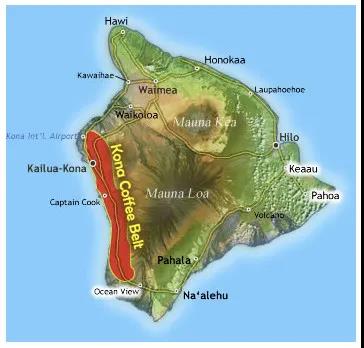
Kona Coffee Growing Region This Kona area is located in the southwest part of the Big Island, 20 miles long and 2 miles wide, covering the slopes of Hualalai and Mauna Loa, with an elevation between 300 and 1,100 meters, making it the most suitable growing environment for coffee trees. Therefore, the slopes of Hualalai and Mauna Loa are covered with coffee trees. Only coffee beans grown in this area and meeting the strictest certification standards can be sold under the Kona trademark name. Through cupping, FrontStreet Coffee unanimously considers the overall profile to be mainly nutty, such as walnut, plus berry notes like plum, and creamy sweetness. The overall cup is clean and richly layered.
FrontStreet Coffee—Hawaiian Kona Coffee Beans
Region: Kona growing region
Estate: Queen Estate
Altitude: 1100m
Variety: Typica
Processing method: Washed processing method
Typica Coffee Variety Typica is the oldest native variety from Ethiopia, and almost all coffee bean varieties now belonging to Arabica are derived from Typica. Typica has an elegant flavor, but its constitution is relatively weak, its disease resistance is low, and it is susceptible to leaf rust. Its coffee bean yield is low and cannot meet economic benefits. Kona's Typica was introduced from Guatemala in 1892. The Typica planted in Kona has large beans, and the planting altitude is also 600-1100m. Compared with other coffee-producing countries, Kona's planting altitude is considered low altitude, but on Hawaii Island, Kona is considered high altitude. People once tried to transplant Kona's Typica to other islands, but because the temperature on other islands was too high and the altitude was too low, Typica did not grow smoothly, so it could not produce the soft acidity and aroma unique to the Kona growing region.
Kona Coffee Processing Method The Kona growing region mainly uses the washed method. The biggest difference from the natural method is the use of fermentation to remove the mucilage layer. After fermentation is completed and the mucilage is removed, because fermentation bacteria and impurities remain on the coffee beans, the coffee beans are washed again. In order to wash them clean, this step consumes a large amount of clean water, and then the fruit is dried and hulled. Hawaii's clean and sweet mountain spring water provides the most ideal conditions for Kona coffee beans to undergo washed processing. This method creates the bright, clear appearance and pure, fresh taste of Kona coffee beans.
FrontStreet Coffee's Experience Roasting Kona Coffee
Front Street's roaster uses a Yangjia 800N, with 550g of green beans charged. The drum temperature is 200°C when the beans are added, the air damper is set to 3, and after 1 minute the heat is adjusted to 150°C with the air damper unchanged. Roast until 5 minutes 35 seconds, at 150°C, when the bean surface turns yellow, the grassy smell completely disappears, and dehydration is complete. Adjust the heat to 140°C and change the air damper to 4; at 9 minutes 30 seconds, ugly wrinkles and dark patches appear on the bean surface, and the toast aroma clearly turns into coffee aroma, which can be defined as the prelude to first crack. At this time, listen clearly for the sound of the first crack point. First crack begins at 9 minutes 30 seconds. Reduce the heat to 70°C and open the air damper fully (adjusting the heat must be done very carefully, and it must not be so low that there is no cracking sound). Turn off the heat at 182°C and drop the beans at 193.4°C.
FrontStreet Coffee Brewing Experience
Dripper: Kono
Water temperature: 89-90°C
Grind size: fine granulated sugar size / sift powder with a No. 20 sieve to 80%
Coffee-to-water ratio: 1:15
Dose: 15 grams
Brewing method: FrontStreet Coffee uses segmented extraction, that is, three-stage pouring. Bloom with 30g of water for 30 seconds, then pour in a slow circular motion with a small stream until 125g and stop. Wait for the water to drop, then pour slowly again at an even speed. The water level should not be too high. Pour again until 225g and stop. Extraction time is 2 minutes—2 minutes 10 seconds (including blooming time).
Brewed flavor: balanced, warm osmanthus honey sweetness and an elegant, full yet not heavy mouthfeel. The brewed coffee gives off a mulberry aroma that makes one feel sweetly happy. The finish has a smooth malt flavor, and when cooled it is like a cup of mulberry tea.
The above content is compiled by CoffeeHunters, a coffee news website.


