








For more specialty coffee knowledge, please follow the WeChat official account: Front Street Coffee (FrontStreet Coffee)
Latte is one of our most common coffee drinks. At Front Street Coffee (FrontStreet Coffee), latte is also the most popular espresso series. So how is a cup of latte made?
What is a latte?
The latte appeared much earlier than espresso. At least since the 17th century, Europeans had been mixing coffee and milk. William Dean Howells first used the term "cafe latte" in his 1867 essay "Italian Journeys." At this point in history, coffee was beginning to cause a sensation around the world, but because the espresso machine had not yet been invented, the brewing method was still very primitive.

Latte is actually a transliteration of the Italian word "Latte," meaning milk, so if you order a latte in Italy, you may be given a glass of milk. Therefore, latte actually means milk coffee. With the emergence of the espresso machine, the steam wand became standard equipment on espresso machines, making it easy to heat milk on the coffee machine, and the modern latte took shape accordingly. In the 1980s, baristas from Seattle, Washington, began "coloring" with rich-textured milk, which was the prototype of latte art.
The ratio of milk to coffee, the beans used, and the extraction parameters for lattes vary slightly from shop to shop. But in general, a latte is a coffee drink made by adding a large amount of milk to espresso. Lattes made with different coffee beans will have different flavors, lattes made with different milks will also have different flavors, and even different ratios of coffee to milk can present different flavors.

What coffee beans are better for making lattes?
Generally speaking, coffee beans used to make lattes must be suitable for espresso machines, so very light-roasted coffee is not suitable for making lattes. The darker the roasted coffee beans, the stronger the coffee flavor in the latte (caramel, bitterness). The lighter the coffee beans, the more obvious the milk flavor in the latte. Therefore, the roast level should be chosen moderately so that the coffee and milk are more compatible.

The Sunflower Warm Sun series, Front Street Coffee's (FrontStreet Coffee) own blend, is the blended coffee currently used by Front Street. It is made by blending Honduran coffee with Yirgacheffe coffee, and when added to milk it highlights rich chocolate, caramel, and slightly tipsy flavors.
If you like a richer type, it is recommended to use Front Street's specialty espresso blend, which will give the latte an obvious roasted nut aroma; if you are looking for value for money, you can also use Front Street's basic espresso blend, with a deep coffee taste and a balanced tone.

How to make a latte
The latte recipe used by Front Street is 1:6.5, that is, 40g of espresso added to 260g of steamed milk.
The espresso extraction plan used by Front Street is 20g of coffee powder extracted into 40g of espresso liquid in 27 seconds, as the base of the latte.

Next is steaming the milk foam. First, we need a steam wand. Ordinary semi-automatic coffee machines are equipped with a steam wand. Second, we need a container to hold the milk, such as a milk pitcher or latte art pitcher (professional tools will get twice the result with half the effort).
Finally, there is the choice of milk. Whether it is room-temperature milk or cold milk, whole milk or skim milk, all can steam milk foam. But if you want the milk's texture, taste, and stability to be better and longer-lasting, Front Street still recommends using cold refrigerated whole fresh milk.

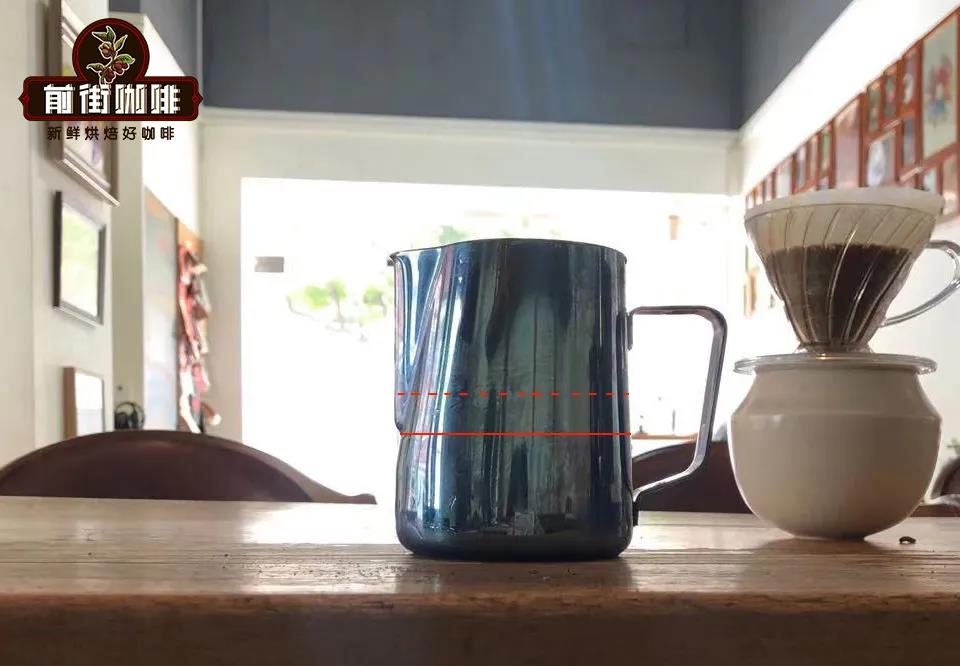
1. Best capacity for steaming milk: Steaming milk requires a reasonable capacity. Front Street recommends using 40-60% of the total capacity of the milk pitcher. Too little milk and too much milk both test your steaming technique. Of course, in addition to this factor, you should also consider the actual amount of milk used in one cup of coffee to avoid excessive waste. The milk pitcher used by Front Street has a capacity of 550ML, and the amount of milk poured in is 250ML (just reaching the bottom of the pitcher spout).
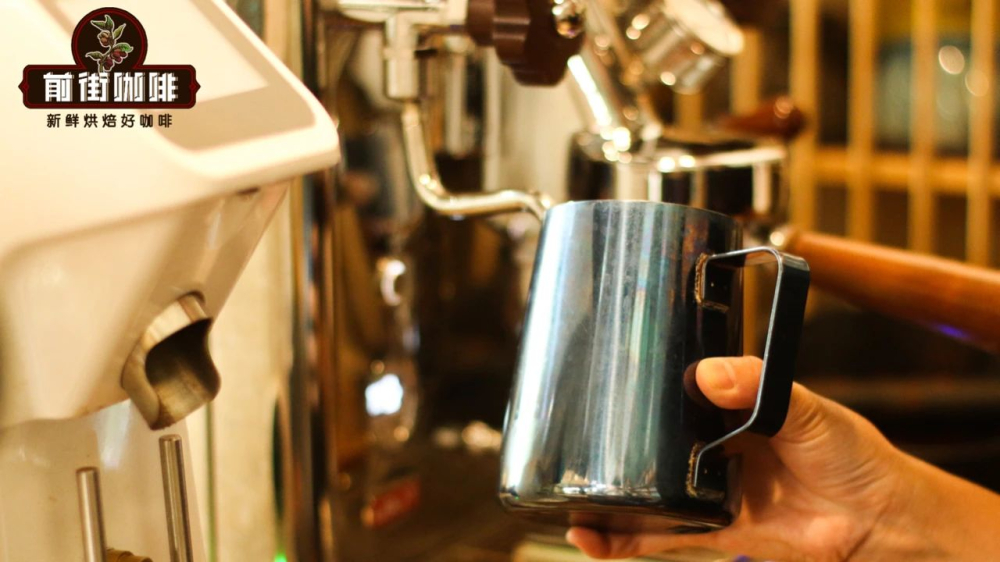
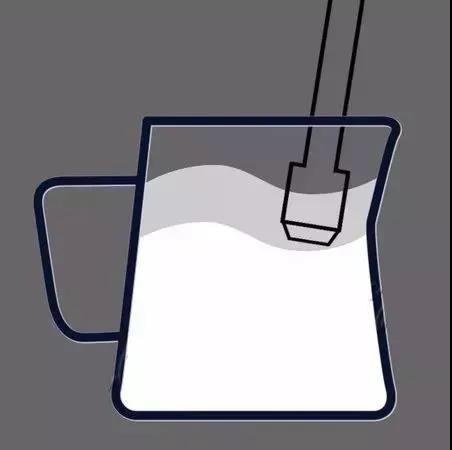
2. Steaming position: Before preparing to steam, first turn on the steam wand switch to release condensed water vapor (turn off the switch after releasing it). Then pull out the steam wand at a 45-degree angle, use the pitcher spout to firmly stabilize the position of the steam wand. This time the steam vortex is counterclockwise, and the steam wand position is on the right side of the center cross on the liquid surface, with the steam wand half submerged.
3. Steaming stage: Turn on the steam switch, and you will hear a chirp-chirp sound. This is the steaming stage. According to the required thickness of the milk foam, the steaming time also varies (the longer the steaming time, the thicker the milk foam). Generally, steaming 50% milk to 60% volume (latte milk foam thickness) takes about 3 seconds. The direction of the milk's rotation forms a unified vortex.

4. Texturing stage: At this point, the steam hole needs to be fully submerged, only heating, no longer steaming. Do not bury the steam hole at the very bottom; it is recommended to keep it in the milk foam layer, which helps with texturing (turning rough milk foam into fine, smooth foam). When to stop? This depends on your milk temperature, generally controlled between 55-65°C. Too high a temperature will denature the protein (generally speaking, heat denaturation of protein in food occurs at about 60°C).
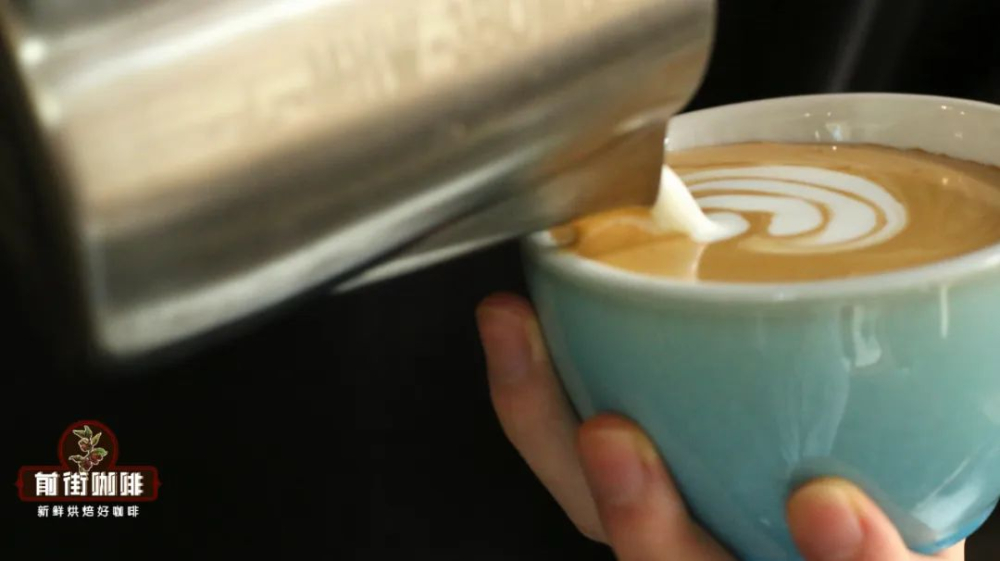
Next is pouring and latte art. Once the espresso is extracted and the milk is steamed, you can carefully pour to complete the latte. Pouring is also a very important part of making a latte. Good pouring can make the latte taste smooth and comfortable, without any off flavors. Good pouring is what we often call latte art. Then a cup of latte is complete.

Front Street Coffee's (FrontStreet Coffee) recipe latte flavor: smooth mouthfeel, lasting chocolate taste, mixed with a pleasant boozy note, long finish, and obvious sweetness.
The above content is compiled by CoffeeHunters, a coffee news website.


