







When walking into a coffee shop, many people choose a milk-based coffee made with espresso, such as a latte, cappuccino, or Americano. Each coffee has its own unique flavor. For example, a latte is a perfect blend of coffee and milk, a cappuccino has a thick layer of milk foam, and a flat white is light and soft. All are very popular. In this article, Front Street Coffee shares knowledge about making espresso-based coffee.

To make a rich and delicious milk-based coffee, you need to prepare two ingredients: espresso and steamed milk. Then, by mixing these two ingredients in different proportions and orders, you can get milk-based coffees with different flavors. Popular drinks like lattes and cappuccinos are made this way, but a latte has less milk foam on top.
Milk plays a very important role in a cup of coffee. Good milk texture can enhance the flavor characteristics of the coffee. With well-steamed milk foam, you can create silky, lightly sweet milk. Front Street Coffee generally uses whole milk because the fat and protein it contains not only improve the flavor but also make the foam more stable.

Another point is about keeping milk fresh. If milk has been left for a few days and is no longer very fresh, the protein will break down into amino acids. Storing milk in the refrigerator can slow this process, but if it is taken out and not put back in time, it will instead accelerate the milk's deterioration, even if it still tastes or smells fresh. So Front Street suggests that milk must be put back in the refrigerator after use.
Once you have chosen a milk, the next step is steaming the milk. Steaming milk has two stages: aeration and texturing. Next, Front Street Coffee introduces the process of steaming milk below.

1. Pour the milk into the milk pitcher. The liquid level should be between 1/3 and 2/3 below the pitcher's spout.
2. Clean the steam wand and remove any residue.
3. Bring the milk pitcher close to the steam wand until the steam wand is just submerged below the surface of the liquid, with the point of entry slightly off the center of the liquid surface. Open the steam valve and listen for the hissing sound of the steam.
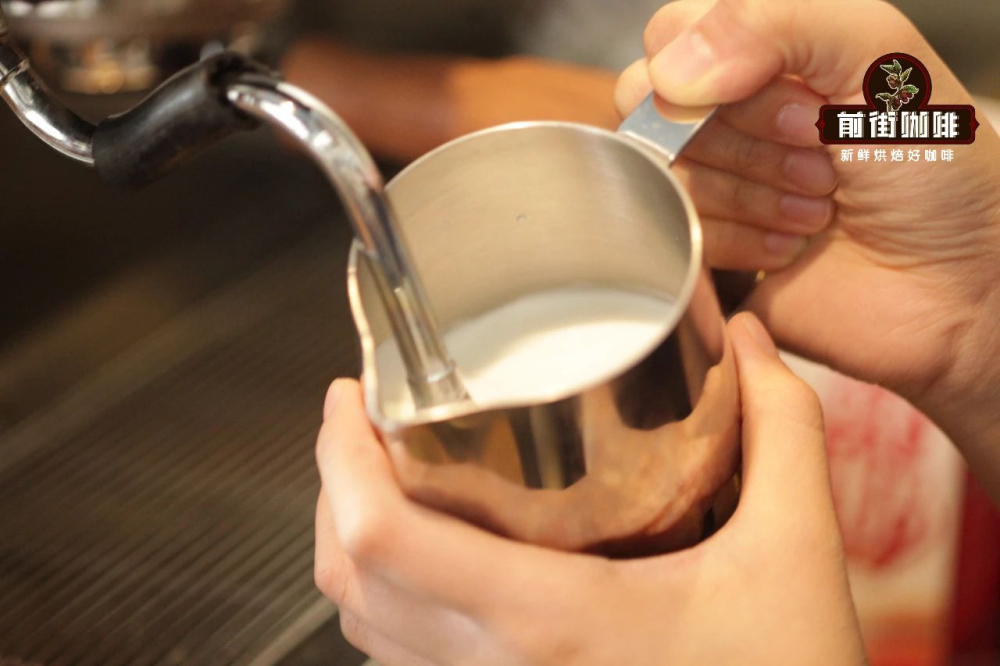
4. After getting enough fine milk foam, slowly lower the milk pitcher. This step is aeration. At this point, the temperature of the milk must not exceed body temperature! Heat the milk to about 60°C, but it must not exceed 70°C, otherwise the protein structure in the milk will be damaged.
5. Prepare for texturing. Using the pitcher's spout as a pivot, lift the milk pitcher upward so that the steam wand goes deeper into the milk. The milk should form a vortex under the action of the steam.
6. Wait until the milk pitcher starts to feel hot to the touch. The temperature should have reached 60–65°C (to check, touch the bottom of the pitcher with your hand; at this temperature, you should not be able to hold it for 3 seconds). Texturing is complete.
7. Do not turn off the steam valve yet. Use the steam to clean the steam wand.

8. Tap the side of the milk pitcher to break up large bubbles on the surface of the liquid, then swirl the pitcher to mix the liquid and milk foam. A good batch of milk foam is now ready.
After discussing milk, the next topic is espresso. First is bean selection. Choosing a coffee bean that suits your preferred flavor is very important. For example, the espresso blend currently used by Front Street Coffee is Sunflower Warm Sun coffee beans. This blend uses beans from Honduras and Ethiopia Yirgacheffe. Through continuous blending by Front Street Coffee baristas, a relatively perfect blending ratio of 6:4 was obtained. The resulting espresso has noticeable fruity acidity, along with berry aroma and vinous notes, and a comfortable sweet aftertaste.

This espresso blend is roasted in-house by Front Street Coffee. In addition to this coffee bean, there are three other espresso blends with different flavors. For example, Front Street Coffee's basic blend uses Yunnan coffee beans paired with Brazilian beans in a 3:7 ratio. The resulting espresso has soft fruity acidity, caramel sweetness, nutty and dark chocolate flavors, is smooth and syrupy, but relatively light in taste.

Front Street Coffee's specialty coffee blend uses Colombia: Brazil, blended by Front Street Coffee baristas in a 3:7 ratio. The resulting espresso is soft with slight acidity, lightly sweet, with nutty sweetness in the aftertaste. Overall, it is not too pungent, is mild, and has medium crema.

Once you have chosen the beans, you can extract the coffee. Below are Front Street Coffee's parameters for extracting Sunflower Warm Sun coffee beans:
Grinder: Galileo Q18
Grind size: 1.6
Pressure: 9 bar
Temperature: 90.5–96°C
Time: 20–30 seconds
Dose: 20g (double espresso)
Yield: 40ml
Under ideal conditions, the coffee liquid flowing from the spout is very uniform in both color and flow. If it flows unevenly, the beans may be ground too fine or the puck tamped too hard, which will lengthen the time for water to pass through the coffee bed and cause over-extraction (strong bitterness); if the beans are ground too coarse or the tamping pressure is insufficient, it will shorten the time for water to pass through the coffee bed and cause under-extraction (watery taste, thin mouthfeel).

If extraction is successful, Front Street Coffee's espresso flavor is: smooth mouthfeel, medium body, with noticeable fruity acidity on the palate accompanied by light berry aroma, whisky notes, rich chocolate flavor, and a clear sweet aftertaste.
The above content is compiled by CoffeeHunters, a coffee news website.


