







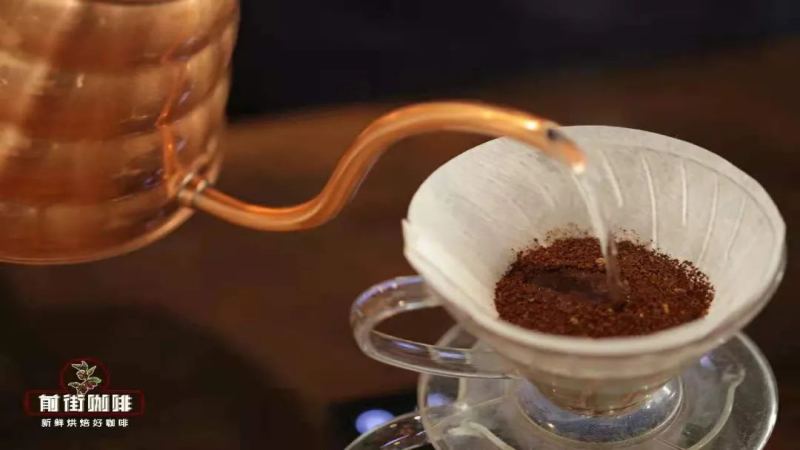
Without sugar or milk, how to hand-brew a delicious and distinctive cup of coffee is a challenge for many beginners. Too much water makes the coffee weak, while too little makes it strong and harsh. Therefore, attention must be paid to the coffee-to-water ratio.
So how much water should actually be used to brew a cup of coffee? The coffee-to-water ratio is probably something everyone has wondered about, and many have been more or less confused about why the recommended ratios seem different at every café, and why Front Street Coffee uses a 1:15 ratio.
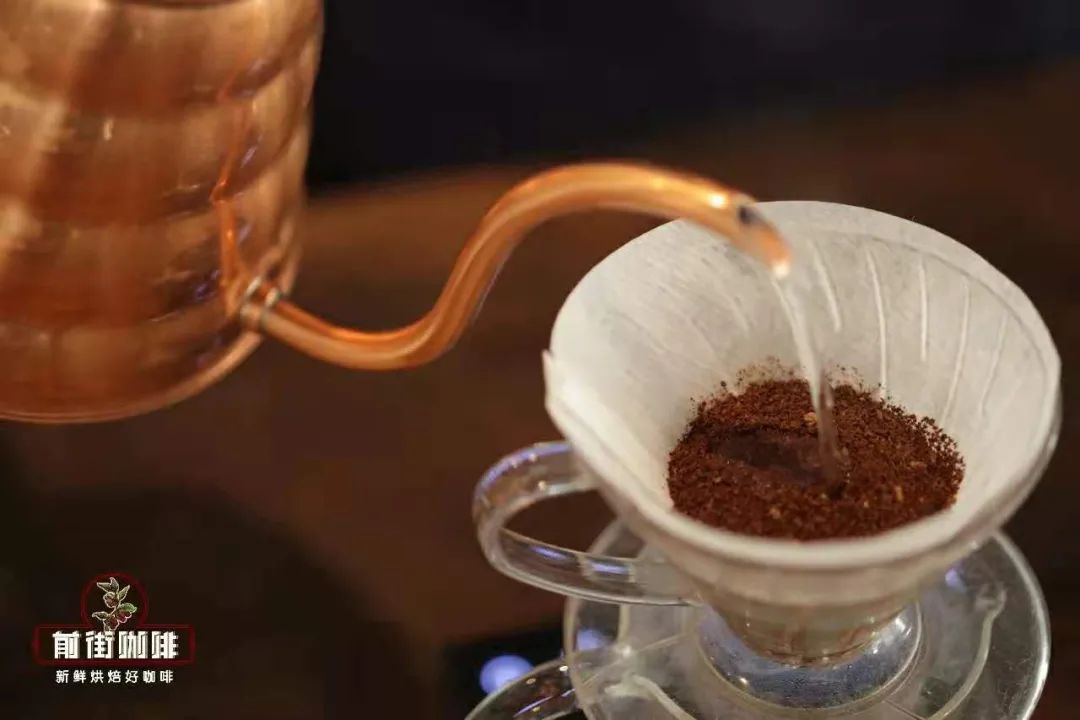
What is the coffee-to-water ratio?
First, let's understand two concepts in hand-brewed coffee: the coffee-to-water ratio and the water absorption rate of coffee grounds.
Coffee-to-water ratio: the ratio of coffee grounds to water, directly expressed as how much water is used to brew the coffee, for example1:15means using15parts water to brew1parts coffee grounds. Assuming 15g of water, then 225g of water is needed.
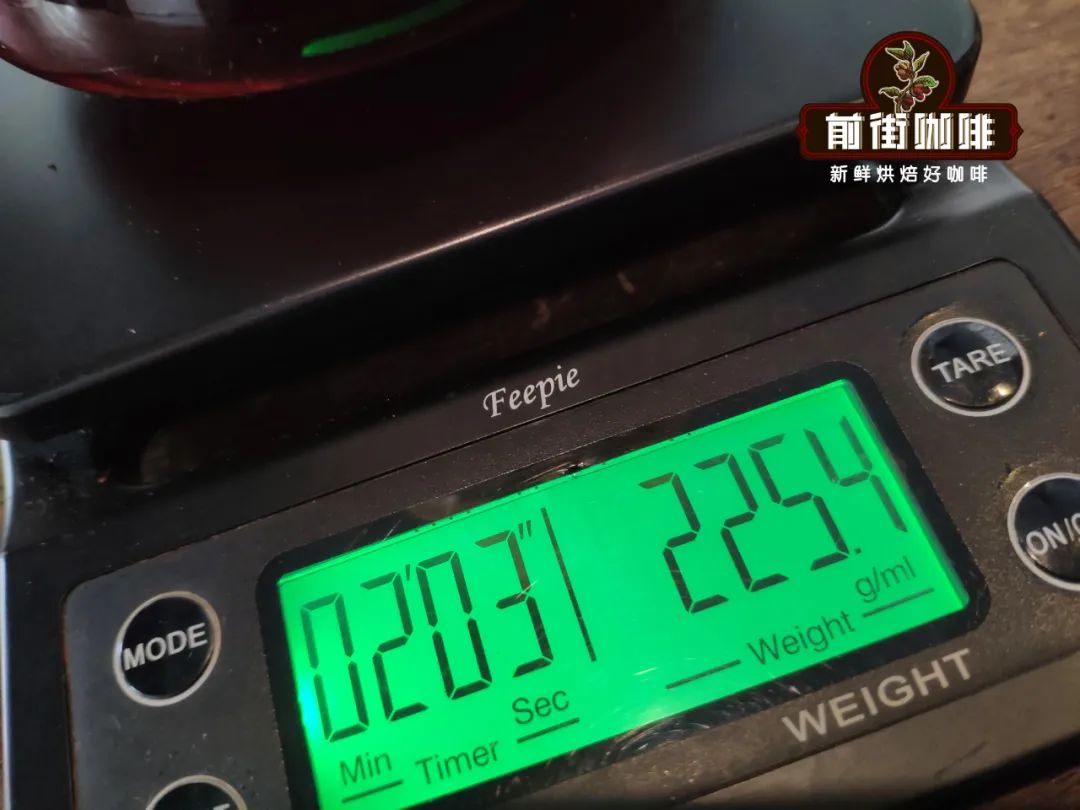
Water absorption rate of coffee grounds: generally, the saturated water absorption of coffee grounds is twice their own weight (there will be deviations, but basically all are around 2 times). Therefore, the coffee liquid we get will not equal the water we used for brewing. Taking a 1:15 ratio as an example, the coffee grounds will absorb 2 parts of water, so we ultimately get 13 parts (the amount of coffee) of coffee liquid.
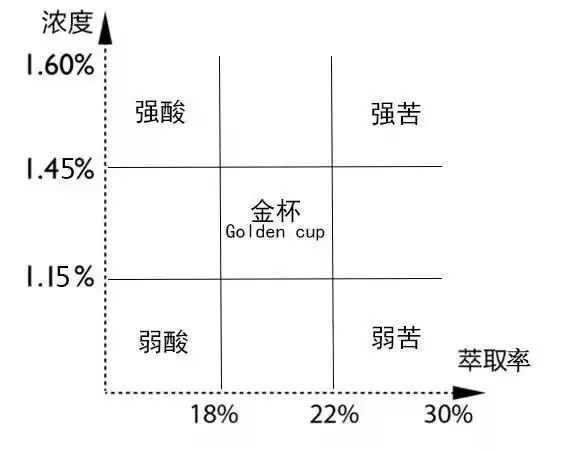
After understanding these two concepts, let's look atSCAthe Golden Cup extraction chart. This chart combines the preference ranges of people in Europe and the United States for coffee as well as the relationship between coffee liquid concentration and coffee grounds extraction yield, and is a very good reference model.
SCA Golden Cup Theory
The SCA Golden Cup extraction range—extraction yield: 18%-22%, concentration: 1.15%-1.45%. Coffee within this range is called Golden Cup extraction (this is what the Golden Cup system considers "tasty," though not necessarily what our senses consider tasty).
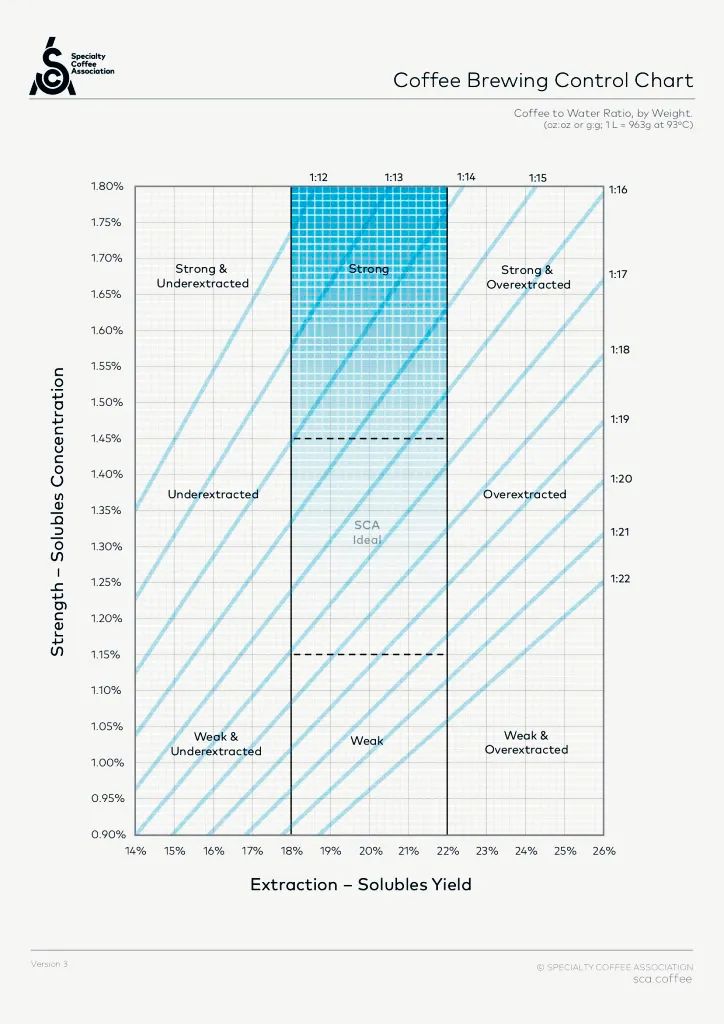
In the Golden Cup extraction chart, the largest and smallest coffee-to-water ratios we can obtain are respectively: 1:20.9 (concentration 1.15%, extraction yield 22%) and 1:14.3 (concentration 1.45%, extraction yield 18%). We observe that the 1:17 ratio passes through the Golden Cup range the most, meaning it is the easiest to hit the Golden Cup range, followed by the 1:16 and 1:18 ratios. In contrast, 1:15 has a very hard time hitting the Golden Cup range.
Why choose 1:15?
Therefore, from the Golden Cup extraction chart, the ideal brewing coffee-to-water ratio is 1:16-18. And 1:15 is not a recommended coffee-to-water ratio. But when we combine this with actual experiments, we find that although widening the coffee-to-water ratio (1:18) fits the Golden Cup extraction range in terms of extraction yield and concentration, it easily extracts unpleasant flavors (during which concentration is easy to ensure, but extraction yield is hard to ensure). Therefore, in practice the ratio used for the final product is reduced accordingly, and the advanced approach adopted is the 1:15 coffee-to-water ratio.
Front Street Coffee conducted multiple brewing experiments with light-roasted coffee and found that the concentration of 1:15 is roughly 1.35-1.42%, with a corresponding extraction yield of 17.79%-18.73%. Although on the Golden Cup it is only at the edge of qualifying, sensory testing found the flavor to be very suitable, without the sharp acidity or astringency brought by under-extraction. It is suitable for the output ratio of the vast majority of coffee beans. Compared with larger coffee-to-water ratios that easily lead to over-extraction or bitterness, 1:15 is a conservative and stable coffee-to-water ratio.
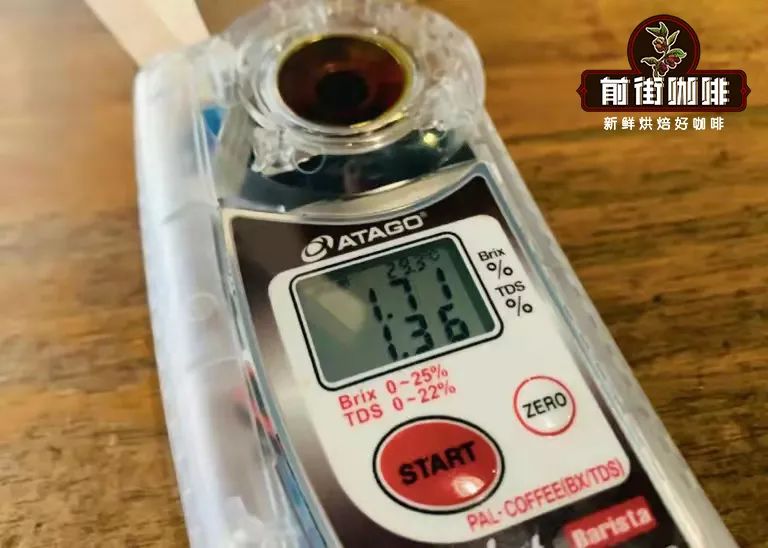
Although 1.35%-1.42% counts as high concentration in Golden Cup extraction, we must know that the concentration range given by the SCA refers to the tastes of people in the United States and Europe. It does not mean that people all over the world have the same preference for concentration. So, is the Golden Cup theory wrong?
Actually not, because in addition to the coffee-to-water ratio, there are many factors affecting coffee extraction. For example, the cupping coffee-to-water ratio we use is 18.18% (11g coffee grounds, 200g water). This is actually the ratio most easily hit within the Golden Cup range used by the SCAA (the predecessor of the SCA). But the premise is immersion extraction.
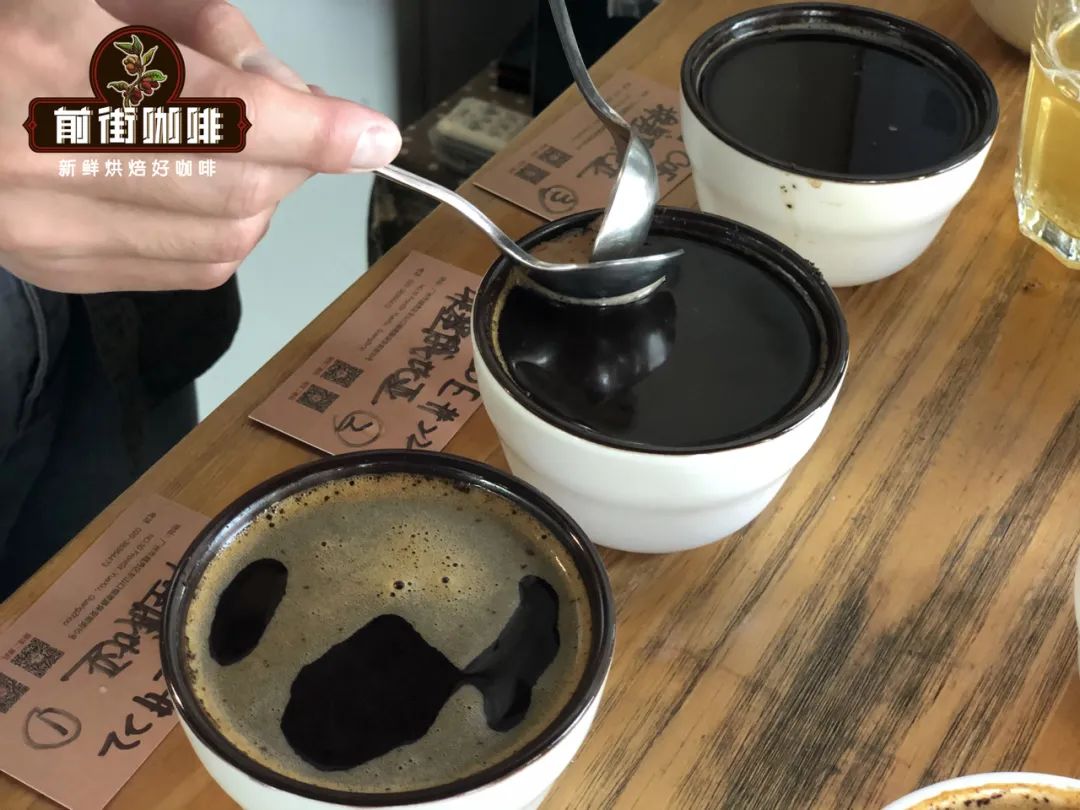
Hand-brewed coffee, however, belongs to drip extraction, which improves extraction efficiency by stirring the coffee grounds with water flow, and thus lowers the coffee-to-water ratio as well.
The above content is compiled by CoffeeHunters, a coffee news website.


