





How Do Coffee Description Words Match Pour-Over Techniques?
Pour-over coffee description words like bright, mellow, or heavy point back to five core parameters: coffee-to-water ratio, dose, grind size, water temperature, and extraction time. The method dates to the early twentieth century, first pioneered by German woman Melitta. Light roasts generally take higher water temperature, a faster-flow dripper, and a finer grind.
Throughout the roasting process, beans change at every stage, so each roast level brews differently. Single-variety, single-origin beans each carry their own flavor, and examples such as Yirgacheffe Kochere and Golden Mandheling show how one-pour, three-stage, and stirring methods produce distinct results. The SCAA Golden Cup extraction range of roughly 18 to 22 percent guides the target.
The essence of pour-over coffee lies in its flexibility and adjustability—every subtle change makes the final flavor completely different. However, faced with numerous variables such as water flow, grind size, and water temperature, many enthusiasts often feel at a loss. Drawing on Front Street Coffee's practical experience, this article systematically breaks down the five core parameters of coffee-to-water ratio, coffee dose, grind size, water temperature, and extraction time, and uses Yirgacheffe Kochere and Golden Mandheling as examples to demonstrate the specific operations and flavor differences of the one-pour, three-stage, and stirring methods, helping you find the right brewing rhythm between light and dark roasts.
For more specialty coffee knowledge, please follow: Front Street Coffee (Frontsteet Coffee)
What makes pour-over coffee so fascinating is its immense room for adjustment. Among the friends who often come to Front Street's café for coffee, many also brew at home, and they often complain that pour-over is too hard to master—you need to keep the water flow steady while also managing the grind, and there are simply too many aspects to juggle. That said, Front Street actually believes this is precisely what makes pour-over most appealing: just slightly change one variable, and the finished cup takes on a completely different direction in flavor.
In fact, there are many ways to brew coffee, and the practice of using pour-over to brew coffee can be traced back to the early twentieth century, first pioneered by German woman Melitta. Coffee beans undergo corresponding changes at every stage of the roasting process, and different roast levels each have their own considerations when brewing. Pour-over usually uses single-variety, single-origin beans, and each bean has a different flavor. Front Street adjusts its brewing plan according to the bean's character—for example, light-roasted beans are paired with higher water temperature, a faster-flow dripper, and a finer grind. Below, Front Street will discuss the specific method of pour-over coffee and the aspects that need attention.
Coffee-to-Water Ratio
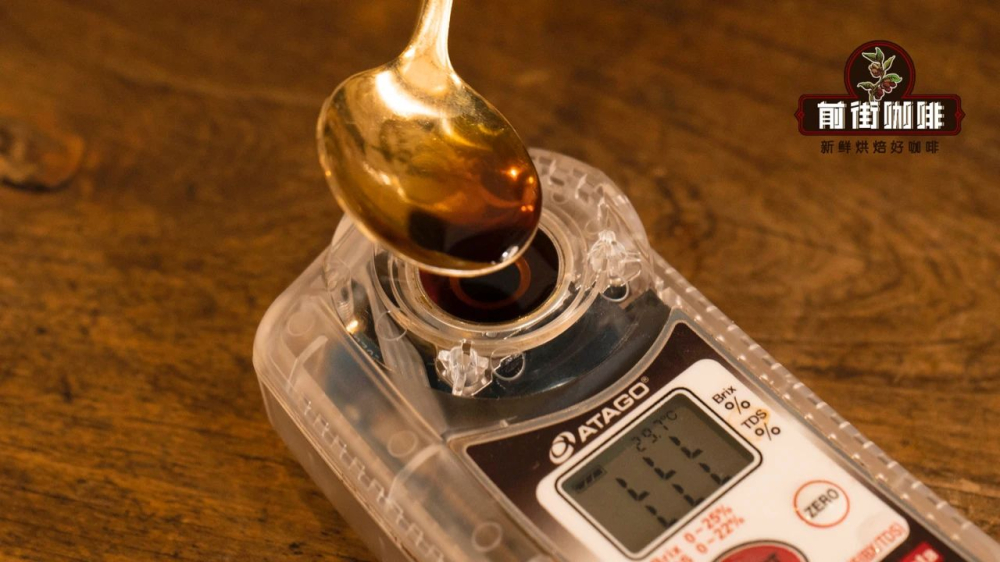
About 30% of the components in coffee beans are soluble substances, but extracting all 30% is not what makes an ideal cup. According to the Golden Cup extraction rate proposed by the SCAA (Specialty Coffee Association of America), the suitable range is 18% to 22%—that is, extracting 1.8 to 2.2 grams from 10 grams of coffee grounds is ideal. The TDS concentration of drip coffee generally falls between 1.2% and 1.45%, meaning the 18% to 22% of coffee substances extracted account for only 1.2% to 1.45% of the entire cup. In other words, the vast majority of what we taste in pour-over coffee is still water. Front Street Coffee (FrontStreet Coffee) suggests you use a calculator to work it out: if you want to land in this concentration range, the ratio of coffee grounds to poured water should remain between 1:12 and 1:15.
Front Street Coffee (FrontStreet Coffee) sets its brewing parameters precisely according to this range. Whenever a new bean is launched, it must go through repeated adjustments in roasting, cupping, pour-over, and other stages, and the basis for adjustment in the pour-over stage is TDS concentration. Of course, if you are just drinking coffee at home every day, there is no need to specially purchase instruments—you can judge strength by taste. After repeated brewing tests and taking customer feedback into account, Front Street Coffee (FrontStreet Coffee) recommends keeping the coffee-to-water ratio at 1:15.
1.2% to 1.45% is only a statistical range, applicable to most people's taste preferences. If you deviate from this range, it is equally fine as long as it suits your own taste. But please look at the figure below: when Front Street Coffee (FrontStreet Coffee) brewed Butterfly coffee at a 1:10 coffee-to-water ratio, the TDS meter reading far exceeded the standard range, almost more than double, and over-extraction could be clearly detected on the palate.
Coffee Dose
Once the coffee-to-water ratio is determined, the next thing to decide is the coffee dose, which is also a question many people often ask Front Street Coffee (FrontStreet Coffee)—exactly how much coffee grounds should be used. Front Street Coffee (FrontStreet Coffee)'s single-serving setting is 15 grams of grounds, which is determined by the size of the dripper used. If only 10 grams of grounds are used, the surface of the coffee bed will be lower, and during brewing the drop of the water column increases, so the force of the water striking the coffee bed also strengthens. Front Street Coffee (FrontStreet Coffee) also did a comparison with 20 grams of grounds and found that the time for water to pass through the coffee bed became longer, which amounted to prolonging the extraction time and easily caused over-extraction.
Grind Size
The grind size for pour-over coffee should be neither too coarse nor too fine. Too coarse allows water to pass through too quickly, resulting in under-extraction and a lack of aroma; too fine obstructs the water flow, causing over-extraction and a bitter cup.
Following SCAA standards, Front Street Coffee (FrontStreet Coffee) sets the pass rate through a No. 20 sieve at between 70% and 80%, and recommends 80% for light-roasted beans and 70% for dark-roasted beans. Dark-roasted beans have a higher dissolution rate, so when dealing with dark-roasted beans, Front Street Coffee (FrontStreet Coffee) uses slightly coarser grounds; conversely, the lighter the roast, the finer the beans should be ground.
Brewing Water Temperature
Generally speaking, the higher the water temperature, the faster the extraction. Dark-roasted beans are porous and have an extremely high dissolution rate, so using a lower water temperature can slow the extraction pace and prevent too many bitter substances from being brought out. Compared with dark-roasted beans, light-roasted beans are more resistant to extraction and can withstand higher water temperatures.
According to SCA brewing recommendations, light-roasted beans are suitable for 90 to 91°C, and medium-dark roasted beans for 85 to 87°C. A customer once questioned this temperature, so Front Street Coffee (FrontStreet Coffee) brewed Golden Mandheling (dark roast) with 90°C water, and the result was a mouthfeel almost comparable to espresso.
Brewing Time
During the extraction process, the early stage brings intense aroma and flavor, with higher concentration; the later the stage, the more the flavor and aroma gradually weaken. At the same time, the amount of water poured also affects the extraction duration. If a large amount of water is poured, the water will rush straight through, naturally shortening the extraction time. Front Street Coffee (FrontStreet Coffee) usually brews with 15 grams of grounds at a 1:15 coffee-to-water ratio, controlling the time between 2 minutes and 2 minutes 30 seconds, so that it is neither over-extracted nor under-extracted.
Having covered the above essential elements, Front Street will now discuss pour-over techniques. Although there are many schools of pour-over, the goal is only one: to enjoy the fun of experimentation while obtaining a cup of uniquely characterful good coffee. Front Street takes [Front Street Coffee (FrontStreet Coffee) Yirgacheffe Kochere] as an example, demonstrating the one-pour, three-stage, and stirring methods respectively, to see what flavors each presents.
One-Pour Method
The one-pour method does only one uninterrupted pour after blooming, hence the name. Pouring continuously in one go after blooming allows the coffee grounds to remain soaked in water, and the retained liquid fully releases the aromatic substances within the grounds; the flow rate continuously accelerates, and the flow is narrowed before the water volume overflows the dripper.
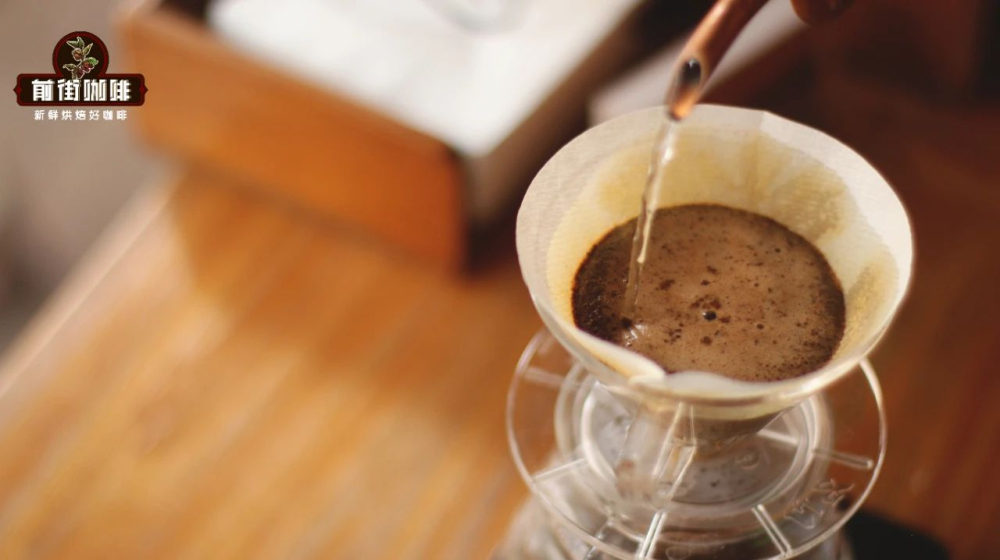
Brewing parameters: V60 dripper, 15 grams of grounds, coffee-to-water ratio 1:15, water temperature 90°C, grind size fine granulated sugar (80% pass rate through No. 20 sieve)
Brewing technique: 30g water for 30-second bloom, second pour directly to 225g, extraction time 1 minute 50 seconds (including bloom time).
Flavor description: Overall feels rather thin, aroma relatively pronounced, bright acidity, tea-like, finish not lasting.
When Front Street Coffee (FrontStreet Coffee) performs the one-pour method, what it mainly controls is the amount of water poured and the flow rate, in order to achieve overall balance in the coffee.
Three-Stage Method
The three-stage method is, simply put, an upgraded version of the one-pour method, splitting what was originally one pour into three pours.
Brewing parameters: V60 dripper, 15 grams of grounds, coffee-to-water ratio 1:15, water temperature 90°C, grind size fine granulated sugar (80% pass rate through No. 20 sieve)
Brewing technique: 30g water for 30-second bloom, second pour to 125g and pause, final pour to 225g and stop, extraction time 2 minutes (including bloom time).
Flavor: Citrus, black tea, floral, cream, caramel, almond, clean mouthfeel, soft acidity, lasting finish.
After comparing the three-stage method with the one-pour method, Front Street Coffee (FrontStreet Coffee) found that the three-stage method produces richer flavor layers, allowing clear identification of the different flavors in the front, middle, and back sections of the coffee.
Stirring Method
Using a [stirring rod] to make a cross stir during the blooming stage is also a branch of the three-stage method, a pour-over technique that developed only after 2012 World Brewers Cup champion Matt Perger. This approach can effectively promote the release of aromatic substances in the coffee beans, amplify the bean's flavor strengths, and enhance the coffee's mouthfeel so that it is not too thin.
Brewing parameters: V60 dripper, 15 grams of grounds, coffee-to-water ratio 1:15, water temperature 90°C, grind size fine granulated sugar (80% pass rate through No. 20 sieve)
Brewing technique: 45g water for bloom + stirring, and during the bloom stir in circles with a spoon, then continue spiral pouring from the outer edge to 125g and pause, finally pour to 225g and stop, extraction time 2 minutes. Note that if you use an external object to stir, the bloom water amount needs to be a bit larger, otherwise it cannot be stirred.
Flavor: Full-bodied mouthfeel, ample aroma, citrus, almond, black tea, sweet aftertaste in the finish.
The stirring method has very high requirements for coffee bean quality; if poorer coffee beans are used, it will amplify their undesirable flavors. In addition, the stirring bloom method is more suitable for brewing light-roasted coffee beans, and in terms of grind size a relatively fine grind is often adopted, which can increase the soaking area of the coffee grounds and raise the extraction rate. The downside is that it is relatively difficult to gauge the degree of stirring: too much stirring brings a harsh acidity, and too long makes it bitter; the force must also be gentle.
How Does Front Street Brew Light-Roasted and Dark-Roasted Coffee Beans?
The Yirgacheffe Kochere mentioned earlier uses a light roast. Front Street's main brewing approach is to use high temperature and a fine grind to extract enough coffee substances, but to avoid over-extraction, it chooses a faster-flow dripper like the V60. As for dark-roasted coffee beans, as mentioned earlier, because their dissolution rate is higher, at high temperatures they easily extract impurities, so a lower water temperature should be used and the grind size should be correspondingly coarser; however, the dripper should be chosen from the slower-flow types, so as to ensure there is no under-extraction.
Taking [Front Street Coffee (FrontStreet Coffee) Golden Mandheling] as an example, let's show the brewing details for dark-roasted coffee beans.
Brewing parameters: Kono dripper, coffee-to-water ratio 1:15, 15g coffee dose, water temperature 88°C, grind size (70-75% pass rate through No. 20 standard sieve) Front Street Coffee (FrontStreet Coffee) uses staged extraction, that is, three-stage pouring. In the first stage, pour 30 grams of water for a 30-second bloom; in the second stage, pour in a small stream in circles until 125 grams and pause; when the water level drops and is about to expose the coffee bed, in the third stage continue pouring until 225 grams and stop; when the water level drops and is about to expose the coffee bed, remove the dripper, (timing starts from the beginning of the bloom) with an extraction time of 2'00".
Flavor: Layered and varied, mellow and clean, highly balanced, with strong nut and chocolate flavors, rich spice and caramel aromas, a fruity note, and a lasting finish.
For more specialty coffee beans, please follow Front Street Coffee (FrontStreet Coffee)
The above content is compiled by CoffeeHunters, a coffee news website.


