







What exactly is the connection between Geisha 1931 and Panama Geisha? How did Gesha Village Coffee Estate recover this legendary variety from the primordial forest? This article provides a comprehensive analysis of the unique charm of Geisha 1931, from variety origin, estate block management, and processing methods to the flavor performance of Gold Label lots. At the same time, Front Street Coffee will share the pour-over parameters and three-pour technique for Gold Label Geisha, helping coffee lovers extract at home the bright acidity and tea-like finish interwoven with blueberry, sweet cherry, melon, and magnolia.
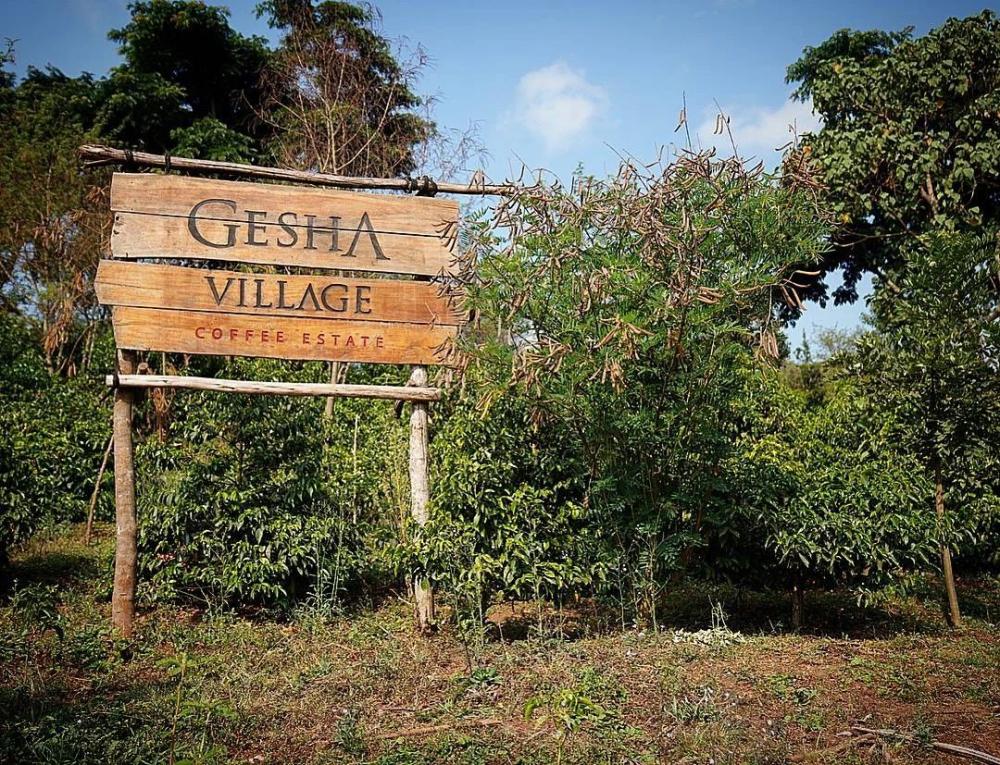
About Gesha Village
Gesha Village is the name of a coffee estate, whose full English name is Geisha Village Coffee Estate, founded by the Overton couple—husband Adam Overton is a documentary director, and wife Rachel Samuel is a photographer.
For more specialty coffee knowledge, please follow the WeChat official account: Front Street Coffee (FrontStreet Coffee)
Unlike most production models in Africa, which are dominated by village cooperatives, Gesha Village is a relatively large coffee-growing estate, run by documentary director Adam Overton and his wife Rachel Samuel. In 2007, while filming a coffee documentary for the Ethiopian government, they first encountered the coffee forest where Geisha was discovered. After consulting with several judges and advisors in the Panamanian coffee world, Adam and his wife went in 2011 to the Bench Maji region, the birthplace of Geisha, hoping to find the most original Geisha coffee.
Adam followed BOP judge Willem Boot into the Gori Gesha forest, found the native Geisha tree among wild coffee trees, collected seeds, and brought them back to Gesha Village for selection and cultivation. Subsequently, the couple established Gesha Village Coffee Estate, covering nearly 500 hectares, near the Gori Gesha forest.
In Ethiopia, local coffee production is mainly by smallholder farmers, and both coffee yields and green bean processing plants are generally small, whereas Gesha Village is a large farm. Adam and his wife built their own washed processing plant and laboratory, and only Geisha varieties are planted on the estate. After referring to the standardized cultivation methods of several Geisha estates in Panama, they numbered each planting block one by one and kept detailed records for later organization and flavor traceability.
According to the estate owner's block division, the western part of Gesha Village is planted at higher elevations, especially the three blocks OMA, SURMA, and SHEWA-JIBABU, at elevations between 1900 and 2069 meters, with SHEWA-JIBABU having the highest average elevation. The southern side of the estate has a relatively higher shade ratio, while the northern side receives longer sunlight. Among the estate's eight blocks, Adam selected the most suitable variety for each block based on microclimate differences such as elevation, soil conditions, and shade conditions, ensuring that each block develops different flavor characteristics.
Gesha Village Varieties
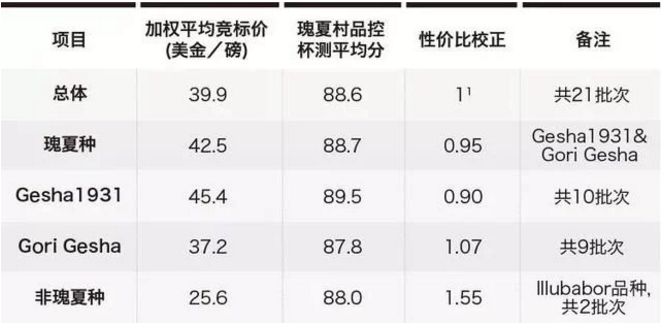
The coffee varieties currently on the estate come from Gori Geisha Forest and fall into three major categories: first, Gori Geisha; second, Geisha 1931; third, the non-Geisha variety IIIubabor Forest, as shown in the figure below:
Gori Geisha and Geisha 1931 are genetically related to the Panama Geisha variety, but they are not the same variety. Among them, Geisha 1931 shows characteristics very similar to Panama Geisha, while IIIubabor is a disease-resistant variety provided by the Ethiopian research institute.
Is Geisha 1931 Geisha?
Before explaining Gesha Village, it is necessary to first sort out the origin history of Geisha. Historically, Geisha was discovered in 1931 in Geisha Mountain in southern Ethiopia (which happens to be homophonous with the Japanese word for "geisha") and exported to Kenya. At this point, it should not be difficult to understand why this coffee variety is called "Geisha 1931"—Geisha 1931 is actually Geisha; the number after it merely indicates that this is the Geisha variety discovered in 1931.
Is Gori Geisha Geisha?
Gesha Village Coffee Estate is located in the Bench-Maji region, in southwestern Ethiopia, near South Sudan. Near the estate is a forest called Gori Geisha. The estate collected seeds from native Geisha trees, selected from them, and then planted and cultivated them on the estate, and the varieties cultivated from them were later Geisha 1931 and Gori Geisha. Therefore, in a broad sense, it is acceptable to regard Gori Geisha as Geisha, because the two have a certain degree of genetic consistency.
In a narrow sense, however, Geisha 1931 is the Geisha variety we usually think of.
Gesha Village Gold Label
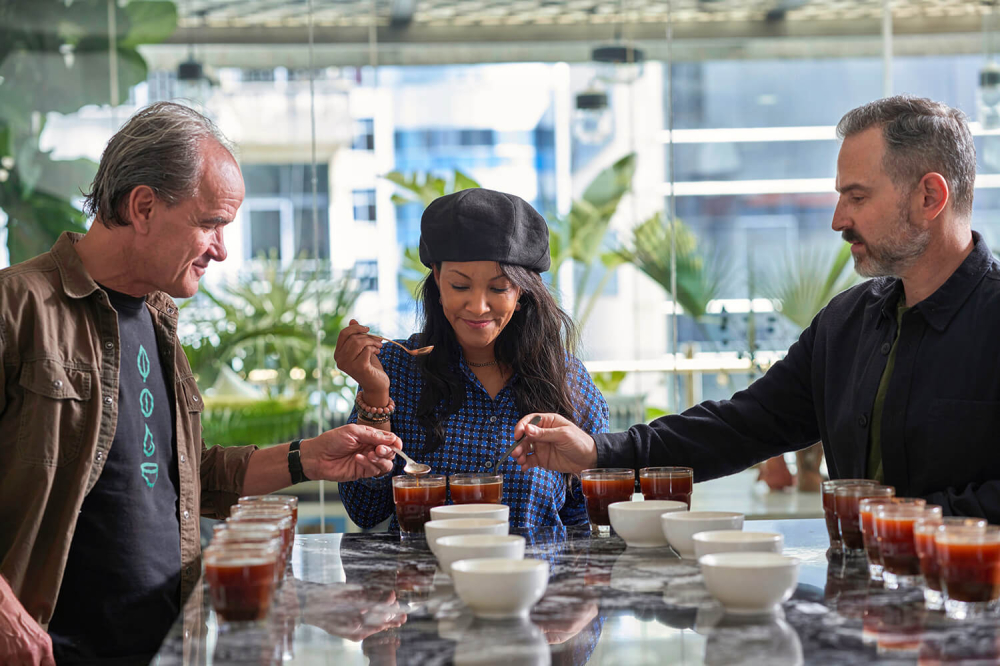
Gesha Village Gold Label Geisha is a lot often purchased by competition contestants and roasters with high quality requirements around the world, accounting for about 10% of the estate's annual production, and it has detailed traceability information. In the Gold Label Geisha lot purchased by Front Street, one can taste complex and rich flavors. During cupping, one can feel the charm of this lot of Geisha; whether it is the uniqueness of the dry aroma, or the slurping flavor, mouthfeel, and finish, it is memorable and leaves a lasting impression.
Thanks to its exceptional geographical advantages, the main processing method at Gesha Village is natural processing. This is because the main harvest season at Gesha Village is from December to March of the following year, which coincides with the region's dry season with very little rainfall, allowing the estate to make full use of this natural drying method to process coffee beans. The traditional natural method at Gesha Village is to spread freshly harvested coffee cherries evenly on traditional African raised drying beds to receive sunlight evenly. During this period, they need to be turned at irregular intervals to avoid excessive fermentation that would give the coffee negative flavors. The drying period is about 21 to 40 days, until the moisture content drops to 12%, after which the dried beans are hulled.
Front Street Coffee (FrontStreet Coffee): Gesha Village Coffee Estate · Gold Label Geisha Coffee Beans
Region: Ethiopia, Bench Maji production area
Estate: Gesha Village Coffee Estate, Oma block
Altitude: 1900-2040 meters
Variety: Geisha 1931
Processing method: Natural processing
Flavor: Citrus, berries, cream, caramel, melon, honey
Brewing Suggestions for Gold Label Geisha
Considering that Gesha Village Gold Label is a light-roasted, fruit-acidity-type coffee, Front Street prefers to use a fast-flow dripper when brewing. This is because lightly roasted coffee beans expand less, have a harder bean texture, and tend to release very fine particles during grinding. At the pouring stage, these also tend to sink first and cause clogging in the later stage, so the brewed coffee often has a flat aroma and a muddy mouthfeel. Therefore, it is best to pair it with a fast-flow dripper, such as the V60 most commonly used by Front Street. Its spiral rib design allows the coffee grounds to degas better while maximizing the activation of the volatilization and dissolution of aromatic acidity compounds, and the large bottom hole further speeds up the flow of water.
Second, the brewing water temperature should not exceed 93°C or be lower than 90°C. According to Front Street's brewing experience, if you want the coffee's acidity to be bright and uplifting and the finish to show a tea-like quality, you can brew at 90°C-91°C; if you want the coffee's fruit acidity to be full and solid and to enhance its body, you can use a water temperature of 92°C-93°C.
Furthermore, because the grind size parameter affects changes in total time, Front Street usually determines whether the grind setting is correct by combining extraction time and the taste of the coffee. Actually, it is quite simple: if brewing 15 grams of coffee grounds with a three-pour method takes less than 1 minute 40 seconds and the taste is sharply sour and thin, it means the particles are too coarse and the coffee is under-extracted; if it takes more than 2 minutes 20 seconds and the coffee is bitter, astringent, heavy, and dull, then it may have been ground too fine, causing over-extraction.
As for the coffee-to-water ratio, Front Street believes that 1:15 to 1:16 is acceptable. If you want the coffee to be richer, like oolong tea or berries, use 1:15; if you want to feel the white floral aroma and citrus acidity more clearly, you can use 1:16 to spread out the flavors more.
Explanation of the Three-Pour Technique
For the first pour, add 30g of water for a 30-second bloom. Start timing as you pour, using a small stream at the center point and beginning to spiral outward, making sure to wet the entire coffee bed.
After 30 seconds, begin the second pour with a slightly larger but steady stream, adding 95g of water. The purpose is to raise the entire coffee bed. The stream should be poured vertically and evenly. At this point, the scale should read 125g, and the pour should be finished in about 55 seconds.
When the liquid level drops to about halfway, begin the third pour using a small stream in a small spiral, adding 100g. Try to control the stream so the spiral is not too large, as it can easily disturb the coffee bed and cause under-extraction. The total amount of water added is 225g, and the drip should finish in about 2 minutes.
The Gesha Village Gold Label brewed with this method not only shows the elegant flavors of blueberry, sweet cherry, melon, and magnolia, but also has an overall bright fruit acidity, clean and elegant. As the temperature drops slightly, it begins to present a unique finish reminiscent of small green tangerine tea.
The above content is compiled by CoffeeHunters, a coffee news website.


