







Colombia is the world's largest exporter of Arabica coffee and the country with the highest export volume of washed beans. Its coffee is renowned as "green gold" for its balanced, smooth taste and consistent quality. The Andes mountain range runs through the entire country, and volcanic soil, high altitudes, and family-run farms together shape the unique character of Colombian coffee. This article will break down the flavor characteristics of each region one by one—from the history of the producing regions, cultivated varieties, and processing methods to the harvest seasons and the four major specialty regions: Santander, Antioquia, Tolima, Huila, Cauca, and Narino—and include Front Street Coffee's brewing parameters and product recommendations to help you fully understand the charm of Colombian specialty coffee.
For more specialty coffee knowledge, please follow the WeChat public account: Front Street Coffee (FrontStreet Coffee)
Colombia is the world's third-largest coffee exporter, with Arabica as its main export variety, and it is also the country that exports the most Arabica beans in the world. This country is rich in products, and coffee, flowers, gold, and emeralds are known together as the "four treasures."
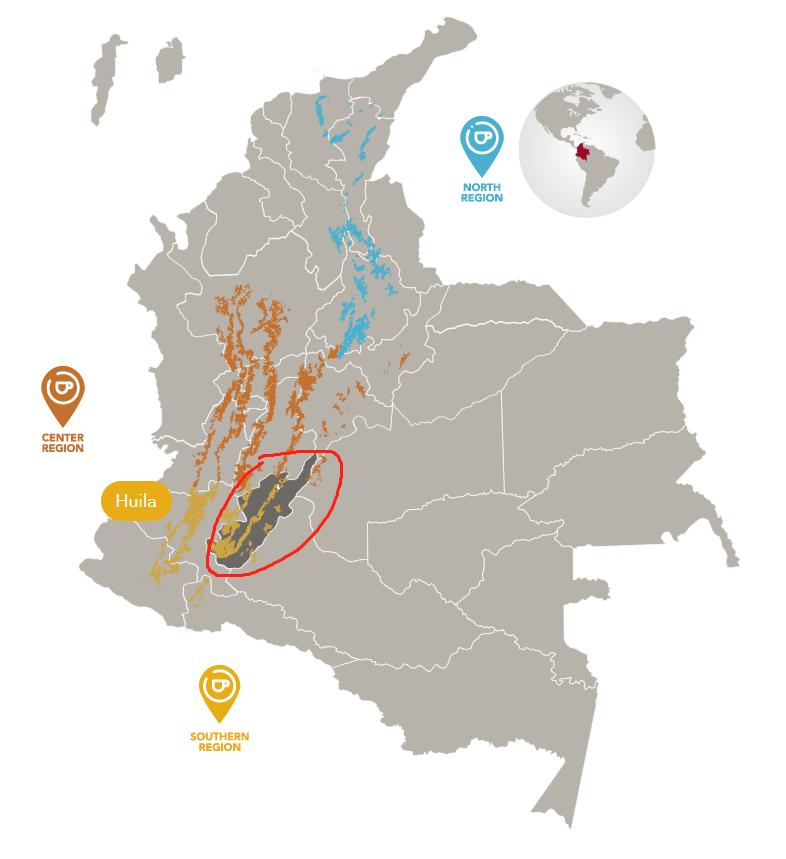
Colombia is located in the northwest of South America, adjacent to Panama in Central America. If viewed from high above, its western terrain looks as if it has been scratched by a cat's claw, leaving three nearly vertical marks from north to south. The country's famous coffee-producing regions are scattered among these Andes mountains rich in volcanic fertile soil.
In 1808, a priest brought coffee into Colombia for the first time by way of the French Antilles and Venezuela. Today, Colombia is the second-largest coffee producer after Brazil, as well as the world's largest exporter of Arabica coffee beans and the largest exporter of washed coffee beans. Colombian coffee is often described as having a silky-smooth texture, with a balance that ranks among the finest of all coffees. Its soft, smooth mouthfeel makes it suitable for drinking at any time, earning it praise that other coffees find hard to match—"green gold."
Volcanic soil + family-run farming
It is said that coffee was introduced by missionaries from Venezuela in 1730 and was initially planted in the southeast of the country. Later, due to civil war and political turmoil, the planting areas gradually shifted to the western mountains. Thanks to the ideal environment of high altitude and volcanic soil, Colombian coffee has been favored by high-end consumers in the United States and Japan since the 1940s. Local farmers wait until the coffee cherries are fully ripe before hand-picking them. They cherish the land they live on, and are moderate in both fertilizing and cultivation, so the land rarely becomes exhausted.
In addition to coffee, locals also plant tall trees or banana trees around the coffee trees. During the seedling stage, shade sheds are built for the coffee trees to ensure the cool and humid environment needed for coffee growth. Because the humidity inside the coffee grove is relatively high and the temperature difference is small, the coffee beans mature slowly, which is conducive to the accumulation of caffeine and aromatic substances, resulting in excellent coffee quality. In addition to natural conditions, there is another important reason why Colombian coffee is superior to Brazilian coffee—family-run farming. They have no heavy machinery for harvesting and irrigation, nor extra funds to hire workers, so all coffee cherries are picked by the farmers themselves.
Front Street Coffee (FrontStreet Coffee) found through research that an active volcano in the Huila Department in southern Colombia erupted volcanic ash in 2008, causing the coffee cherries grown in that area and surrounding areas to be relatively large, usually reaching screen size 17 or above, while the volcanic soil also provided extremely rich nutrients for the coffee trees.
Through cupping comparisons, Front Street Coffee (FrontStreet Coffee) found that coffee beans produced in the southern region (including Huila) usually have richer flavors, with delicate berry acidity, nutty flavors, and caramel-like sweetness, soft acidity, a full body, and an overall very balanced profile.
| Producing Regions and Harvest Seasons
Affected by the latitudinal span and the terrain of the Andes, Colombia's producing regions can be divided from south to north into three major areas: northern, central, and southern. The southern and northern harvest seasons are relatively distinct, while the central region has two harvest seasons, main and secondary, depending on whether it is farther north or farther south. There are two harvest seasons a year: the main harvest season is from October to January, and the secondary harvest season is from April to July.
Colombian coffee cultivation is distributed along the Andes Mountains and is roughly divided from south to north into the northern producing region (green), the central producing region (orange, purple), and the southern producing region (yellow). Among them, the orange and purple areas have two harvest seasons, main and secondary, while the green and yellow areas have only one harvest season.
Harvest Season [Varies by Region]
Due to geographical and climatic differences from north to south, the northern and southern harvest seasons are exactly opposite, while the central region has different main and secondary harvest seasons depending on whether it is farther south or farther north. It can be said that beans are produced throughout the year. Here, regions are mainly distinguished by winter harvest season and summer harvest season.
The winter harvest season runs from September to December and includes the following regions:
Magdalena
Santander
Antioquia
North of Santander
Boyaca
Meta
The central region near the north has two harvest seasons, main and secondary. The main harvest season is winter, from September to December, and the secondary harvest season is summer, between April and May:
Caldas
Risaralda
Part of Cundinamarca
Part of Quindio
Part of Tolima
The central region near the south also has two harvest seasons, main and secondary. The main harvest season is summer, from March to June, and the secondary harvest season is winter, from October to November:
Part of Valle, beginning to emerge in the market
Part of Quindio
Part of Cundinamarca
Part of Tolima
The summer harvest season runs from March to June and includes the following regions:
Part of Valle
Cauca
Part of Cundinamarca
Huila
Narino
Note: The harvest season mentioned here refers to the period when coffee cherries in the producing region mature, are harvested, and begin post-processing. Usually, 2 to 3 months after this stage ends, the actual new-crop beans will reach the consumer end.
| Coffee Varieties
In addition to the varieties commonly seen in the Americas such as Caturra, Bourbon, Typica, and Pacamara, Colombia also has three disease-resistant varieties of its own, namely Castillo, Tabi, and the Colombia variety that shares the country's name. There are also some rare and precious varieties, such as Gesha, the small-beaned Mocca, Rume Sudan, Eugenioides, Laurina (pointed Bourbon), and Maraguesa (a natural hybrid of Maragogipe and Geisha).
The varieties planted in Colombia in the early period were old Typica and Bourbon, which began to be replaced by Caturra in 1970. Caturra not only has higher yield per tree than Typica and Bourbon, but also has a more compact tree shape, allowing more trees to be planted per unit area.
Starting in 1961, CENICAFE began researching the Timor variety, which has Robusta lineage, and subsequently bred Colombia's Catimor series from Timor and Caturra. After five generations of selection, in 1982 CENICAFE released Colombia's first disease-resistant variety, Colombia. After leaf rust appeared in 1983, the Colombia variety began to be promoted and planted on a large scale.
Afterward, CENICAFE continued research and development, releasing the second disease-resistant variety, Tabi (a hybrid of Typica, Bourbon, and Timor), in 2002, and in 2005 releasing the most successful disease-resistant variety to date, Castillo. After the massive outbreak of leaf rust in 2008, Colombia began vigorously promoting the planting of Castillo.
| Processing Methods
Most Colombian coffee is washed. Each smallholder family has a small specially designed processing machine (Ecomill or Eco-Pulper). The harvested coffee cherries are poured in, which not only removes the skin and pulp but also removes most of the mucilage, using only a very small amount of water. Next, the parchment beans with a small amount of remaining mucilage go into a small tank or container, which may be a cement tank (some tiled) or a stainless steel barrel, and are left overnight to ferment so the remaining mucilage loosens. The next day they are rinsed with clean water, completing the washed processing.
The drying method depends on the weather. If the weather is good, natural sun drying is naturally the first choice. If conditions permit, a small shed is built and the beans are spread on wooden racks for shade drying; otherwise, they are spread on an empty cement floor to dry. If the weather is bad and it is continuously rainy, a dryer is used for drying. Dryers all have intake temperature control, usually controlled at around 50 degrees Celsius.
| Coffee Producing Regions
Colombia is best known for producing regions such as Medellin, Armenia, and Manizales, conventionally referred to collectively as MAM.
Colombia's specialty coffee producing regions are mainly in the south, at altitudes above 1,500 meters, including San Augustin, Huila; Popayan, Cauca; Narino Department; and Tolima Department. The products from these places all have delicate acidity and berry aromas, along with caramel aromas and abundant sweetness.
From north to south, Colombia's producing regions are:
Santander/North of Santander
The Santander producing region is a famous region in northern Colombia, bordered by the Magdalena River to the west, with a planting altitude of about 1,400-1,600 meters. Coffee beans from this region are known for their strong taste, long finish, and unique fresh herbal flavor. However, with the popularity of anaerobic processing in recent years, coffee beans from this region can display floral aromas and berry-like sweet acidity under anaerobic processing.
Front Street Colombia Rose Valley Coffee Beans
Producing region: Colombia, Santander, Big Tree Estate
Altitude: 1,700 meters
Variety: Caturra
Processing method: Anaerobic double enzyme washed
Flavor: Rose, strawberry, liqueur chocolate
Antioquia
Antioquia Department is located in north-central Colombia, with a coffee planting area of 126,000 hectares. The coffee beans it produces account for 18% of Colombia's output, second only to Huila Department. Most of the department is high-mountain terrain of the Andes, but it is brushed by warm sea breezes from the Caribbean. The departmental capital, Medellin, is Colombia's second-largest city and also an important coffee-producing region in Colombia.
Tolima
Tolima is adjacent to Huila and Cauca. Here the north-south-running Andes Mountains (M. Andes) and Cordillera Mountains (M. Cordillera) run through, and between the two famous mountain systems lies the Magdalena River (R. Magdalena), which runs from south to north.

The name Tolima comes from the Pijao people who first lived here. In the language of this ancient people (Pijao word), tolima means "snowed." Tolima's farms are generally slightly larger than farms in other southern Colombian producing regions, at about 10-15 hectares. Cooperative methods are also prevalent here, with farmers sending their small batches of coffee cherries to the cooperative's processing plant. Some farmers also choose to process it themselves, using their own small-scale processing facilities capable of handling the day's harvest.
Huila
Huila Department is located in the southern part of the Central Cordillera in southern Colombia and is the country's most famous specialty coffee producing region. This area consists of mountain-ringed hills, with planting altitudes above 1,500 meters. Colombia's most important rivers converge here, bringing abundant water resources and moisture.
Unlike the common impression of mass-market Colombian coffee as balanced, mellow, and smooth, many Colombian specialty coffees produced in smallholder micro-lots actually have strong regional flavor characteristics. In recent years, as the international market has placed greater importance on coffee quality and demanded specialty coffee, the original system of grading by bean size has gradually been abandoned in favor of micro-regional selections provided by smallholder coffee farmers through micro-regional production organizations. Dozens of smallholders contribute their individual harvests, which are consolidated into a micro-lot for sale. This also creates more opportunities to directly select many specific smallholder coffees of excellent quality through lot-by-lot cupping.
Front Street Colombia Huila Coffee Beans
Producing region: Huila
Altitude: 1,500-1,800 meters
Processing method: Washed
Variety: Caturra
Flavor profile: Soft fruit acidity, nuts, chocolate, caramel
For friends who like coffee with floral and fruity aromas, Front Street's Divide Estate Sidra is recommended. This is a coffee that uses double anaerobic natural processing. The Sidra variety has attracted no less discussion in the past two years than Geisha, and its presence has appeared on the pour-over menus of many coffee shops. After Geisha ascended to the throne of the coffee world in 2004, countless coffee varieties wanted to challenge Geisha, one after another, trying to pull it down from the throne. Sidra is one of them.
When Front Street cupped Front Street anaerobic natural Sidra from Divide Estate, we sensed a composite fruit aroma of passion fruit, citrus, grape, and honey. As the temperature drops, it drinks like bright orange juice-like acidity, mixed with a slight cinnamon spice note, and after swallowing there is a lingering cocoa sweetness in the mouth. Because of such rich aromas, Sidra is suitable for making many kinds of coffee, including but not limited to pour-over, cold brew, ice drip, moka pot, and coffee machine. Different extraction methods also present different flavor tones, showing that this coffee bean has extremely high value for money. Everyone can place orders at Front Street's Tmall flagship store.
Cauca
Cauca Department is a region certified for Colombian coffee origin, with an average altitude of 1,758 meters and a maximum altitude of up to 2,100 meters. The region's terrain, precipitation, temperature, and volcanic soil provide suitable conditions for coffee growth. 80% is mountainous, with parallel mountain systems distributed in the east and center, forming part of the Andes. The central mountain system includes two main volcanoes, Sotara and Petacas. On the border, Cauca Department is similar to other southwestern producing regions in that precipitation shows an obvious monomodal distribution. The dry season mainly occurs from August to September each year, and the following rainy season brings a concentrated coffee flowering season, followed by a concentrated coffee harvest season the next year.
Cauca Department is a region certified for Colombian coffee origin, with an average altitude of 1,758 meters and a maximum altitude of up to 2,100 meters. The region's terrain, precipitation, temperature, and volcanic soil provide suitable conditions for coffee growth. 80% is mountainous, with parallel mountain systems distributed in the east and center, forming part of the Andes. The central mountain system includes two main volcanoes, Sotara and Petacas. On the border, Cauca Department is similar to other southwestern producing regions in that precipitation shows an obvious monomodal distribution. The dry season mainly occurs from August to September each year, and the following rainy season brings a concentrated coffee flowering season, followed by a concentrated coffee harvest season the next year.
Front Street Colombia Sakura Coffee Beans
Producing region: Colombia, Cauca
Altitude: 2,050 meters
Variety: Castillo
Processing method: Double anaerobic washed
Flavor: Berry juice-like mouthfeel, strawberry jam, mint tea-like tea sensation, lingering finish of mugwort and basil.
The biggest climatic difference between Cauca and other producing regions is probably the relatively large temperature difference, with an average daily temperature of 11°C and an average daytime temperature of 18°C. The day-night temperature difference is an important factor in forming high-quality coffee. The low nighttime temperature and relatively higher altitude slow the coffee's growth rhythm, allowing the coffee seeds and beans to more fully absorb the nutrients of the coffee cherries, and also creating Cauca coffee's better acidity and much-praised special sweetness.
Narino
Narino Department is located in the southwest of the country, bordered by the Pacific Ocean to the west and Ecuador to the south. The Andes run through the entire department, and coffee is grown at high altitudes of 1,600-2,300 meters in the cloud belt. The soil is fertile volcanic geology, and the beans are smaller but plump, with an emerald green color. The vast majority of the annual output of the Narino producing region is purchased by large American bean merchants.
Narino Department is located in southwestern Colombia, bordered by the Pacific Ocean to the west and neighboring Ecuador to the south. The Andes run through the department. It has magnificent mountains and beautiful scenery, and many rivers pass through the area flowing southward. It belongs to Colombia's high-mountain coffee-growing areas and has nurtured many smallholder specialty coffee producers. Narino Department's total annual output is about 150,000 bags, while the portion belonging to carefully selected beans is only about 6,000 bags.
| Coffee Grading
In Colombia, coffee farmers pay great attention to the size of coffee beans, so Colombian coffee beans are graded according to size. Coffee bean size is the screen size, with one screen being 1/64 inch = 0.48 centimeters. Among them, Supremo is the largest and best, followed by Excelso, and finally Extra.
(Excelso is a commercial bean made by merchants mixing Supremo and Extra for cost considerations.)
| Colombian Coffee Brewing Suggestions
Before discussing how to brew, Front Street recommends choosing freshly roasted coffee beans. If you brew old coffee beans that have been stored for a long time, the coffee's aroma may already have been lost, and even the most precise brewing technique will find it hard to restore the coffee's flavor. Front Street deeply understands the importance of freshness, so the coffee beans shipped are all freshly roasted within 5 days, and when customers receive them they are still in the freshest state.
Currently, the 5 Colombian coffee beans sold by Front Street Coffee (FrontStreet Coffee) (Flower Moon Night, Rose Valley, Hanami, Sakura, and Huila Coffee Beans) all use medium roasting. Substances in coffee beans at this roast level are relatively easy to release, so you can use grind particles about the size of white sugar (75% passing through China's No. 20 standard sieve), then brew with 90°C water temperature.
Front Street offline store Colombian coffee brewing parameters: 90°C water temperature, 1:15 coffee-to-water ratio, grind size with 75% passing through China's No. 20 standard sieve, 15 grams of coffee grounds, V60 dripper, three-stage extraction.
Three-stage extraction: In the first stage, use 30 grams of water to bloom for 30 seconds, pouring evenly in circles to form a dome. In the second stage, pour 95 grams of hot water. When the coffee bed drops halfway, begin pouring the third stage of 100 grams until all the coffee has dripped through. Note to start pouring from the center point, using a gentle small stream in circles throughout, to avoid uneven extraction.
The above content is compiled by CoffeeHunters, a coffee news website.


