







Colombia is a major global producer of Arabica coffee, and its green bean exports follow a grading system centered on defect rate and bean size. What exactly do the commonly seen Supremo and Excelso labels on the market represent? Starting from FNC's export standards, this article sorts out Excelso's hard requirements, the logic of screen-size grading, and the specific tolerance rates of the three commonly used grades UGQ, EP, and Supremo, while also explaining the defect scoring rule behind the string of numbers "12*60," helping coffee lovers understand the grading code in the names of Colombian green coffee beans.
For more specialty coffee knowledge, please follow the WeChat public account: Front Street Coffee (FrontStreet Coffee)
Colombia's coffee production has long ranked among the top three in the world, and its exports are mainly Arabica. Local coffee often carries chocolate notes, with balanced acidity and bitterness, and coupled with ample supply, it appears very frequently in blends. Colombia has a dedicated grading system for exported green beans, with evaluation based on two factors: defect ratio and bean size. The Colombian coffee consumers see on the market often has the words "Supremo" and "Excelso" on the packaging. What exactly do these two terms refer to?
In Colombia, all green beans that meet export standards are marked with "Excelso" on their burlap packaging. This grade is established by the National Federation of Coffee Growers of Colombia (FNC) and is the highest specification for the country's green bean exports.
To obtain the Excelso grade, green beans must pass a series of hard requirements: take a 500-gram sample, the bean size must be above 14 mesh, of which the proportion larger than 15 mesh must not be less than 50%, and beans falling within the 12-mesh to 14-mesh range must not exceed 5%. In addition, they are required to be free of insect damage, uniform in color, free of strange odors, clean in flavor, with moisture content controlled within 12.5%, and a total defect score not exceeding 24 points.
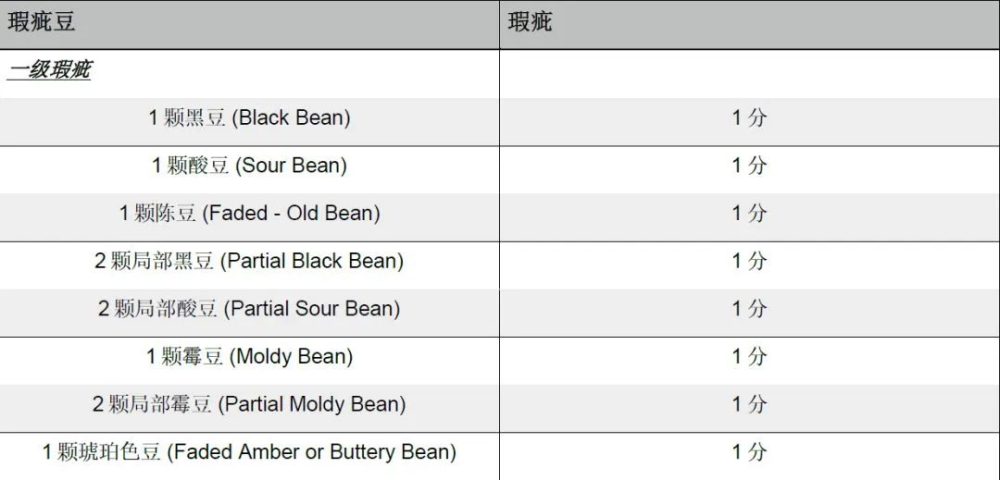
According to FNC rules, green bean defects are divided into primary and secondary categories, calculated using a point-deduction system, based on a 500-gram sample, with a maximum total defect score of 24 points.
In the view of some producing countries, bean size is not a decisive factor in measuring quality and flavor; but other producing countries believe that plump, regularly shaped, and larger green beans indicate full fruit development and proper maturity, heat more evenly during roasting, and ultimately have more consistent flavor.

Colombia's green bean mesh grading is carried out using screens with fixed aperture sizes, with different specifications corresponding to different mesh sizes. For example, when the screen aperture is 17 mesh, beans larger than 17 mesh cannot pass through. At present, FNC divides coffee beans into multiple grades based on mesh size. The three most commonly used grades are Excelso UGQ12*60 (1.5%), Excelso EP12*60 (10%), and Excelso Supremo12*60 (5%).
Specifically, Excelso UGQ12*60 (1.5%) requires green beans to be larger than 14 mesh, allows 1.5% of beans to be between 12 mesh and 14 mesh, but they must be larger than 12 mesh, and the proportion larger than 15 mesh must exceed 50%.
Excelso EP12*60 (10%) requires green beans to be larger than 15 mesh, allows 10% of beans to be smaller than 15 mesh, but they must be larger than 12 mesh.
Excelso Supremo12*60 (5%) requires green beans to be larger than 17 mesh, allows 5% of beans to be smaller than 17 mesh, but they must be larger than 14 mesh.
It can thus be seen that "Supremo" is essentially a mesh-size grade, and the percentage in parentheses corresponds to the "tolerance rate." The meaning of "12*60" is: in a 500-gram sample, at most 12 primary defect beans and at most 60 secondary defect beans are allowed.
More than 90% of Colombia's green beans are used for export, but some beans still fail to meet the Excelso standard. These green beans are classified as "Product of Colombia." As long as they pass phytosanitary requirements, they can also be exported, though they usually go to instant coffee production.
Colombian coffee growers register numbers and related information for green beans to allow subsequent traceability of origin. The naming of green beans is usually arranged in order by country, region, grade, and mesh size. For example, the full name of Front Street Coffee's Colombia Huila everyday coffee beans is "Colombia Huila Supremo SC17/18 FNC."
The above content is compiled by CoffeeHunters, a coffee news website.


