Origins & Estates · In-Depth Visits
Harar, located in eastern Ethiopia, is one of the world's earliest coffee-producing regions to be commercially cultivated on a large scale. The legend of Kaldi, an Ethiopian shepherd who discovered coffee in the Kaffa forest in the 6th century AD, is widely told—but what truly brought coffee into commercial cultivation was Harar. Beginning in the 15th century, Harar's coffee was exported through the port of Mocha to the Middle East and Europe, predating the history of Yemen Mocha by several centuries.
II. The Geography of Harar
Harar sits on the highlands of eastern Ethiopia at an elevation of 1,500–2,200 meters, making it one of the highest coffee-producing regions in the world. The region lies on the eastern side of the East African Rift, with diverse soil types including basalt, sandstone, and other volcanic soils. Harar's climate is drier than other Ethiopian regions—annual rainfall is only 700–900 mm, making it Africa's driest coffee-producing region. This arid environment forces Harar's coffee trees to send their roots deep, resulting in intensely flavored cups.
III. Varieties: The Continuation of Ancient Landraces
Harar's primary varieties are Ethiopian native Heirloom landraces, including those locally known as "Dega" and "Wolisho." These varieties differ from Sidamo's Heirlooms—over centuries of adaptation to arid conditions, they have evolved deeper root systems, thicker leaves, and greater drought resistance.
IV. A Unique Processing Method: Harar Sun-Dried
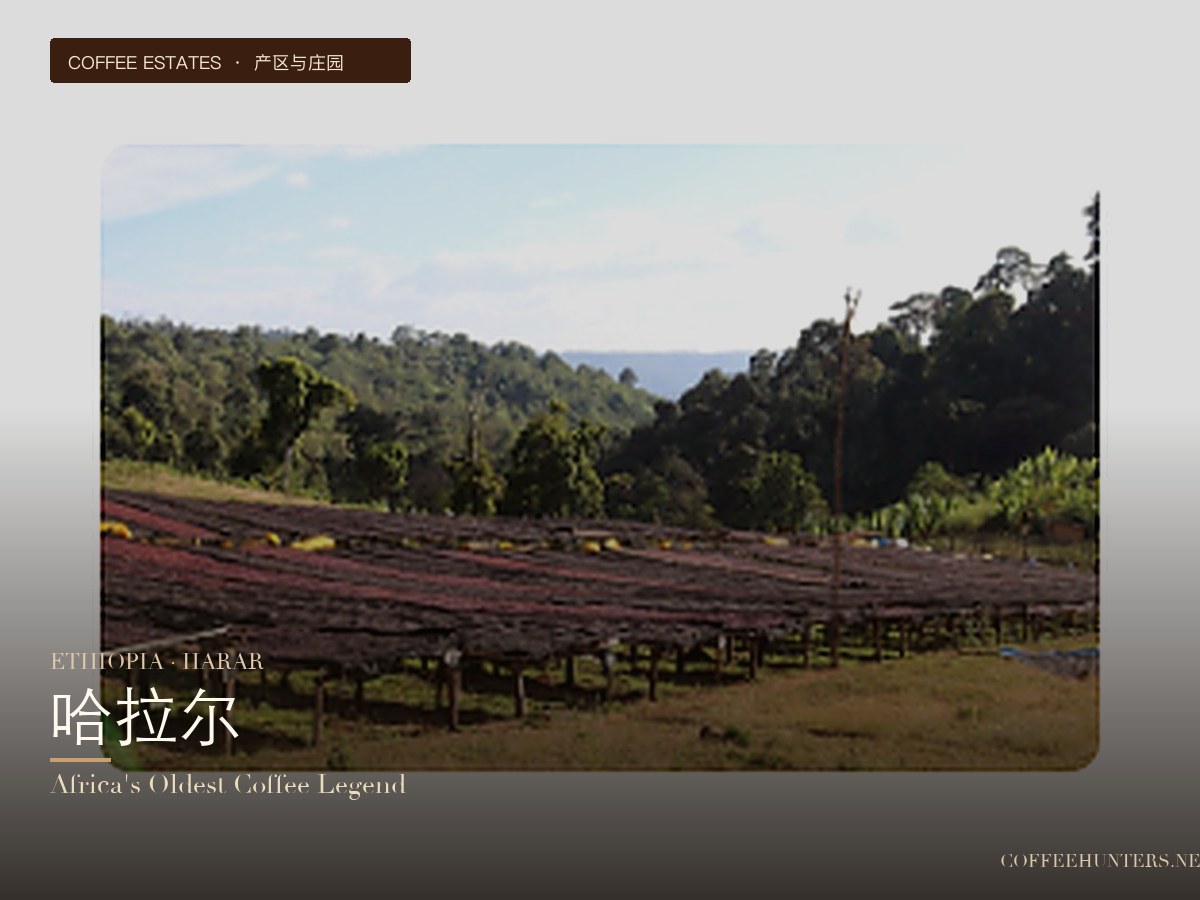
Harar is home to the world's most distinctive coffee processing method—"Harar Sun-Dried." This method differs from Sidamo's natural process: Harar's coffee cherries are left to naturally over-ripen on the branch (about 3–4 weeks) before being picked. After harvest, the cherries are dried on wooden racks for 15–21 days, with constant hand-turning throughout. Finally, the cherries are stored in bags for several months, allowing sugars from the fruit pulp to further permeate the beans. This processing method gives Harar coffee its unique "wine-like" and "fermented" character.
V. Typical Flavor Profile
A cup of traditional Harar Sun-Dried coffee presents an extraordinarily distinctive cupping profile: the aroma shows pronounced complexity of blueberry, wine, and fermented fruit; on the palate, low-to-medium acidity with a full body; the mid-palate reveals a combination of dark chocolate, earth, spice, and dried fruit; the finish carries distinct notes of red wine, tobacco, and herbs. The overall cup is complex, richly layered, and carries a powerful "Old World" character.
VI. The Relationship with Yemen Mocha
Harar shares a deep historical connection with Yemen Mocha. During the 16th and 17th centuries, large quantities of Harar coffee were exported through the port of Mocha to European markets. Today, the word "Mocha" is sometimes used to refer to Yemeni coffee, and sometimes to Harar coffee. The two also share flavor similarities—both lean toward complex fermented, spicy, and earthy tones.
VII. Key Sub-Regions
Within the Harar region there are several core sub-regions—the area around Harar City, Dire Dawa, Chiro, Gelemso, and others. Among these, the area around Harar City is the most traditional, with coffee grown on mountain terraces at elevations of 1,800–2,200 meters.
VIII. The Specialty Coffee Progress
Harar's coffee industry has long been dominated by smallholder farmers, and its specialty coffee progress has been relatively slow. But over the past five years, local processing stations such as Aricha and Idido have begun releasing specialty lots. Since 2017, the Ethiopia Commodity Exchange (ECX) has allowed farmers to export specialty lots directly, giving Harar's specialty coffee a more direct export channel.
IX. Representative Estates
Representative estates in Harar include Harar Highlands Estate, Chiro Estate, and Aricha Estate. Aricha is a famous processing station in Sidamo, but some of its lots also originate from the Harar region.
X. Brewing Recommendations
Brewing Harar Sun-Dried requires particular care—it has a strong fermented character but relatively low acidity, and over-extraction easily produces off-flavors. A V60 or Origami dripper is recommended, with water at 88–90℃ (slightly lower than for most coffees), a coffee-to-water ratio of 1:16–1:18, and a medium-fine grind. Use a single-pour method: after a 30-second bloom, pour in a thin stream for 60 seconds.
Conclusion: The Homeland of Coffee
In Ethiopia, coffee is not just a crop—it is a culture. As Ethiopia's oldest coffee-producing region, Harar carries the entire history of coffee's journey to the world. To understand Harar is to understand coffee's childhood.
— CoffeeHunters · CoffeeHunters Editorial Team
The above content is compiled by CoffeeHunters, a coffee news website.