Origins & Estates · In-Depth Visits
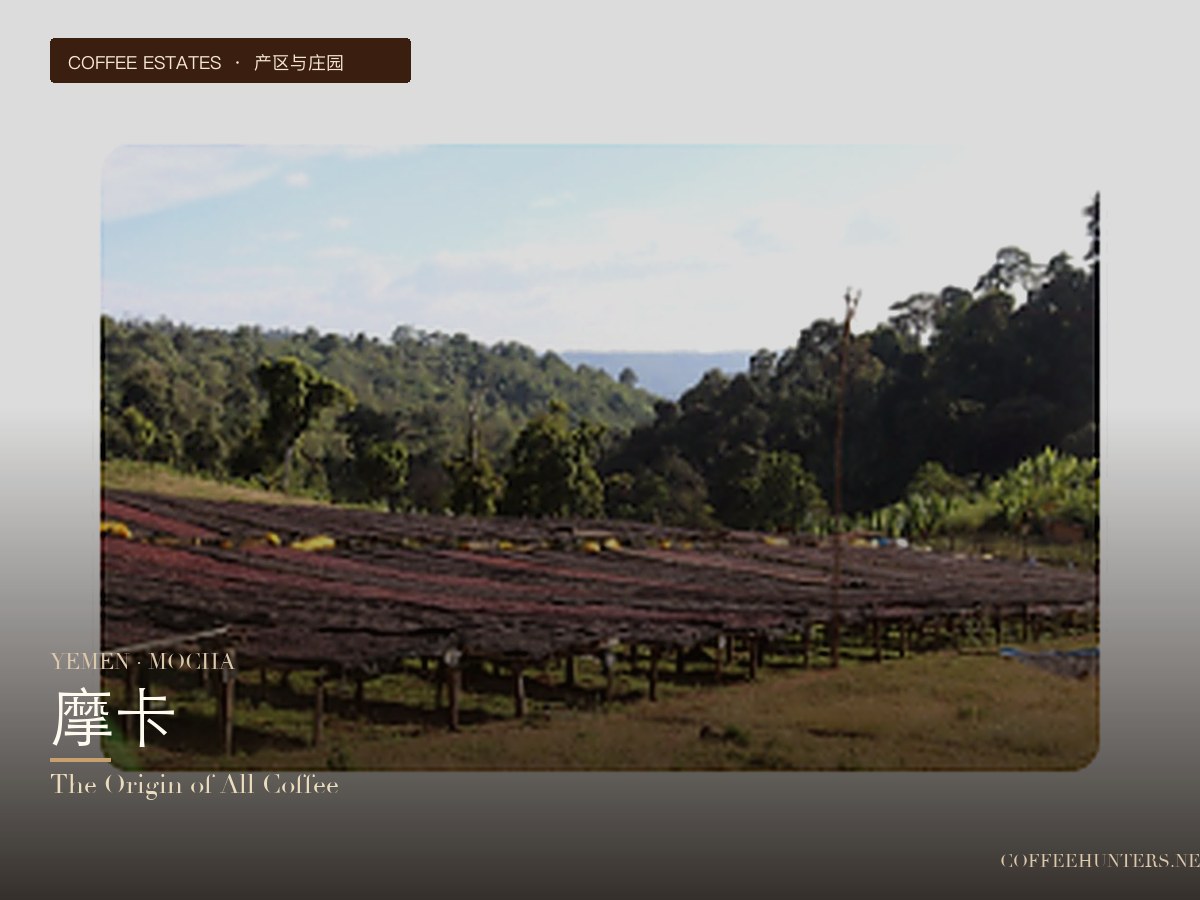
The global commercialization of coffee began in Yemen. In the mid-15th century, coffee was cultivated on a large scale in Yemen, and by the early 16th century it was exported to the Middle East and Europe through the port of Mokha (now Mukha). Yemen's monopoly on coffee exports lasted nearly 200 years, until the early 17th century, when the Dutch East India Company brought coffee seeds to Indonesia and broke Yemen's monopoly. Today, the word "Mocha" not only refers to the Yemeni port, but has also become synonymous with "Mocha Coffee."
II. Yemen's Geography and Climate
Yemen is located in the southwestern part of the Arabian Peninsula, and the vast majority of its territory consists of arid highlands and deserts. However, coffee cultivation is mainly concentrated in the western mountains—sub-regions such as Haraz, Sana'a, Mahweet, and Hayma—at elevations of 1,500-2,200 meters, making it one of the highest and driest coffee-producing regions in the world. Yemeni coffee is grown on mountain terraces without irrigation systems, and the trees survive almost entirely on rainfall and groundwater, which also gives Yemeni coffee its unique flavor.
III. Varieties: The Continuation of Ancient Typica
Yemen's coffee varieties are mainly ancient Typica variants, including local traditional varieties such as Udaini, Dawairi, Jufaini, and Ismaili. These varieties have centuries of cultivation history and are genetically significantly different from modern commercial varieties. They display a unique acidity and herbal notes in the cup—a "primitive flavor" that cannot be found in any other producing region.
IV. Unique Processing Methods: Ismaili and Sun-Dried
Yemen's coffee processing methods are very primitive, and almost all are "sun-dried," but unlike Brazilian natural process—Yemeni sun-drying usually does not involve sorting fresh cherries by sugar content; instead, entire branches of coffee cherries are dried on stone slabs or the roofs of earthen houses. This processing method gives Yemeni coffee a unique fermented, earthy, and spicy character. Ismaili is a processing technique unique to Yemen—the dried fruit is first stored in warehouses for several months before being hulled.
V. Typical Flavor Profile
A cup of traditional Yemeni Mocha has an extremely distinctive cupping profile: the aroma shows complex notes of wine, fermented fruit, tobacco, and spices; on the palate, it has low-to-medium acidity and a thick body; the mid-palate is a combination of dark chocolate, dried fruit, spice, and earth; the finish carries distinct red wine, herbal, and earthy notes. The whole cup is complex, layered, and long-lasting.
VI. Political Impact on the Producing Region
Yemen's coffee industry has long been affected by civil war and political instability. After the outbreak of civil war in 2015, many Yemeni coffee exporters were forced to suspend operations, and the coffee trade shrank significantly. Today, Yemen's coffee production is only about one-third of what it was in the 1990s, but its scarcity and uniqueness have instead driven prices higher.
VII. Representative Producing Regions
Haraz is Yemen's most famous specialty coffee-producing region, with an average elevation of 1,800-2,200 meters, where coffee is grown on steep mountain terraces. There is also specialty coffee cultivation around Sana'a, but production is relatively small. The Mahweet region is known for its unique processing methods, while Hayma is an emerging specialty-producing region.
VIII. Representative Estates and Processing Facilities
Yemen's coffee industry is dominated by smallholder farmers and cooperatives. Al-Ezzi Industries is Yemen's largest coffee exporter, and its Mocha brand enjoys considerable recognition in the international market. Emerging specialty brands such as Qima Coffee and Mokhtar Family Estate focus on specialty lots from single producing regions.
IX. Brewing Recommendations
Brewing Yemeni Mocha requires special care—its flavor is complex but its acidity is relatively low, and over-extraction easily produces off-flavors. A V60 or Origami dripper is recommended, with a water temperature of 88-90°C (slightly lower than for regular coffee), a coffee-to-water ratio of 1:16-1:18, and a medium-fine grind. Use a single-pour method: after a 30-second bloom, pour in a thin stream for 60 seconds.
Conclusion: The Origin of Coffee
In the world of specialty coffee, Yemen may not be the most famous producing region, but it is the most important—without Yemen, there would be no global coffee industry. To understand Yemeni Mocha is to understand the source of coffee and the thousand-year history behind every cup.
— CoffeeHunters Editorial Team
The above content is compiled by CoffeeHunters, a coffee news website.