Origins & Estates · In-Depth Visits
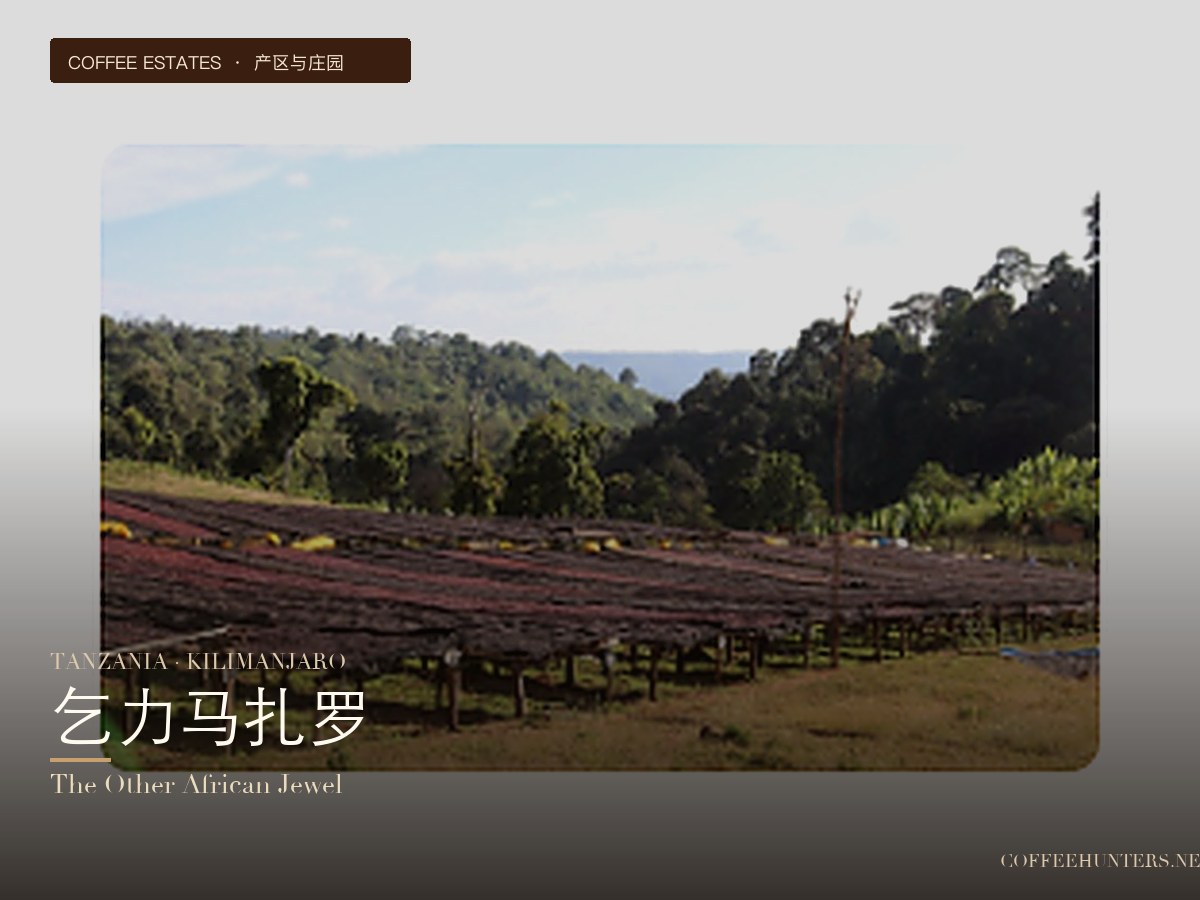
Coffee cultivation in Tanzania began in the late 19th century, introduced by German colonists from Kenya and the island of Bourbon. The earliest coffee was planted on the slopes of Mount Kilimanjaro, and the first commercial coffee exports followed in 1898. Today, Tanzania is the world's 16th largest coffee producer, with an annual output of about 50,000–80,000 tonnes, of which specialty coffee accounts for roughly 10%.
2. The Kilimanjaro Region
Mount Kilimanjaro lies on Tanzania's northern border near Kenya. At 5,895 metres, it is the highest peak in Africa. The core Kilimanjaro coffee region is on the southern slopes of the mountain, at 1,000–2,000 metres, centred on sub-regions such as Moshi, Arusha and Machame. The volcanic soil here is fertile, rainfall is abundant (1,500–2,000 mm) and sunshine is plentiful. The name Kilimanjaro means "white mountain" in Maasai, so called because its summit is snow-capped year-round.
3. The Mount Meru Region
Mount Meru lies to the southeast of Kilimanjaro. At 4,566 metres, it is Tanzania's second-highest peak. Coffee in the Meru region grows at 1,400–1,900 metres, on volcanic soils similar to those of Kilimanjaro, but with a slightly different microclimate—more humid and cooler, giving a "brighter" cup. Meru is a rising star of Tanzanian specialty coffee, with specialty lots increasing markedly over the past five years.
4. Varieties: Bourbon, Kent, Bourbon Mutants
The main varieties in Tanzania are Bourbon, Kent and KP423. Kent and KP423 are both disease-resistant varieties with fairly good cup quality, though not as good as pure Bourbon. Among specialty lots, rarer varieties such as N39 and Blue Mountain (a Blue Mountain mutant introduced from Jamaica in the 1930s) are also common.
5. Processing: Predominantly Washed
Nearly all Tanzanian coffee is washed. Local washing stations use a standard sequence of depulping, fermentation, washing and drying, with fermentation typically lasting 24–48 hours. In the cup, Tanzanian washed coffees show a bright acidity similar to Kenya's, but the intensity of that acidity is usually lower than Kenya's, making them feel "softer" overall.
6. Typical Flavour Comparison
Kilimanjaro's typical profile: "medium acidity, solid sweetness, full body"—acidity of lemon and green apple, sweetness of caramel and brown sugar, a finish of milk chocolate and almond. Meru's typical profile: "bright acidity, pronounced florals"—acidity of lemon and grapefruit, aromas of jasmine and orange blossom, sweetness of honey and peach. Both are "softer" than Kenya, yet both possess the bright acidity typical of African coffee.
7. Representative Cooperatives
Tanzania's coffee industry is dominated by cooperatives. The best known is the Kilimanjaro Native Cooperative Union (KNCU), founded in 1925 and one of Africa's earliest coffee cooperatives. KNCU encompasses more than 70 primary cooperatives under unified growing and processing standards. Other representative cooperatives include Kagera Cooperative and Mara Cooperative.
8. Representative Estates
Representative estates in the Kilimanjaro region include Burka Estate, Mondul Estate and Kilimanjaro Plantation. Representative estates in the Meru region include Meru Plantation and Usa River Estate. The specialty lots from these estates are widely acclaimed in international markets.
9. Brewing Recommendations
Tanzanian coffee suits pour-over brewers like the V60 and Origami that bring out acidity and layering. Use a water temperature of 90–92°C, a coffee-to-water ratio of 1:15–1:16 and a medium-fine grind. If you want to highlight Kilimanjaro's full body, the Kalita Wave with a three-pour method is a better fit; if you want to highlight Meru's brightness, the V60 with a single continuous pour is a better fit.
Conclusion: An Underrated African Gem
On the global specialty coffee map, Tanzania has long been overshadowed by the "African twin stars" of Kenya and Ethiopia. Yet Tanzania has growing conditions as excellent as Kenya's and variety resources as rich as Ethiopia's. To understand Tanzania is to understand another side of Africa's specialty coffee world.
— CoffeeHunters Editorial Team
The above content is compiled by CoffeeHunters, a coffee news website.