







How Does Brazil's Coffee Grading System Work on the Sack?
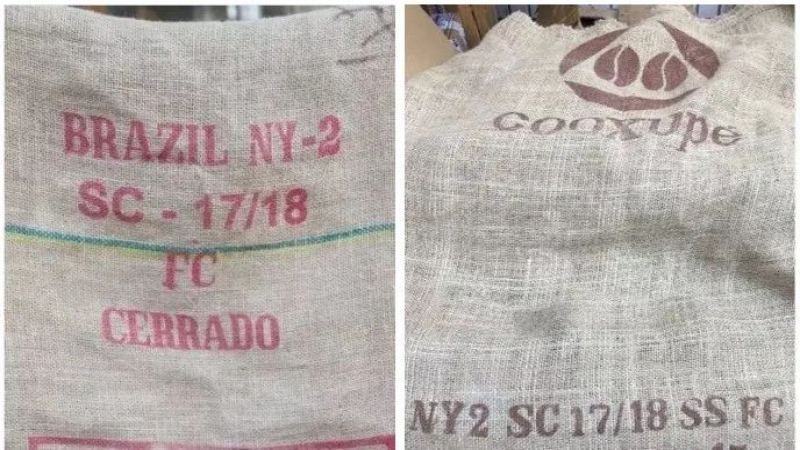
On Brazilian coffee sacks, markings like "CERRADO NY-2 SC-17/18 SS FC" encode five grading dimensions set by the Brazilian Ministry of Agriculture, Livestock and Supply (MAPA): producing region, defect rate, screen size, cupping score, and sensory grade. SS and FC are part of that sensory and quality labeling, not random letters.
Brazil leads global coffee exports, supplying roughly one out of every three bags worldwide. Defect grading follows Green Coffee Association of New York standards, which is why the prefix NY appears, with NY2 as the top grade. Beans are typically low in acidity, high in sweetness, and full-bodied, often used as espresso blend bases.
As the world's largest coffee producer, Brazil accounts for about one-third of the global market in exports. Its beans have low acidity, high sweetness, and a full body, and are often used in coffee blends. When purchasing Brazilian green beans, you will often see markings on the burlap sacks such as "CERRADO NY-2 SC-17/18 SS FC," where every letter and number corresponds to strict grading information. These codes are established by the Brazilian Ministry of Agriculture, Livestock and Supply (MAPA) and cover five major dimensions: producing region, defect rate, screen size, cupping score, and sensory grade. This article will break down the meaning of symbols such as "SS" and "FC" one by one to help coffee lovers understand the complete quality profile of Brazilian beans.
Brazil occupies the top position in the global coffee landscape, leading by a wide margin in both production and exports. One out of every three bags of coffee in the world comes from Brazil. However, Brazilian beans are not known for bright acidity; instead, they are prized for low acidity, high sweetness, and a thick body, which is why they are often used as the base for espresso blends. When purchasing Brazilian green beans, people notice a long string of English letters and numbers printed on the burlap sacks, such as "CERRADO NY-2 SC-17/18 SS FC." What exactly does each of these characters mean?
To understand these markings, you first need to understand Brazil's green bean grading system. This system was established by the Brazilian Ministry of Agriculture, Livestock and Supply (MAPA) and generally consists of five major elements: specific producing region, defect grade, coffee bean screen size, cupping score, and sensory grade.
First, let's look at the producing region. Brazil is vast, and 17 of its 26 states produce coffee. These states themselves are producing regions, and each region is further divided into several sub-regions. Therefore, beans from a single sub-region are labeled separately. For example, "CERRADO" refers to the Cerrado sub-region. Other common ones include Mogiana (MOGIANA) and Sul de Minas (SUL DE MINAS). Some markings also include the port name, such as Santos, which represents the Port of Santos in Brazil.
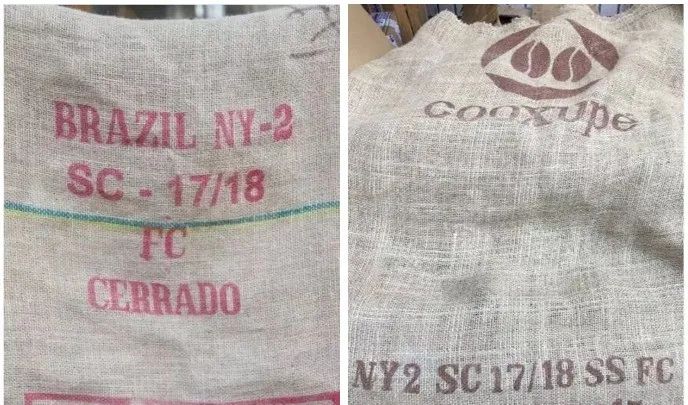
Regarding defect grading, Brazil follows the standards of the Green Coffee Association of New York, hence the prefix "NY." Brazil's highest grade is "NY2." The reason there is no NY1 is that Brazil regards coffee as an agricultural product, and its flat terrain is suitable for mechanical harvesting. Although this greatly saves labor, it also affects specialty quality to some extent, making zero defects nearly impossible. Therefore, grading starts at 2. The following numbers represent the defect ratio and are divided into 2, 2/3, 3, 3/4, 4, and so on. The larger the number, the more defects. A "deduction method" is usually used, counting the number of defective beans in 300 grams of green beans to determine the grade.
After defect grading, coffee beans are graded by screen size using screens with fixed aperture sizes. "SC" stands for screen size, with common sizes being 17/18 and 16/17. Brazilian coffee includes both flat beans and peaberries. Flat beans usually range from 10 to 19 screen sizes, while peaberries range from 8 to 13. Although Brazil's largest domestic screen size can reach 19, the yield is extremely small, so 17 and 18 are already considered the highest grades.
After screening is completed, sample beans are roasted and cupped. The cupping score draws on the method of the Specialty Coffee Association (SCA), and the results are divided into grades such as Strictly Soft (SS), Soft (S), Softish, Hard, Hardish, Rioy/Rioysh, and Rio. Among these, "SS" is the highest grade, usually with a cupping score of 85 or above; "S" is next, with a score of 80 to 84; below that is "Softish," with a score of 75 to 79.
The final component is the flavor grade, which is divided into six levels: Fine Cup, Fine, Good Cup, Fair Cup, Poor Cup, and Bad Cup. The most common are Fine Cup (FC) and Good Cup (GC).
Taken together, the marking "BRAZIL NY-2 SC-17/18 SS FC CERRADO" means: produced in Brazil's Cerrado region, defect rate grade 2, green bean screen size 17 to 18, and cup quality rated as fine. This is also the Brazilian blend bean that Front Street Coffee has been using.
To learn more information about coffee origins, please scan the QR code to follow: Coffee Review
Long-press the QR code to follow:
TRANSLATE with
x
English
Arabic Hebrew Polish Bulgarian Hindi Portuguese Catalan Hmong Daw Romanian Chinese Simplified Hungarian Russian Chinese Traditional Indonesian Slovak Czech Italian Slovenian Danish Japanese Spanish Dutch Klingon Swedish English Korean Thai Estonian Latvian Turkish Finnish Lithuanian Ukrainian French Malay Urdu German Maltese Vietnamese Greek Norwegian Welsh Haitian Creole Persian
TRANSLATE with
COPY THE URL BELOW
Back
EMBED THE SNIPPET BELOW IN YOUR SITE Bing Webmaster Portal
Back
The above content is compiled by CoffeeHunters, a coffee news website.


