







Why Are Arabica Coffee Prices Pressuring Italian Espresso?
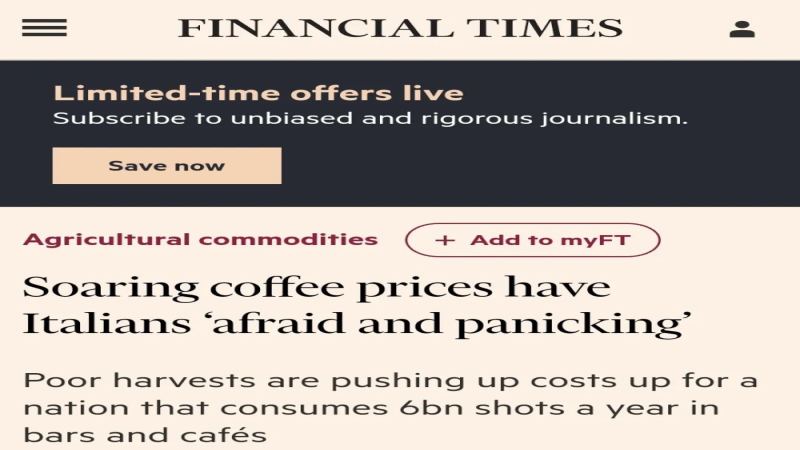
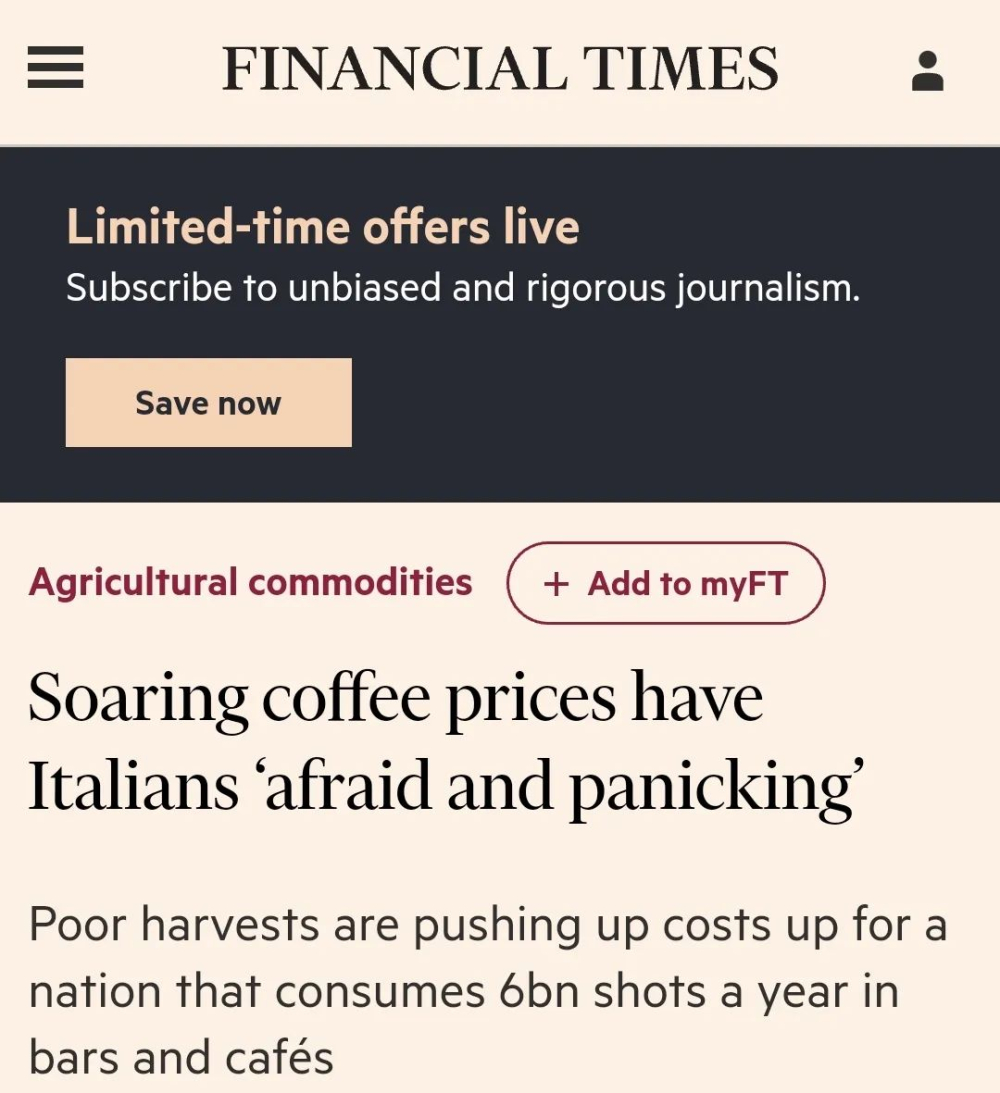
Global coffee bean prices keep climbing, with New York Arabica futures and London Robusta futures both hitting record highs, and Italy's espresso culture is absorbing the pressure. Since 2021, Italian espresso prices have risen about 15 percent. A cup that cost roughly 1.2 euros could reach 2 euros, roughly 15.71 yuan, driven by climate change, energy costs and Red Sea shipping disruptions, the Financial Times reports.
Local consumer association Assoutenti estimates residents and tourists drink 6 billion cups in public places each year, generating about 7 billion euros for the coffee industry. Prices in Italy remain among the lowest in Western Europe, around 1.2 euros for espresso and 1.5 euros for cappuccino, which makes further increases politically and socially difficult for small family-run cafes.
Global coffee bean prices continue to climb, with New York Arabica futures and London Robusta futures both hitting record highs, and Italy—this stronghold of espresso culture—is facing unprecedented pressure to raise prices. From 2021 to now, espresso prices in Italy have risen by about 15%, with climate change, energy costs, Red Sea shipping disruptions and other factors intertwining, making a cup of coffee that originally cost 1.2 euros potentially rise to 2 euros. Consumer associations and industry federations each hold their own views, while small family-run cafes struggle to survive between profits and social pressure. This article will take you through the ins and outs of this coffee price storm, and how it affects Italians' daily ritual.
▲
Click to follow | Daily specialty coffee culture magazine Coffee Workshop
According to the UK's Financial Times, global coffee bean prices continue to rise, making Italians begin to worry about whether their beloved affordable espresso can be maintained.
Coffee prices in Italy are among the lowest in Western European countries. In cafes on streets and in alleys, a cup of espresso is priced at about 1.2 euros (about 9.43 yuan), while a cappuccino is about 1.5 euros (about 11.79 yuan).
It is precisely this accessible price that has cultivated Italians' deep dependence on caffeine. Local consumer association Assoutenti estimates that Italian residents and foreign tourists drink 6 billion cups of coffee in public places each year, bringing the industry about 7 billion euros in revenue.
However, the global coffee supply crisis caused by climate change may push Italians' spending per cup of coffee up to 2 euros (about 15.71 yuan). This price may not seem high to consumers in other countries, but Romans find it hard to accept.
Assoutenti said baristas are under multiple pressures such as soaring energy costs, and since 2021, the selling price of Italian espresso has cumulatively increased by about 15%.
The organization warned that if cafes continue to raise prices, it will endanger "the daily ritual of millions of citizens," and those who bought coffee machines during the pandemic may switch to drinking at home. "If prices rise further, some people may completely give up enjoying espresso in stores."
And severe weather in major global coffee-producing regions is the direct reason driving international coffee prices to refresh historical peaks in recent days. This week, the futures price of high-end Arabica coffee in the New York market rose to $2.49 per pound, while London Robusta coffee futures reached $5,000 per ton, double that of a year ago.
At the same time, Houthi attacks on ships in the Red Sea have made the coffee supply chain even worse. Since last November, cargo ships traveling between Asia and Europe have had to detour around the Cape of Good Hope instead of passing through the Suez Canal.
The combination of the above factors has forced roasters to raise coffee bean prices. In July this year, the chairman of Lavazza hinted in an interview with the Financial Times that further price increases might be possible. The CEO of Illycaffè also issued a similar warning at a major public forum last month.
Although the trend of price increases seems unavoidable, Assoutenti believes that for Italian cafes, "the production cost of a cup of coffee is far lower than the selling price, and profit margins are still expanding."
However, this view has been rebutted by people in the coffee industry.
The president of the public institution federation representing about 132,000 cafes in Italy pointed out that only traditional cafes that are family-run, do not hire employees, and do not need to bear high rents can continue to survive.
Historically, Rome once imposed price controls on espresso. Although the controls were long ago abolished, local consumers have become accustomed to cheap coffee and regard it as a daily necessity. Therefore, when customers realize the importance of the product, it becomes very difficult for coffee shops to raise prices.
The president of the federation also said that some coffee shops may charge more for labor-intensive drinks such as cappuccino and for snacks, but they still have to face social pressure to keep coffee prices low.
An operator who inherited a cafe founded by his father 70 years ago revealed that he currently sells espresso at 1 euro per cup, compared with the previous price of 0.9 euros per cup. The shop owner said that if raw material prices continue to soar, he may raise espresso prices by another 10%.
Image source: Internet
Disclaimer: Some images in this article are from the Internet. For some content on the website, such as images, we will respect the original author's copyright and indicate the source. However, due to the large quantity, some images and texts may not have been credited in time. Please understand. If the original author has any dispute, they can contact the website for handling. Once verified, we will correct it immediately. Compiled and edited by "Coffee Workshop." Please indicate the source when reposting. If there is infringement, please inform us for deletion. Thank you~!
The above content is compiled by CoffeeHunters, a coffee news website.


