







What Went Wrong With This Old Street Coffee House-Style Crossover?
On World Book Day, Lelecha released a milk tea called Smoky Oolong with publisher Yilin Press, built around a portrait of Lu Xun holding a cup. The slogan "Old Smoky Voice, New Youth" drew criticism, and CCTV.com said turning a literary figure into entertainment was inappropriate. Lelecha pulled the merchandise and promotional posts soon after.
The wording drew particular objection because "old smoky voice" echoes a Shanghai dialect term for a heavy smoker, which can read as derogatory. Commentators noted that New Youth should carry Lu Xun's spirit rather than a smoking reference. The episode has renewed debate about how far tea and street coffee brands should go when borrowing historical figures for co-branding.
On World Book Day, Lelecha partnered with Yilin Press to launch the "Smoky Oolong" milk tea, centering its promotion on the image of Lu Xun, but it sparked controversy due to the advertising slogan "Old Smoky Voice, New Youth." CCTV.com published an article criticizing the collaboration for turning a literary master into entertainment and for inappropriate wording. Subsequently, Lelecha urgently removed the related merchandise and promotional posts. Behind the incident, the issue of the boundary between tea beverage brands and historical figures in co-branding has once again drawn attention. Front Street Coffee takes you through the whole story.
▲
Click to follow | Daily specialty coffee culture magazine Coffee Workshop
Recently, a tea beverage brand used the image of Lu Xun to promote a co-branded new product, and the advertising slogan sparked considerable controversy. The related merchandise has been fully removed from shelves.
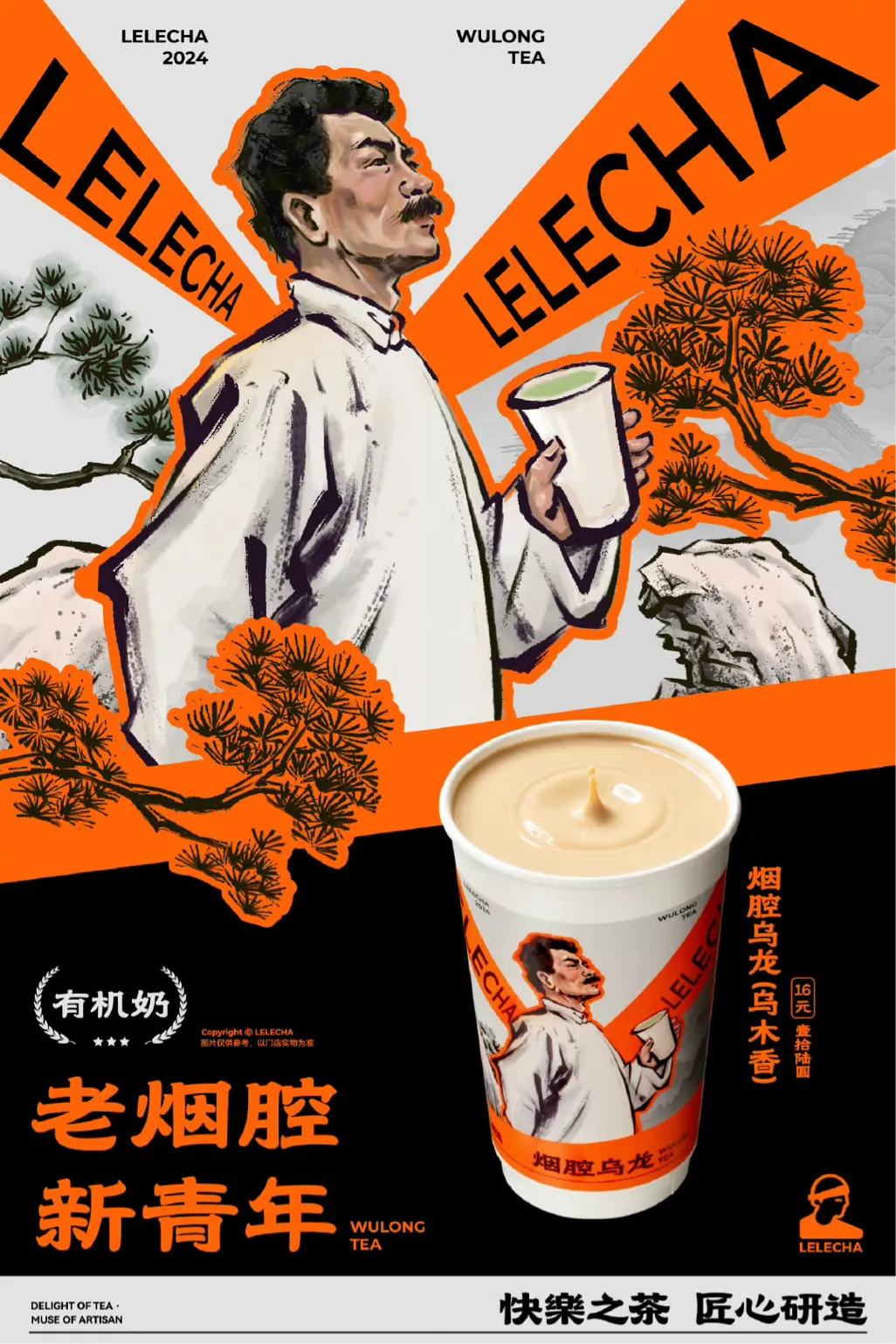
On April 23, World Book Day, Lelecha teamed up with Yilin Press to launch the co-branded milk tea "Smoky Oolong," claiming to pay tribute to the literary figure Lu Xun. The collaboration used a portrait of Lu Xun holding a milk tea cup with his head raised as the core visual, with pine trees as background decoration, and excerpted famous lines from Lu Xun's works.
In addition to paper cups, "Smoky Oolong" also came with a booklet printed with Lu Xun's portrait, acrylic standees, paper bags, and other merchandise. A large number of Lu Xun "excerpts" were incorporated into the promotion, with the slogan "Old Smoky Voice, New Youth."
The term "old smoky voice" easily brings to mind "old smoker." Hu Bao, author of the Shanghai dialect novel "Longtang," said: "An old smoker is also called 'old gun' in Shanghai dialect. This term is sometimes derogatory in daily Shanghai life. Now it is a new era, and 'New Youth' should learn from and inherit Lu Xun's spirit, not the 'smoky voice' in the post. It is inappropriate as advertising."
Regarding the collaboration, the official Weibo of CCTV News published an article yesterday pointing out that as a literary master, Lu Xun's writings are profound and serious, showing concern for the country and the people, and his overall image is not suitable for entertaining commercial advertising. The term "old smoky voice" used by the brand is even more inappropriate. The CCTV.com commentary emphasized that innovation cannot be without scruples, and cross-industry collaborations must never treat vulgarity as fun.
On April 28, a reporter found through Lelecha's official mini-program that "Smoky Oolong" could still be purchased, but it did not use the Lu Xun image cup, instead using the brand's regular cups. Staff at multiple Lelecha stores in Shanghai told the media that the "Smoky Oolong" cups and merchandise at many stores had sold out on the 27th, and all stores would no longer sell cups and merchandise printed with Lu Xun's image.
On the same day, the co-branding post published by Lelecha's official Weibo on the 23rd had been deleted, and promotional copy on other official channels was also nowhere to be seen. The reporter contacted the brand's person in charge, who said that the related promotional copy and merchandise had been taken down. As for whether they would be relisted, it would depend on arrangements from the company headquarters. "Follow subsequent official actions; it cannot be determined now."
The post has now been deleted
Public information shows that Lelecha opened its first store in Shanghai in 2016 and became popular with hit products such as "dirty bun" and "dirty tea." At the end of December 2022, Lelecha signed an investment agreement with Nayuki. Nayuki spent 525 million yuan to acquire a 43.64% stake in Lelecha, becoming the largest shareholder, and Lelecha became an associate company of Nayuki. In April 2023, Lelecha announced that it would open franchising and accelerate expansion. As of April 2, Lelecha had 428 stores nationwide, mainly distributed in East China, accounting for more than 80%.
In fact, apart from Lelecha, which sparked controversy this time, many tea beverage brands have previously had "collaborations" with historical figures and literary figures. On April 23 last year, World Book Day, Heytea collaborated with the People's Literature Publishing House to launch merchandise printed with the images of Lu Xun, Zhu Ziqing, Hu Shi, and Lin Huiyin. Subsequently, when Auntea Jenny opened a new store in Lu Xun's hometown of Shaoxing, it also launched cup sleeves printed with Lu Xun's image.
Image source: Southern Metropolis Daily
Disclaimer: Some images in this article are from the internet. For some content on the website, such as images, we will respect the original author's copyright and indicate the source. However, due to the large quantity, there may be individual images or texts that have not yet been credited. Please understand. If the original author has any dispute, they may contact the website for handling. Once verified, we will correct it immediately. Compiled and edited by "Coffee Workshop." Please indicate the source when reposting. If there is infringement, please inform us for deletion. Thank you~!
The above content is compiled by CoffeeHunters, a coffee news website.


