








Why Pre-Infusion Matters for Consistent Espresso Extraction
Pre-infusion is the step in which water wets the coffee puck at low or zero pressure before the machine applies full pressure. Espresso normally runs at about 9 bar from the moment the button is pressed, so a gentler wetting phase lets hot water penetrate the bed evenly and helps release carbon dioxide from fresh beans before the main coffee extraction begins.
How long pre-infusion lasts and whether pressure rises during it are not fixed. Baristas set it according to the bean's flavor direction and resting state. Two common problems, fresh-bean degassing and channeling, are the practical targets. A comparative test on a Lelit Bianca V3, with and without pre-infusion, showed differences in crema, flavor layers and flow rate.
In pour-over coffee, blooming is an almost indispensable step, as it helps release carbon dioxide and makes subsequent extraction more stable. So, in the high-pressure extraction of espresso, is a similar "blooming" also needed? The answer is pre-infusion. This article will start from the definition of pre-infusion, applicable equipment, and the adjustment logic of duration and pressure, and combine the two major issues of fresh bean degassing and channeling to explain the practical role of pre-infusion. Then, taking Front Street Coffee's Warm Sun Blend as an example, using the Lelit Bianca V3, we will conduct comparative extractions with and without pre-infusion, presenting differences in crema state, flavor layers, and flow rate, to help coffee enthusiasts understand the value of pre-infusion in Espresso output.

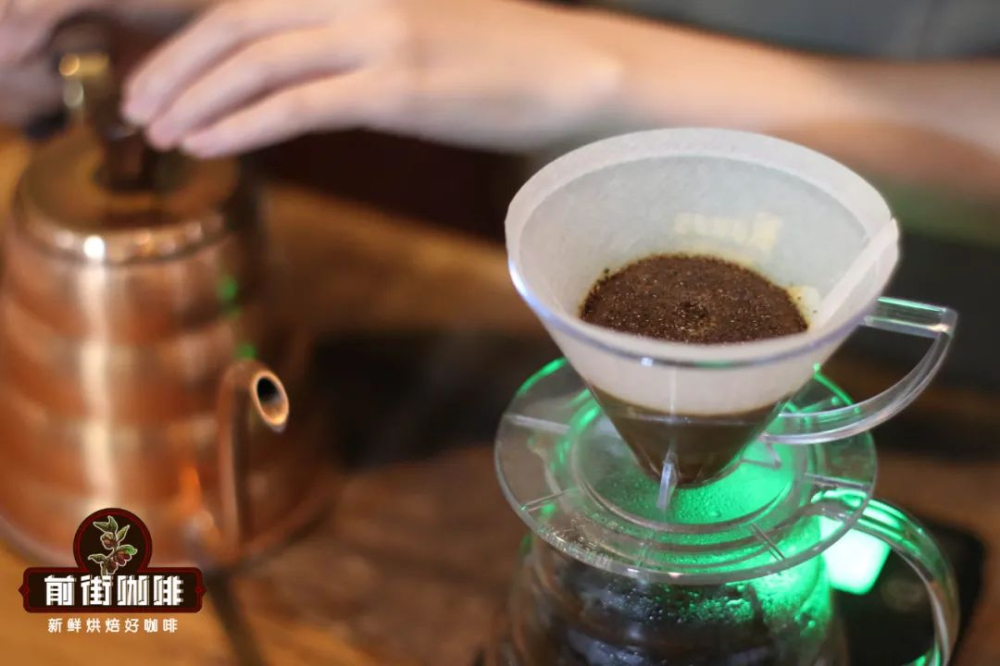
When designing a pour-over coffee extraction plan, blooming is often regarded as a default step. It allows carbon dioxide to be released in an orderly manner, while also "waking up" the soluble substances in the coffee, laying a more stable foundation for the subsequent flavor extraction.
Since blooming can have such a noticeable effect on flavor, then when switching to other brewing methods, such as the most common espresso extraction, should a similar "blooming" step also be arranged?
Generally, espresso is extracted continuously at about 9 bar pressure until the end. That is, as soon as the extraction button is pressed, hot water rapidly passes through the coffee puck in an environment close to 9 atmospheres, carrying out the soluble flavor components. If, before the coffee machine formally applies full pressure, water is first released without pressure or at lower pressure, allowing hot water to gently penetrate the coffee bed and evenly wet the coffee grounds, this step is called "pre-infusion."
To use pre-infusion, the first thing is to check whether the coffee machine itself has this function, and its working method also varies depending on the equipment. Some machines can directly set a "one-touch pre-infusion" before extraction, while others require the operator to control it manually.
There is no fixed standard for how long pre-infusion lasts or whether pressure is increased. It mainly depends on the barista's judgment of the flavor direction of this bean, and also needs to be adjusted in coordination with the bean resting state and extraction parameters.
If espresso beans that were roasted only a few days ago are directly ground and extracted, under high temperature and high pressure, the overly active carbon dioxide will "escape" in all directions as soon as it meets water. These gases will be wrapped by coffee oils, forming a thick Crema (crema) and flowing out rapidly with the coffee liquid.
Espresso extracted from beans that are too fresh often has crema that looks relatively rough and is not stable enough, dissipating and breaking down within a few minutes, and the coffee flavor is also prone to being thin or sour. To alleviate the interference caused by a large amount of gas from fresh beans, a step that helps degassing can be added, just like in pour-over, namely pre-infusion.
For example, the Warm Sun Blend beans that Front Street Coffee stores sometimes receive are too freshly dated, and need to be used for service before they have had time to rest. The espresso extracted directly usually has strong acidity and an unpleasant bitterness, while the fermented wine aroma and fruity sweet-sour notes that should be present are almost nowhere to be found. In this situation, Front Street Coffee will coordinate adjustments to grind size and coffee-to-water ratio, and add pre-infusion during the dialing-in stage, hoping to "stabilize" these gases, thereby better capturing more coffee flavors.
In addition to handling the degassing problem of "new beans," pre-infusion can also reduce the chance of channeling during extraction. If the coffee puck is not evenly tamped, then during extraction, when a 9 bar water flow hits directly, the water column can easily break through from weak spots, forming channeling. But if the coffee bed is first wetted, allowing the particles to absorb water and expand, the puck becomes denser, the water flow is less likely to "sneak away," and the contact between water and coffee is also more stable.
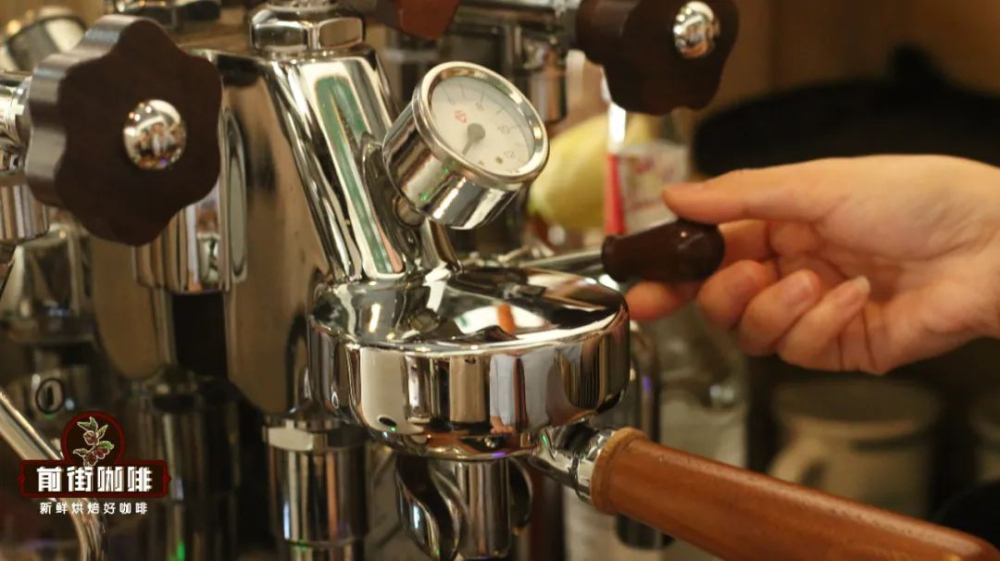
Below, Front Street Coffee takes the equipment and espresso beans used in its own stores as an example to briefly try the application of pre-infusion extraction. The coffee beans are a 22-day-rested Warm Sun Blend, and the coffee machine is a Lelit Bianca V3 that supports pre-infusion. When using it, the paddle needs to be manually controlled to change the extraction pressure and water flow rate.
Left is pre-infusion, right is constant-pressure extraction
Direct extraction without pre-infusion : 20 grams of coffee grounds, the first drop of coffee liquid flows out at 6 seconds, liquid weight 38 grams, total time 27 seconds, and the later-stage flow rate is relatively fast.
Espresso: The crema is fluffy and slightly rough, the mouthfeel is balanced, the aroma is mainly nuts, citrus acidity, and vanilla, with a hint of caramel aroma in the finish.
Extraction with pre-infusion : 20 grams of coffee grounds, low-pressure water release for 15 seconds (move the paddle to the far left, aligned with the handle), coffee liquid begins to flow out at the 8th second, increase pressure to 11 bar at 16 seconds (move the paddle to the far right, at a 90-degree angle), extract 38 grams of liquid weight, total time 34 seconds, and the flow rate is gentle throughout.
Espresso: The crema is dense and delicate, with obvious aromas of whiskey and chocolate cookies when smelled, the acidity is light and uplifting, similar to cherries and berries, and after swallowing there is a clear sweetness like candied fruit in the mouth, with very rich layers. Even when drinking the espresso directly, it is very easy to drink.
Front Street Coffee
No. 10, Bao'an Qian Street, Yandun Road, Dongshankou, Yuexiu District, Guangzhou City, Guangdong Province
The above content is compiled by CoffeeHunters, a coffee news website.


