







Could Liberica and its Excelsa variety offset arabica losses?
Liberica, the large-bean coffee species long set aside for poor flavor, is drawing fresh research interest as the climate warms. Droughts in 2021 and 2022 tightened global coffee inventories and pushed arabica prices to double in a short period, exposing how vulnerable coffee crops are to abiotic stress and shrinking the zones suitable for cultivation.
In December 2022, Nature Plants noted that Liberica could regain attention during supply chain disruptions. Its natural variety Excelsa combines disease resistance, drought tolerance, low-temperature tolerance, and a flavor close to arabica, and farmers in Uganda and elsewhere are planting it widely. Researchers also propose relocating production regions and adjusting cultivation methods as parallel strategies.
Today, when Arabica and Robusta absolutely dominate global coffee supply, a species once forgotten for its poor flavor—Liberica (large-bean coffee)—is re-entering researchers' view. From 2021 to 2022, climate change-induced droughts tightened coffee inventories and sent prices soaring, with Arabica prices doubling in a short period. Facing the crisis of shrinking cultivable areas, academia proposed three paths: relocating production regions, adjusting cultivation methods, and developing new crops. In December 2022, Nature Plants pointed out that Liberica may regain attention in an era of supply chain disruptions. One of its natural varieties, Excelsa, combines disease resistance, drought tolerance, low-temperature tolerance, and a flavor close to Arabica, and is being widely planted by coffee farmers in Uganda and elsewhere. Front Street Coffee takes you through the full picture of this potential variety.
For professional coffee knowledge exchange and more coffee bean information, please follow Coffee Workshop (WeChat public account cafe_style)
For more specialty coffee beans, please add private WeChat Front Street Coffee (FrontStreet Coffee), WeChat ID: qjcoffeex
When it comes to coffee variety classification, most people first think of Arabica (small-bean coffee, Coffea arabica) and Robusta (medium-bean coffee, Coffea canephora/robusta). Today's global coffee supply is almost entirely supported by these two species, with the former accounting for about 55% and the latter about 45%.
However, in 2021 and 2022, global inventories of these two varieties ran short, driving coffee prices up sharply, and Arabica prices even doubled in a short time. The reason is that climate change has caused frequent droughts in major production regions, leading to reduced or failed harvests. This phenomenon not only reveals the link between weather fluctuations and market conditions, but also exposes the vulnerability of coffee crops to abiotic stress.
The continued rise in global temperatures will further shrink the zones suitable for coffee cultivation, making the future coffee supply gap a topic scholars continue to discuss. In response to this dilemma, researchers currently propose three approaches: (1) move coffee-growing areas to regions with a more suitable climate; (2) change coffee cultivation and management methods; (3) develop new coffee crops and turn attention back to forgotten or underutilized species.
On December 15, 2022, the professional academic journal Nature Plants published a latest study pointing out that Liberica (also known as Liberia coffee)/large-bean coffee (Coffea Liberica) may rise again as one of the major crops in this era of increasing warming and repeated supply chain shocks.
Liberica originally grew in the low-altitude forests of Liberia on the West African coast, and its name comes precisely from its place of origin, Liberia. This variety was not discovered by humans and began to be cultivated artificially until the 19th century. Because the tree is too tall, harvesting is extremely difficult, so it was never promoted on a large scale.
In the late 1870s, it once emerged as a substitute for Arabica in South Asia (especially Sri Lanka and Southeast Asia). At that time, Arabica coffee in these regions was being devastated by highly destructive leaf rust, and by the end of the 19th century, most local Arabica coffee had been destroyed by the disease.
Liberica not only has excellent disease resistance, but is also drought-tolerant, heat-tolerant, and easy to grow. At the time, many industry insiders believed it could replace Arabica and open up new coffee-growing territories. However, due to its poor flavor, both its quality and taste were not favored by coffee sellers and consumers. Entering the early 20th century, with the introduction of Robusta and the expansion of Arabica cultivation, Liberica was gradually forgotten, and few mentioned it afterward.
Only in recent years have researchers discovered that coffee farmers in many parts of Africa have begun growing a coffee variety called Excelsa. The fruit size of this variety is close to that of Arabica, and it can produce mild, smooth coffee with low acidity and bitterness, but its caffeine content is comparable to Arabica. At present, in Uganda, at least 200 farms are growing Excelsa coffee.
This variety was discovered as early as 1903 and was confirmed in 1940 as a natural variety of Liberica, so Excelsa also belongs to large-bean coffee.
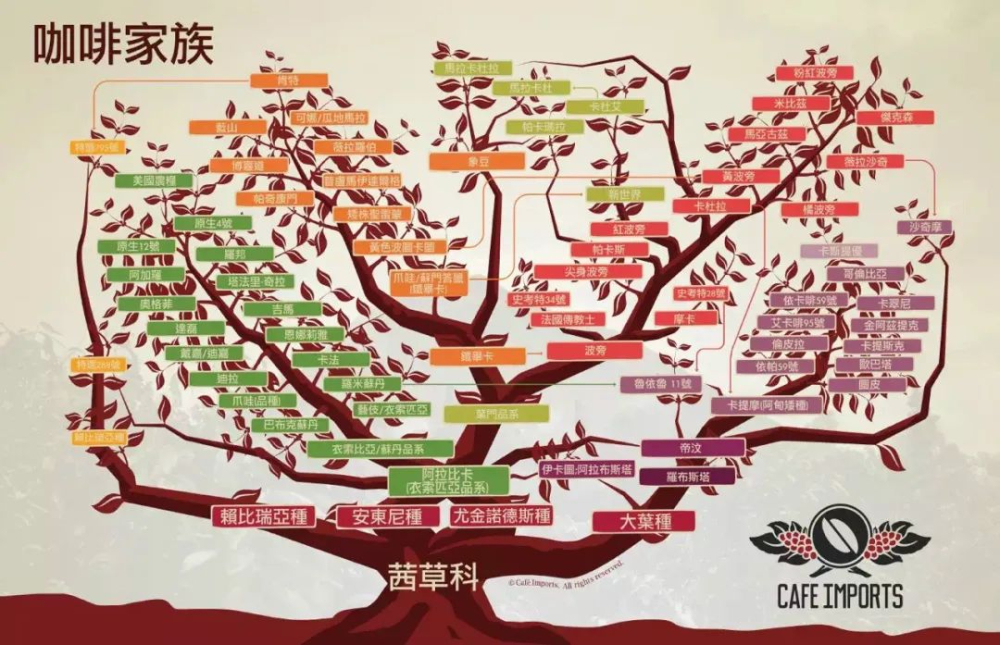
Excelsa inherits the disease resistance and drought tolerance of Liberica, while also tolerating low temperatures and frost, and its yield is also greater than that of Arabica. In terms of flavor, Excelsa does not have the strong bitterness of Liberica; its taste is mild, somewhat similar to the flavor of Ethiopian heirloom coffee, with soft fruit acidity and notes of cocoa, nuts, and maple syrup, very close to the style of Arabica.
Many coffee farmers growing Excelsa say the first reason they chose it is that it is a native variety, and the local terroir is very suitable for its growth; second, this variety has strong disease resistance and high yield, with each tree able to bear 30 to 60 kilograms of coffee fruit, equivalent to 4.3 to 8.6 kilograms of coffee beans per tree, which means a richer and more stable income for growers.
Researchers believe that in the process of ongoing climate change, Liberica/large-bean varieties at least offer this possibility: growing coffee with commercial viability, or even high value, under warmer conditions (and at lower altitudes) than Arabica. At the same time, its climate resilience is also stronger than that of Robusta.
Although Liberica (including Excelsa) has a tiny share of the global coffee market, Excelsa's lower optimal altitude may perhaps provide an indirect solution for farmers affected by climate change. Perhaps Liberica varieties (including Excelsa) are expected to become a main force in future coffee supply.
Image source: Internet
The above content is compiled by CoffeeHunters, a coffee news website.


