







What does high test coffee have to do with tea grades?
High test coffee refers to a strong, high-caffeine brew, and the same logic of strength and leaf quality sits behind the international black tea grading system. Grades run from whole leaf through broken leaf, fanning, and dust, and the codes come from India, Sri Lanka, and other producing regions. Pekoe is the highest grade, subdivided by how many tender leaves were picked with the bud.
Abbreviations such as S, P, OP, FOP, and TGFOP describe which leaf part and quality level a lot represents, and the codes appear on packaging in the black tea trade. Whole leaves are said to release richer aroma and flavor, tips add intensity, and broken leaves and fannings give the liquor more strength. Caffeine and aromatic substances are richest in delicate buds, so finer picking usually means higher value. A useful comparison point is coffee full form and caffeine content, since both drinks are judged on strength and grade.
The grading system for tea leaves is an important basis for judging the quality and style of finished tea, and is especially common in the international black tea trade. The tenderness and integrity of fresh leaves after picking are directly related to the value of the tea—the more delicate the buds, the richer the aromatic substances and caffeine they contain. From whole leaf to broken leaf, fanning, and then dust, different grades correspond to completely different brewing performance and flavor characteristics. This article will systematically sort out the meanings of international black tea grading abbreviations originating from India, Sri Lanka, and other producing regions, and explain one by one the leaf parts and quality levels represented by terms such as S, P, OP, FOP, and TGFOP, helping coffee and tea enthusiasts quickly understand the grade codes on packaging.
Tea grading is the process in the tea industry of evaluating products according to the quality and production conditions of finished tea. After picking, leaf size directly determines the quality of the tea, because small leaves are usually more valuable than coarse ones. Tea is divided into different grades, with the highest grade being “Pekoe” and the lowest falling into the category of “fanning” or “dust.” The role of grade is to distinguish the type and style of dry leaves. There are quite a few parameters that affect the final grade of tea, including leaf size, the tea varieties in the blend, the down on the leaf surface, aroma, taste, and the color of the brewed liquor.
Overview of Black Tea Grades
Tea grading systems are not uniform across countries. At present, the most widely used scoring system originated in India, Sri Lanka, Africa, Indonesia, Malaysia, and other places, and this system applies to both green tea and black tea.
Grades of Black Tea
Grades of Black Tea
Each tea grade carries a specific meaning. For example, whole leaves are considered capable of releasing richer aroma and flavor; when the leaves include buds and tips, the aroma becomes more intense; and broken leaves and fannings can bring greater strength to the tea liquor.
“Pekoe” is the highest grade in tea, and it is further subdivided internally. The basis for subdivision lies in how many adjacent tender leaves are attached at picking—possibly one leaf, two leaves, or none at all. The finest tea is made only from leaf buds, carefully picked with the fingertips.
The grade “Broken Pekoe” refers to broken tea used in tea bags. They belong to a lower grade because they are mixed with fannings and dust, and sometimes are also the residue left over from the breaking process.
Tea grade also reflects caffeine content to a large extent, because leaf buds contain more caffeine than mature leaves. At the same time, grade also affects the brewing method: whole leaves require the longest brewing time, while fannings release their flavor the fastest.
Tea grades are broadly divided into four categories: whole leaf, broken leaf, fanning, and dust, and each category has further subdivisions.
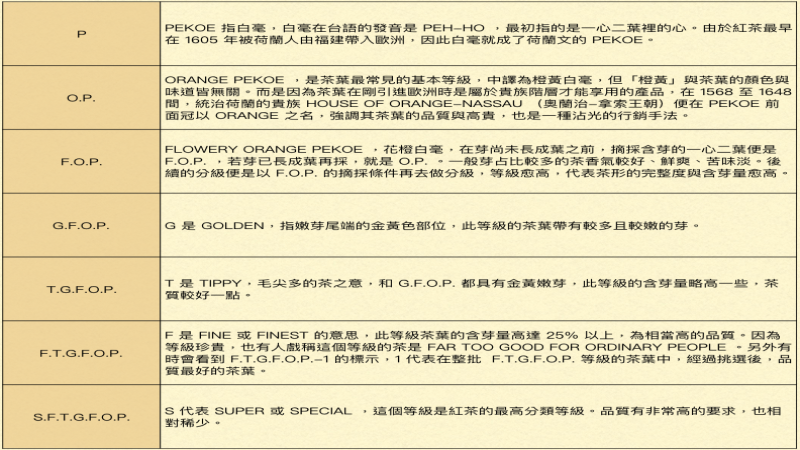
The meanings of the abbreviations are as follows: W - Whole leaf F - Fine/Tippy/Broken G - Golden O - Orange T - Tippy B - Broken P - Pekoe S - Souchong
S (Souchong): In Chinese it is called “Souchong” and refers to about the fifth leaf down from the terminal bud, relatively large in appearance.
PS (Pekoe Souchong): In Chinese it is called “Pekoe Souchong” and refers to about the fourth leaf down from the terminal bud, relatively large in appearance.
P (Pekoe): In Chinese it is called “Pekoe” and refers to about the third leaf down from the terminal bud; it is the standard leaf of black tea.
OP (Orange Pekoe): In Chinese it is called “Orange Pekoe” and refers to the second new bud or tender leaf down from the terminal bud.
FOP (Flower Orange Pekoe): In Chinese it is called “Flower Orange Pekoe” and refers to the new bud at the tip of the tea branch, quite precious.
TGFOP (Tippy Golden FOP): A higher grade containing golden buds.
FTGFOP (Finest Tippy Golden FOP): A higher grade containing a large number of golden buds.
SFTGFOP (Special Finest Tippy Golden FOP): With an extra Super, it indicates the highest grade, meaning super good. There are also those that add “1” after this string of letters; one can imagine that it is already impossible to express how much better it is in words, so a number “1” had to be added.
What do the abbreviations for tea grades mean?
Each abbreviation has its own meaning and significance. For example, “Flowery” means the leaves have buds, “Pekoe” means the leaves are whole, “Tippy” means the tips are dense, “Golden” means the leaves also have tips, and “Fine” means tea of better quality.
Flowery consists of large leaves, picked during the second or third flush, with a large number of tips. Golden Flowery contains very young tips or buds (usually golden in color), picked early in the season.
These abbreviations combine to refer to various kinds of tea. For example, OP (Orange Pekoe) refers to whole leaves, FOP (Flowery Orange Pekoe) refers to whole leaves plus long buds, and similarly, FTGFOP is one of the best grades of Pekoe tea; interestingly, this abbreviation has also been turned by ordinary people into “Too Good For Ordinary People.” Likewise, Broken Pekoe also has different grades, such as GBOP (Golden Broken Orange Pekoe), TGBOP (Tippy Golden Broken Orange Pekoe), and so on.
The above content is compiled by CoffeeHunters, a coffee news website.


