








The Evolution of the Coffee Flavor Wheel: 1995 vs. 2016
The Coffee Flavor Wheel helps enthusiasts and professionals understand coffee flavors. The SCAA published the first edition in 1995, and a comprehensively revamped version in 2016. These two generations differ significantly in structure, classification logic, and sensory descriptions. This article compares their design concepts and usage methods from a professional perspective. It also analyzes the background and significance of each version, helping you cup and taste coffee more accurately. At Front Street Coffee, you can see physical displays of both versions on the wall.
Before 1995, the coffee industry lacked a unified standard for defining flavor. Descriptions varied, and tasters often struggled to identify what they sensed. To solve this, Mr. Ted Lingle, then director of the SCAA, launched the first coffee flavor wheel in 1995. It provided a reference system for basic coffee flavors and helped determine whether a flavor was positive or negative. The old version consists of two parts: on the left, a negative flavor wheel listing undesirable defective flavors.
The Coffee Flavor Wheel is an important tool for every coffee enthusiast and professional to understand coffee flavors. From the first edition of the flavor wheel published by the SCAA in 1995 to the comprehensively revamped new edition of the flavor spectrum in 2016, the two generations of versions have significant differences in structure, classification logic, and sensory descriptions. This article will compare the design concepts and usage methods of the old and new versions of the flavor wheel from a professional perspective, analyze the background and significance of the birth of the new and old versions, and help you more accurately cup and taste coffee. When you come to Front Street Coffee, you can see physical displays of both versions of the flavor wheel in the store. Follow this article to gain an in-depth understanding of the evolution of the coffee flavor wheel.
Professional coffee knowledge exchange For more coffee bean information, please follow Coffee Workshop (WeChat public account: cafe_style)
For more specialty coffee beans, please add the private WeChat of Front Street Coffee (FrontStreet Coffee), WeChat ID: qjcoffeex
Walking into Front Street Coffee, you will find two coffee flavor wheel versions from different eras displayed on the wall.
One of them is the coffee flavor wheel that came out in 1995.
The other is the coffee flavor wheel released in 2016.
Comparing these two versions together, it is not difficult to find that the 2016 version is more refined and detailed in flavor descriptions. So, what exactly are the differences between these two versions of the flavor wheel?
The Origin of the Coffee Flavor Wheel
Regarding the definition of taste, everyone has their own understanding. Before 1995, the coffee industry had never formed a unified standard for defining flavor, so there were often situations where different parties described things differently. Or when you tasted a certain flavor, you might not immediately recall what it was like and could only fall into painful pondering.
To resolve this problem, Mr. Ted Lingle, who was then the director of the SCAA, launched the first edition of the coffee flavor wheel in 1995, providing the industry with a reference system for basic coffee flavors. It also helped determine whether a certain flavor appearing in coffee was positive or negative.
How to Interpret the Old Version of the Coffee Flavor Wheel?
The old version of the flavor wheel consists of two parts. On the left is the negative flavor wheel (that is, what is commonly called defective flavors), listing various undesirable flavors produced by coffee beans due to external contamination, internal contamination, aroma contamination, and taste defects, making it convenient for everyone to trace which stage had a problem when defective flavors appear in coffee.
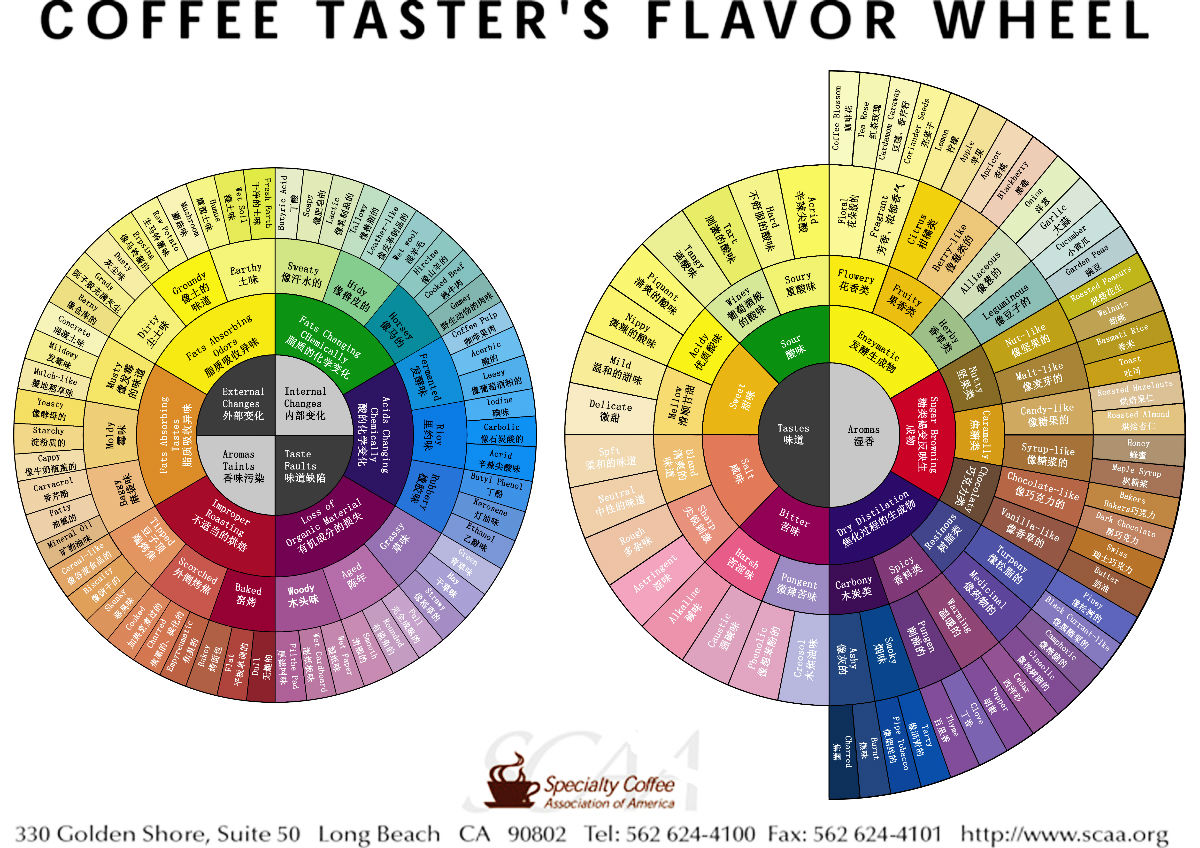
On the right is the positive flavor wheel, divided into taste (the flavor part) and smell (the wet aroma part). From top to bottom, the arrangement of flavors shows a pattern from light to heavy. The formation of coffee flavors involves three stages: enzymatic reactions occur during cultivation and green bean processing, caramelization occurs after first crack, and dry distillation occurs after second crack. Therefore, through the old version of the flavor wheel, we can intuitively see how flavors present themselves as the roast level goes from light to dark and the extraction degree goes from low to high.
Why Study the New Version of the Coffee Flavor Wheel?
After looking at the old version and then examining the new version, do you feel that the new version looks more information-dense and a bit dazzling? Observant friends may also notice that in the new version of the flavor wheel, there are gaps of varying sizes between various flavors. What is the reason for this?
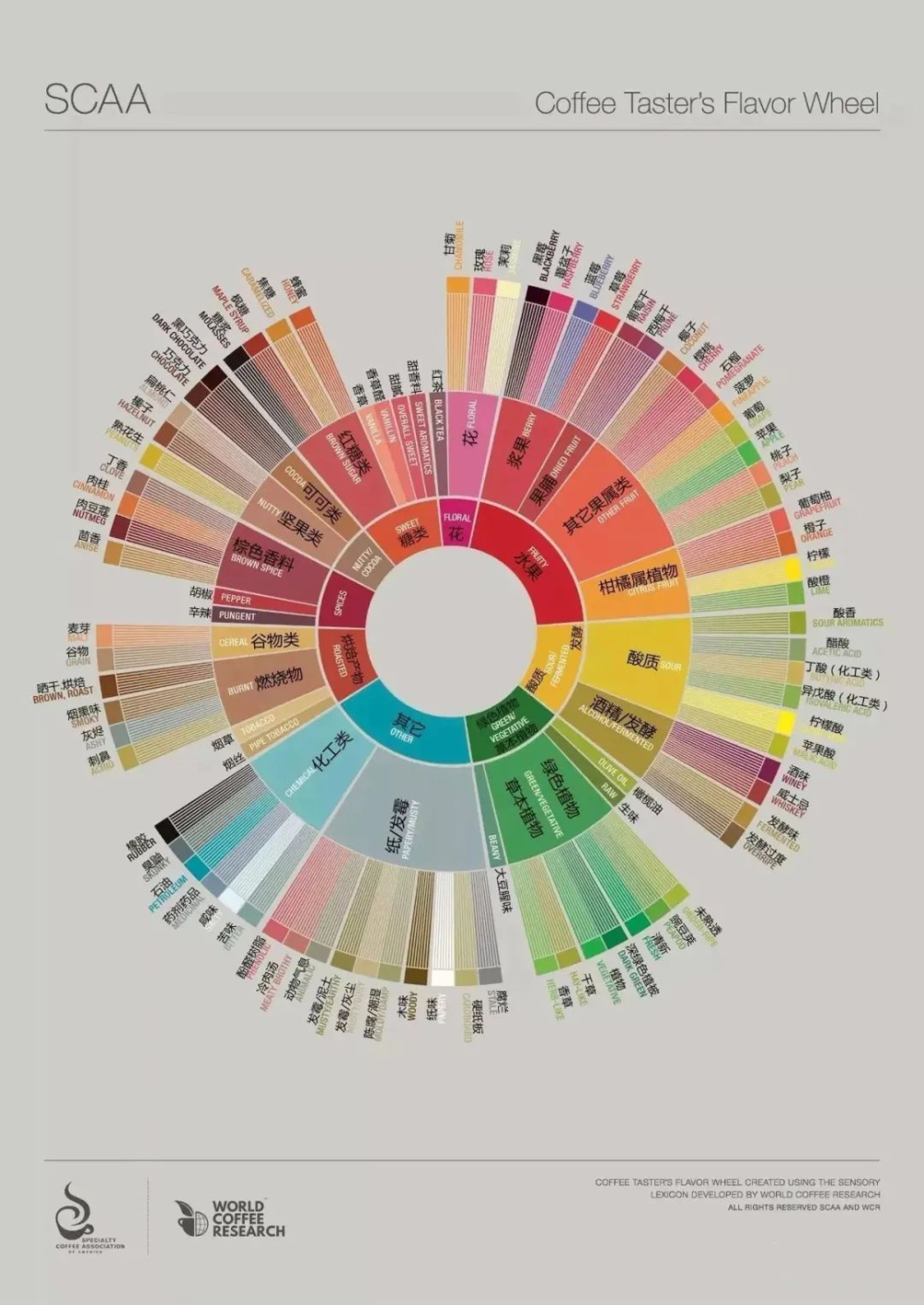
The new version of the flavor wheel makes up for the old version's inability to clearly explain, with just one chart, the relationship between aroma and taste, as well as the connection between defective flavors and positive flavors. To this end, the SCAA, together with the World Coffee Research Institute (WCR), Kansas State University, the German Agricultural University, and coffee industry representatives, analyzed and tested 105 different samples from 13 coffee-producing countries, compiling the World Coffee Research Sensory Lexicon as the basis for the new version of the coffee flavor wheel.
Afterward, they invited 29 people who had not received sensory training but had long-term coffee drinking habits, as well as 43 coffee industry experts, to conduct tests on the perception of relationships between flavors. In the end, coffee flavors were summarized into nine major categories: floral, fruity, sour/fermented, green/vegetative, other, roasted, spices, nutty/cocoa, and sweet. Among them, "other" and "floral" show polarization, while sweetness, fruity, and floral are considered the flavors closest to one another.
How to Interpret the New Version of the Coffee Flavor Wheel?
The new version of the coffee flavor wheel allows us to understand more intuitively the relationship between aroma and taste, as well as the connection between defective flavors and positive flavors, and it also positions taste and aroma more precisely. Therefore, when tasting or cupping a coffee, we can refer to the new version of the flavor wheel: first look at the inner ring to determine the major category of the flavor, then look outward to determine the flavor category, and finally look at the outermost layer to determine the final flavor.
As mentioned above, in the new version of the flavor wheel, there are gaps of varying degrees between flavors. The size of these gaps actually reflects the sensory similarity between the two. The smaller the gap, the more similar the two flavors are; the larger the gap, the more obvious the distinction between them.
The above content is compiled by CoffeeHunters, a coffee news website.


